Remarketing: what it is, how it works, types and examples
How to reconnect with people who have already visited your website, with ads and with emails that win back sales

How to reconnect with people who have already visited your website, with ads and with emails that win back sales
If you have, or want to build, a profitable business or professional activity online, “conversion” will be one of your business’s top priorities. And don’t let anyone sell you a pig in a poke.
To turn visitors into customers, working on your pages’ ranking in Google won’t be enough. You’ll also need to run remarketing actions, no ifs or buts.
Those of us who work in SEO are more than used to seeing cases where traffic from new visitors brings very low conversion rates. Here I’m relying on statistics that have a simple explanation:
“Not everyone who arrives for the first time makes a purchase decision.
Even less so if you’re not doing everything you should in terms of communication and website usability.”
While it’s true that the Internet gives us all the tools we need to make a lot of money, you need the right knowledge and, above all, you need to know which path to follow. Keep in mind that:
With this in mind, today I’m going to talk to you about remarketing as a way to reconnect with your visitors and make the most of every euro you’ve invested in SEO or online advertising (among other things).
To do so, we’ll look at what remarketing is, each and every one of its advantages, how you can apply it depending on the tools you use for online advertising and, finally, some success stories so you can see that all of this really works.
Although the introduction has already given you a good idea, here I want to give you a more precise definition of what remarketing is:
“Remarketing is a set of highly effective marketing actions or techniques whose goal is to encourage conversion. This is achieved by creating segmented ads for an audience that has already interacted with you once, for example through a website visit, a download or a subscription.”
Seen this way, there should be no doubt that segmentation is essential to getting results and should therefore be another of your priorities if you don’t yet use it in your digital marketing strategy.
Something you should know, and that I’m already applying myself to get my blog ready, is that from May this year things will change a little regarding how we must handle our users’ emails and data.
And what do I mean by this? That in May the GDPR, the European Union’s data protection regulation, comes into force, and one of its particular features affects us if we want to do remarketing legally:
“Under the GDPR, you can’t run email remarketing actions to recover carts or announce offers unless the user has given their prior consent.”
Legal aspects aside, let’s get back to the advantages of remarketing. The most obvious one has already been mentioned more than once: its main goal is none other than helping you get a better ROI from your visibility campaigns and, more specifically, from your online advertising.
But that’s not all: as well as increasing your sales rate by turning more users into customers, you’ll be able to do it at a lower cost.
That all sounds great, doesn’t it? But… what if I told you that remarketing also has many other benefits based on segmentation?
By analyzing your visitors’ behavior and applying this technique, you can strengthen things like:
Win back your visitors by email
Collect their details with forms and get back in touch with them using Mailrelay newsletters and automations.
In reality, there isn’t much difference between these concepts when we talk about online actions, since remarketing also covers actions carried out offline.
So we could say that remarketing is a broader concept than retargeting, and that for our purposes either term would do.
If you search the Internet for a definition of retargeting, you’ll find very similar descriptions that refer to its use for reaching specific users who have already shown some kind of activity, tracked through cookies, a tag or a pixel placed on a website.
“Online, retargeting or remarketing is equivalent to running online advertising segmented on the basis of data about potential customers.”
In other words, both concepts refer to advertising aimed at a custom audience that already has some interest in a brand, product or service.
Today the two terms are used almost as synonyms. If there’s one nuance to point out, it’s this:
| Remarketing | Retargeting | |
|---|---|---|
| Origin of the term | Google Ads calls it remarketing | Used by Meta, LinkedIn and most platforms |
| Scope | Any action to get back in touch: ads, email, SMS | Mainly ads for people who visited your website or app |
| Most common channel | Ads and email | Ads on websites and social media |
| Example | An email to someone who left a cart half-finished | An ad for the product you looked at yesterday |
Depending on the channel and the information you use, there are several types of campaigns:
| Type | How it works | Example |
|---|---|---|
| Standard (display) | Ads on other websites for people who visited yours | A banner for your store on a news website |
| Dynamic | The ad shows the specific products each person viewed | The sneakers you looked at, with their price |
| Search | Different bids when a past visitor searches on Google | Your ad shows up first when they search for “hotel in Seville” again |
| Video | Ads for people who watched your videos | A YouTube ad for people who watched your tutorial |
| On social media | Custom audiences on Meta, LinkedIn or TikTok | An Instagram ad for someone who visited your pricing page |
| Messages to contacts who are already on your list | The abandoned cart email |
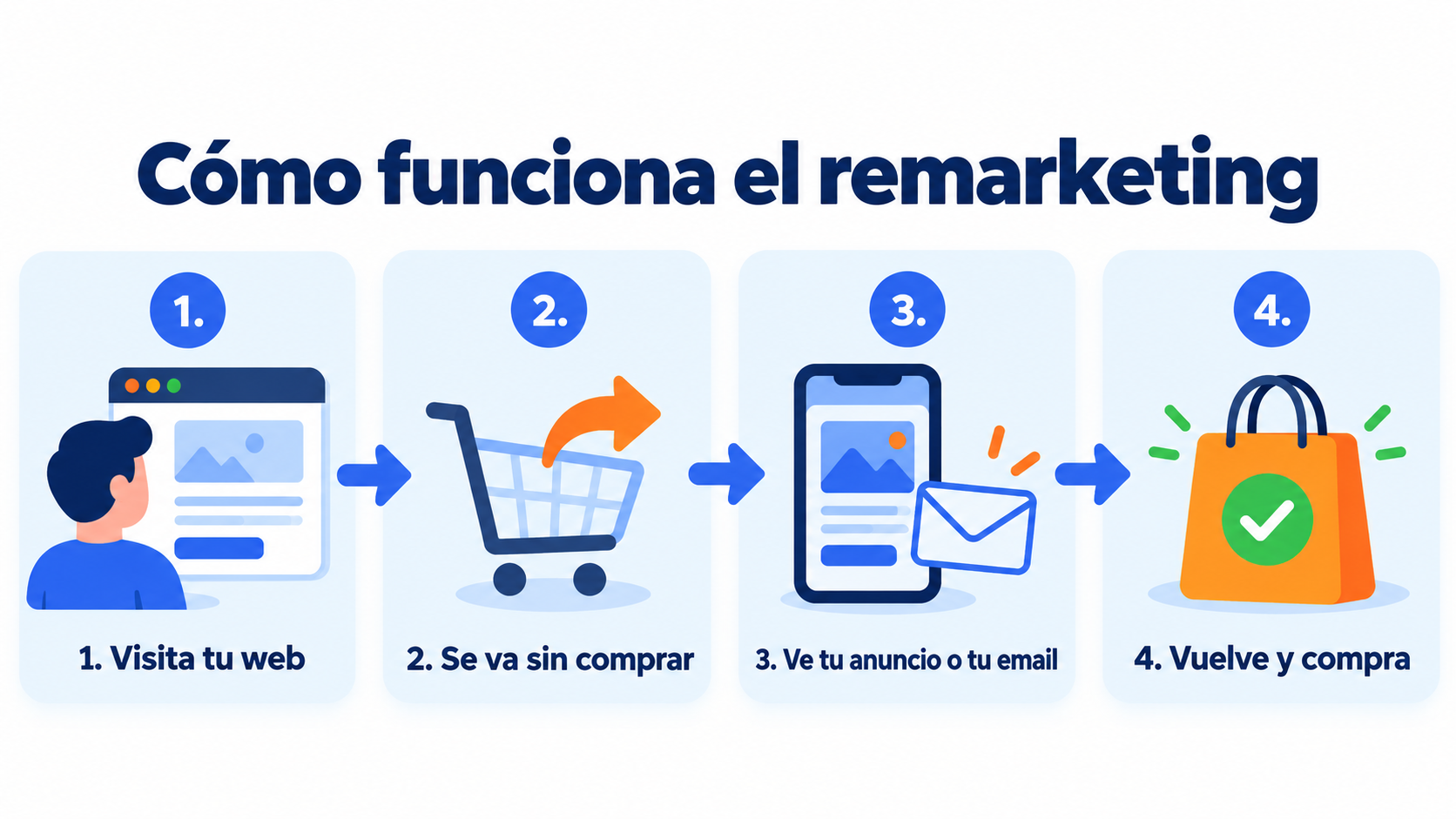
Although I’ve already told you above about the benefits of remarketing, there’s something I haven’t mentioned yet: the different online advertising tools we have give us more and more options for running segmented actions like these.
That’s why, so you understand how all this works, in this section we’ll look at the most widely used online tools for remarketing, along with some real examples of success stories.
Remarketing lets us take another “shot” at people who have already visited us, through ads. And this is possible thanks to very popular tools such as Google AdWords and social media, but also through an email marketing strategy (having asked for explicit consent).
While Google AdWords isn’t the only tool developed for this purpose, it was one of the pioneers, as it was designed for:
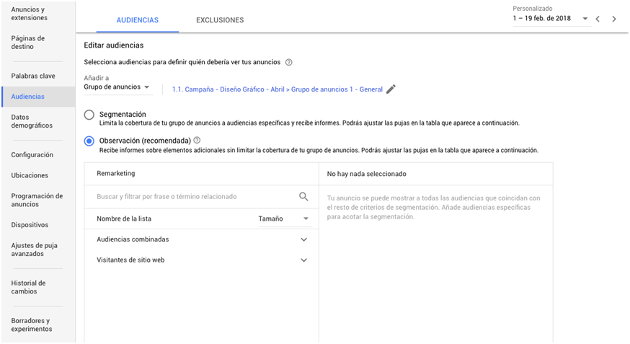
Currently, in Google AdWords you’ll find the “Remarketing” option after selecting the type of audience for your ad group in the “Audiences” > “Edit audiences” section.
We’ve also gradually seen social networks themselves add these kinds of options to their platforms for creating social ads. For example, we can launch remarketing campaigns using:
With any of these options, you can create your ads based on different goals and the type of user you’re targeting. For example:
In addition, specifically for ecommerce, where remarketing is a highly effective technique, you can build lists based on:
A good practical example of ecommerce remarketing would be a campaign built around cart tracking that combines Google AdWords and Google Analytics. This lets us:
If an online store isn’t running remarketing campaigns, every user who browses it (whether or not they become a customer) will never hear from it again once their visit is over.
However, thanks to online remarketing and cookies stored in browsers, these users can keep seeing ads related to offers that interest them, which considerably increases the chances of them buying again.
So, for all this to be possible, the online store must have installed the corresponding HTML code or tag to register those cookies.
Finally, so I don’t go on too long, I’ll just mention that Facebook Ads and Twitter Ads also get their slice of the pie in all this.
For example, in Power Editor on the Facebook Ads platform, in the “Audiences” section, you can already find the different options for creating a custom audience.
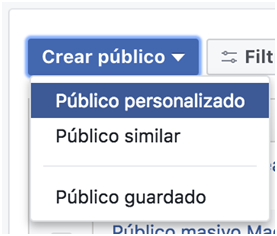
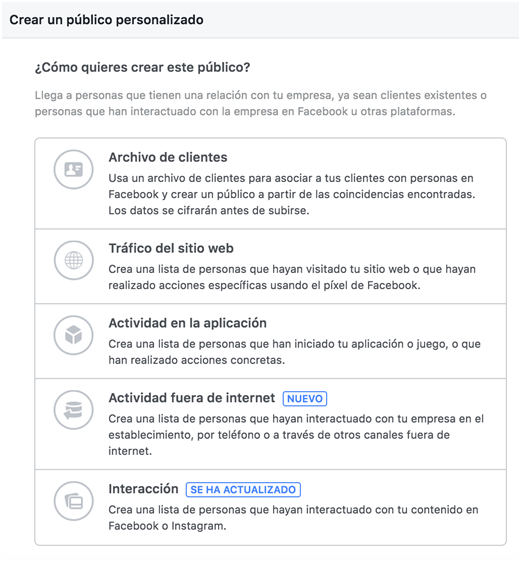
Briefly, here are some particular features of remarketing with:
Facebook custom audiences and dynamic ads. For these you’ll need to add a pixel to your destination site or install the Facebook SDK in your app. You may also need to get to know Meta Business Suite and its product catalog in depth.
X (formerly Twitter) tailored audiences. For these you’ll need to set up tracking for a list of Twitter users who visit your website by adding a conversion tag to your site. These lists let you send personalized messages in your Twitter Ads remarketing campaigns.

Related posts:
Automate your abandoned cart emails
Set up the sequence once and win back sales every day with Mailrelay.
After so much theory, and as promised, it’s time to tell you about some real examples of companies that have built remarketing campaigns into their strategies.
And, incidentally, they’ve done so very successfully, according to the social networks themselves. Let’s take a look!
Meliá and Cathay Pacific Airways are among the companies Facebook Ads highlights in its success stories with dynamic ads for the travel industry.
Building a campaign around this type of ad considerably increases the chances of people making a specific kind of booking.
Meliá’s case is a clear example of this: using Facebook Ads dynamic ads, it achieved an ROI on its online advertising campaigns 6.7 times higher than with other traditional remarketing actions.
And how did they do it? By showing ads for specific hotels to customers in their different target regions, with the best message for each one based on their interests.
This was something they had never done before: traditionally they only showed ads based on the destination, but thanks to dynamic ads they now also show different hotels based on customers’ more specific needs.
The campaigns of iclothing, an Irish women’s fashion company, are a very good example of remarketing on Twitter. So much so that the social network itself has included it in its list of success stories, sharing real statistics and data for each of its actions.
The key to iclothing’s success lies not only in having a strong business model, but also in betting on fruitful collaborations and going all the way for its marketing goals.
Thanks to the blue bird network’s tailored audiences, they managed to create very effective campaigns aimed solely at Irish women interested in fashion.
And how did they manage it? They created Twitter Ads with custom tags and different photos to reach users who had previously abandoned a cart or simply visited the website.
As a result, this female audience’s willingness to make a purchase ended up paying off in a good number of cases.
Remarketing isn’t just advertising. Email is the most direct way to get back in touch with someone. It doesn’t depend on bids or cookies. You’re writing to a person who has already given you their address and their permission.
These are the most common remarketing emails:
| When to send it | What it includes | |
|---|---|---|
| Abandoned cart | A few hours after the cart is abandoned | The products they left behind and a button to complete the purchase |
| Navigation | After viewing a product or category several times | That product and similar ones |
| Post-purchase | A few days after the order arrives | Tips for use and complementary products |
| Re-engagement | When they haven’t opened or bought anything for months | What’s new, or an incentive to come back |
| Renewal | Before a subscription or service ends | A reminder and what they’ll lose if they don’t renew |
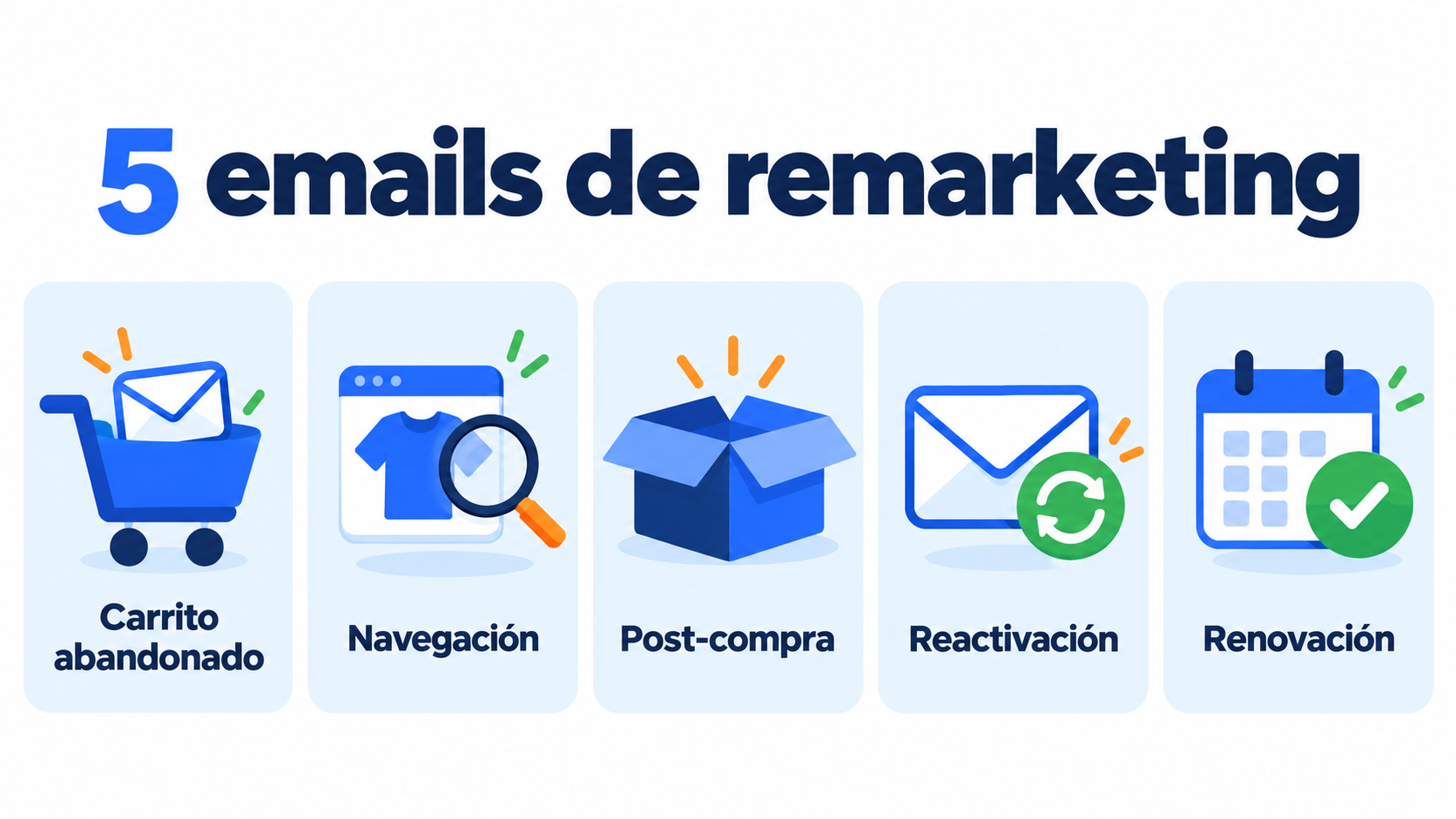
For them to work, you need two things. First, your contacts must have given their permission, for example through double opt-in. Second, good segmentation so that each person gets the right message.
Ad remarketing relies on cookies and pixels. They require the user’s consent, and more and more people are rejecting them. Browsers also restrict their use. That’s why ad audiences are smaller than they were a few years ago.
First-party data is becoming more important: your subscriber list, your customers and what they do in your emails. They’re your own contacts. You can write to them without relying on third parties.
With Mailrelay you can automate your remarketing emails. Welcome, re-engagement and renewal emails go out on their own when the condition is met. You can also segment by what each contact opens and clicks. And measure the results of each send.
The free account includes up to 80,000 emails a month and 20,000 contacts, with human support by chat, ticket and phone.
Send your newsletters with Mailrelay
Up to 80,000 emails a month and 20,000 contacts for free, with human support on every plan.
These are the most common questions about remarketing.
It means reaching people again who have already visited your website, looked at your products or given you their email address, so that they complete the purchase or come back.
Almost none. Retargeting is used mainly for ads; remarketing also includes email and other channels.
On Google Ads, Meta (Facebook and Instagram), LinkedIn, TikTok, YouTube and also by email or SMS to your contacts.
Yes, as long as you comply with the GDPR: ads need cookie consent and emails need each contact’s permission.
It depends on the buying cycle. For inexpensive products a few days is enough; for purchases that take more thought, such as a trip or software, it can last weeks.
And that’s the end of my article on remarketing and the types of campaigns we can launch online to get more and better sales results. What do you think about this topic? Let us know!
For this technique to work well, it’s worth fine-tuning your customer targeting first, so that you only show the ad to people who are genuinely likely to be interested.