Is there a secret to writing email marketing copy that gets read, hooks readers and sells more?
Bad news: there isn’t one. At least, there’s no magic formula that will turn you into a professional writer or copywriter overnight.
Writing a great email, just like writing a great blog post, a great ebook or a great sales landing page, is as much art as it is science, and it takes time, sweat and know-how.
But hey, we’re starting from a realistic place, and here’s the good news: there are small tricks that will help you write clearer, more persuasive and engaging email marketing copy.
Emails that grab attention.
Emails where the words catch the eye and stick in your readers’ minds because of the emotions they inspire or the details they evoke.
And copy that grabs attention, gets read, is understood, is liked and persuades… is copy that sells.
Voilà! There you have it. It’s not a secret formula, but the sum of many small details. It’s like having an arsenal of options, or a closet full of writing resources ready to use in your sales emails.
And each one is a small improvement to your copy.
What’s more, by applying them consistently you’ll build the habit of paying attention to your email marketing copy, which will become more polished and more effective every time; and that’s the closest thing there is to a magic formula for writing better email campaigns.
These 11 quick tips (some quicker than others) will help you edit your sales emails or write them from scratch, knowing exactly what to look out for.
7 tips for writing more persuasive copy
A striking headline
Both the subject line and the headline are the first things the reader sees, so they need to be striking and grab their attention right from the start.
It’s important to keep it short, clear and relevant.
Example: “Learn how to double your sales in a month”.
Explanatory paragraph
The first paragraph should explain what the text is about and why it matters to the reader.
It should spark their curiosity and make them want to keep reading.
Example: “Would you like to grow your sales exponentially in a short time? If so, keep reading, because today we’ll show you how to do it”.
Motivation
The copy should motivate the reader to take action.
You can use different persuasion techniques, such as scarcity, urgency or the fear of missing out.
Example: “Don’t wait any longer: seize this unique opportunity to take your business to the next level”.
Use evidence
Include data, statistics or testimonials that back up your arguments and show how effective your offer is.
Example: “More than 80% of our customers have seen a significant increase in their sales after applying these tips”.
Simple, direct language
Use simple, direct language that the reader can easily understand.
Avoid jargon or complicated words that could confuse the reader.
Example: “Follow these simple steps to double your sales in a month”.
Clear benefits
Highlight the benefits the reader will get by taking the action you propose.
Example: “With these tips, you’ll be able to increase your sales and win more satisfied customers”.
Call to action
Finally, the copy should include a clear, direct call to action.
Tell the reader what they need to do to get the benefits you’ve promised.
Example: “Start applying these tips today and you’ll see results in no time”.
11 ways to write more persuasive copy for your email marketing and your emails
Got your copy ready? Send it to your whole list
Design your email with templates, personalize the greeting with each contact’s name and send it to your whole list from your free Mailrelay account.
1. Include a “hook” to current events
Imagine you sell a product or service related to emotional well-being and you want to send an email about the benefits of mindfulness, or full awareness.
You could start writing your email like this: “Mindfulness is a powerful tool for easing life’s ups and downs.”
Not bad. It presents the benefit quickly, but it’s too direct, isn’t it? The reader’s brain switches just as quickly into “watch out, sales email” mode.
A simple writing trick that will help you avoid this effect is to use a “hook” to current events, and all you have to do is open your copy by connecting with something that’s happening right now.
And it has to be something important that’s happening and that your audience is aware of.
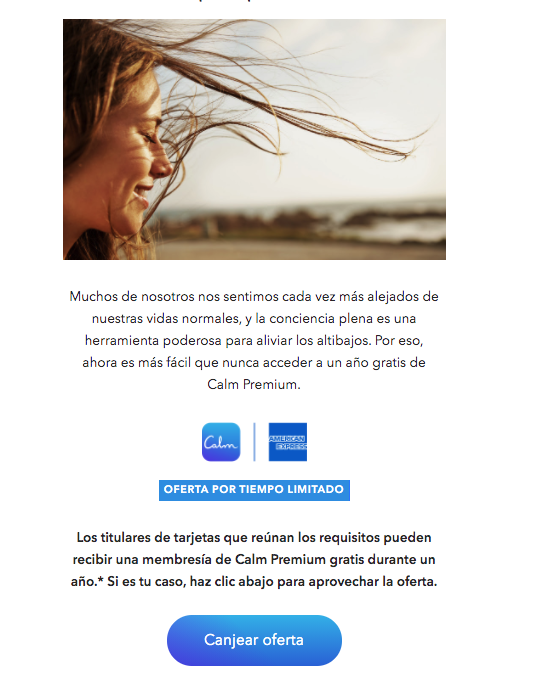
Going back to the mindfulness example, look at the difference between opening the email by presenting the benefit directly and opening it by connecting with the current moment, which in this case is the post-Covid period (the famous return to normal).
A) Mindfulness is a powerful tool for easing life’s ups and downs.
B) Many of us are feeling more and more removed from our normal lives, and mindfulness is a powerful tool for easing life’s ups and downs.
Calm email copy
Option B, the one the Calm app actually chose in the example you’ve just seen, is less direct, but it creates a connection with current events; more than that, it creates an emotional connection.
The current-events hook in this email is a single sentence: “Many of us are feeling more and more removed from our normal lives.”
But it shows that you’re aware of what your audience is going through and that the one talking to them is a flesh-and-blood person, a real brand.
Anchoring your email marketing copy to current events is a way to give context to what you’re about to say and to empathize with the person reading. This will help your copy sound warm and approachable and avoid a salesy tone.
2. Break up your content visually
You can improve email marketing copy through what you say, how you say it, or the formatting you use to make it easier to read.
And this one really is a quick tip. A bit of bold or italics here, some quotation marks or dialogue there… and you’re already breaking the monotony and adding variety.
That means your copy will be more eye-catching, easier to read and easier to remember.
Take a look at this copy from a Notion email: it’s pretty long, but thanks to the bold text, quotation marks, dashes, arrows and links highlighted in blue, they manage to visually separate every element, and the result feels light and pleasant to read.
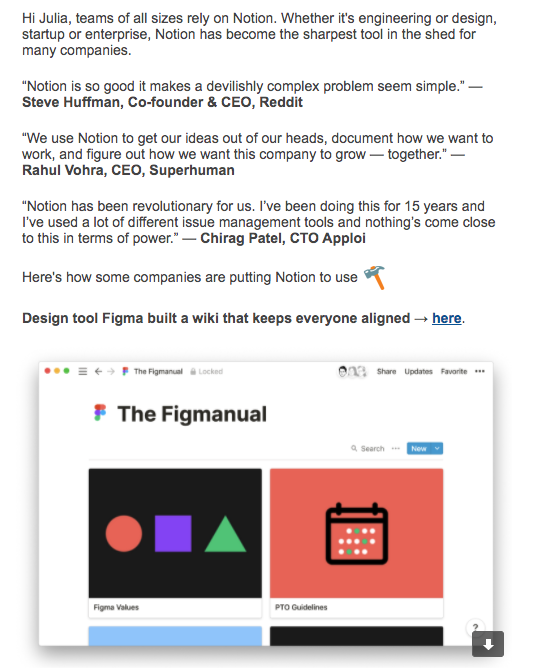
Notion email copy
3. Add some punch
This tip is related to the previous one, because sometimes the secret to making your email copy stand out isn’t the words you use, but the special effects you give them.
And the options are endless (as far as your imagination will take you), but to give you an idea, here are a few examples of how to emphasize a word or idea by adding some punch.
● Use capital letters for just one word, or italics for a short phrase.
● Split a word into syllables with hyphens, as if you were stressing each syllable as you speak.
● Include onomatopoeia (woohoo, wow, brrr, pfff, oh, ah, bah, booo). It depends a lot on each particular case, but they work well to give your copy a fresher, more personal feel.
● Use ellipses to create (you guessed it) suspense.
● Include a very short sentence (and we mean really short, just a couple of words), finished off with a period. This helps emphasize the idea you talked about in the previous paragraph.
● Add thoughts, personal opinions or a narrator’s voice between dashes or in parentheses.
● Put visual or sound effects into words.
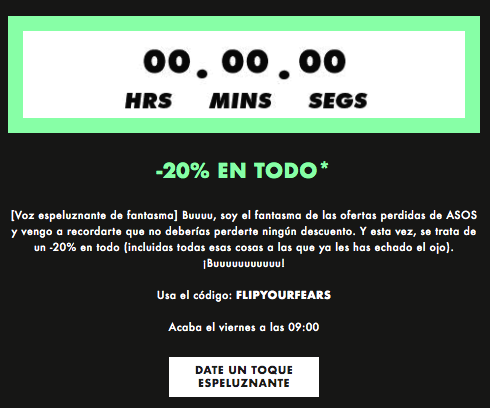 Asos email copy
In the following example of a sales email from Asos’s Halloween campaign, besides the current-events hook, you can see two of these punchy effects in action:
– Onomatopoeia: “Booo”
– Sound effects put into words: (“Spooky ghost voice”)
4. Try emojis
Emojis are part of our everyday lives. In fact, we love emojis; and we like them as much on WhatsApp as in our email inbox.
Obviously, this depends a bit on your audience, but even communication in B2B industries is becoming more and more casual, friendly and fun.
And emojis are exactly that: casual, friendly and fun.
When you add them to your email copy, they give it that fresh feel that’s sometimes so hard to find with words alone; as if by magic. They also help break the monotony of the text and make the whole email more visually appealing.
And the best part is that you can use them almost anywhere in the email you can imagine, from the subject line to the sign-off, including a list with an emoji on each item.
You can even use them in your microcopy, for example in the text of your call-to-action buttons or CTAs (Calls to Action), like in this email from Factorial.
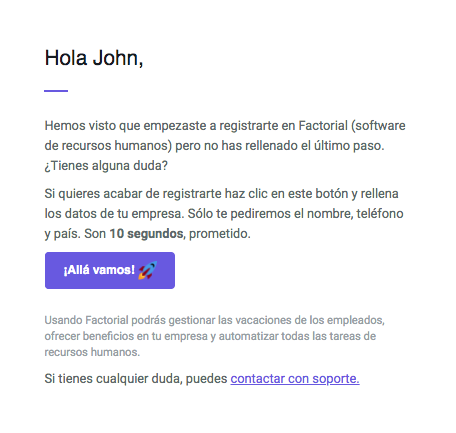 Factorial email copy
5. Leave more white space
And by white space I mean making your paragraphs shorter with the quickest trick in the history of writing: using more periods.
Because short sentences and paragraphs are easier to read and remember. And they also make the information easier to skim.
So, as a general rule, the shorter and clearer a paragraph, the better.
But there’s a digital writing technique that has been gaining popularity, especially on social media and in email marketing, which takes this advice to the extreme by putting each sentence in a new paragraph.
Many copywriters combine this way of writing email copy with another technique: varying the length of each sentence (one shorter, one longer, and so on), which gives the outline of the text a distinctive wave shape.
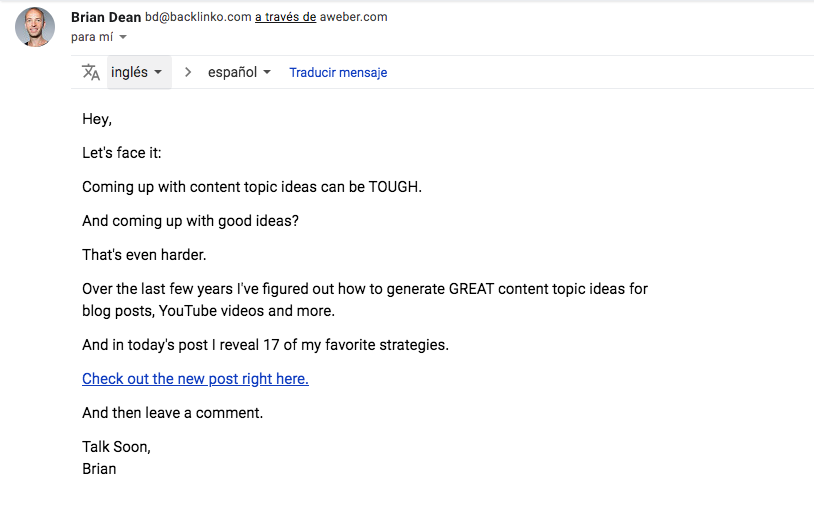 Backlinko email copy
As you can see in this example, this writing style creates a sense of energy and visual variety, although it isn’t for everyone.
You can give it a try or not. But either way, what you can do to quickly improve your copy is make the paragraphs in your emails shorter.
Whenever you see 3 or 4 lines together, ask yourself where you could cut, and hit Enter. Your copy will thank you for that extra white space (room to breathe!).
6. Highlight the benefits in a list
And going back to the previous point, if it has emojis, even better 🙈.
Lists are easy to skim, which makes them more digestible and lighter to read.
What’s more, in the middle of an email they grab attention right away, so your readers’ eyes will probably go straight to them. That’s why it’s the perfect format for highlighting benefits.
The trick is to use very few words to highlight, in this format, the benefits of whatever you’re trying to sell, whether it’s a product, a service, an event, an idea or a blog post.
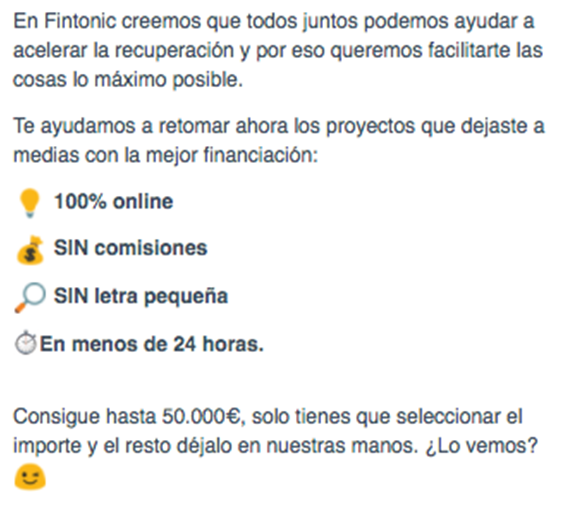 Fintonic email copy
7. Leave them wanting more
This tip works especially well with newsletter copy, where the main action you want is to promote a blog post.
For example, if you’ve just published a listicle with 4 points or sections, include only 2 in the email copy and make your recipients click if they want to read the full list on your blog.
The beauty of it is giving just enough copy to create intrigue and anticipation, because our human brains go crazy when we see an incomplete list.
What’s more, giving just a preview instead of telling the whole story in the copy has another advantage: it makes your emails shorter.
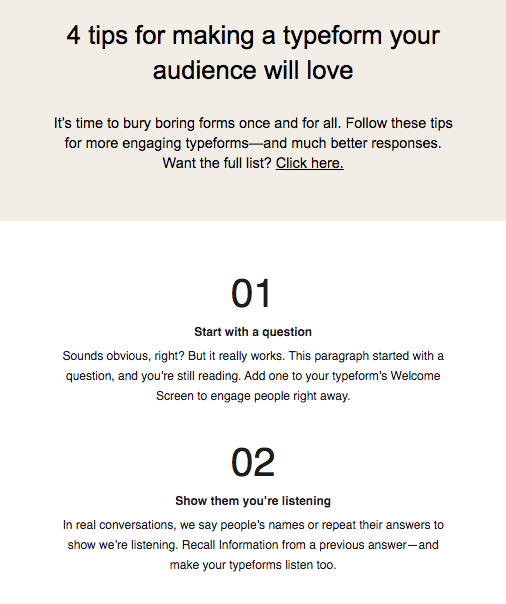 Typeform email copy
Because you say so? No way! Because the more than XXX customers who have already trusted you say so.
In email marketing, the trust you manage to build with your copy is crucial. And large-scale shows of popular support can help.
Because if 6,000 people liked a product, it must be good, right? Well, maybe it is and maybe it isn’t, but popular wisdom says it is.
And it’s all down to a cognitive bias known as the bandwagon effect, which happens when we do something simply because other people have already done it.
As if we were carried along by our trust in what others do, say and think.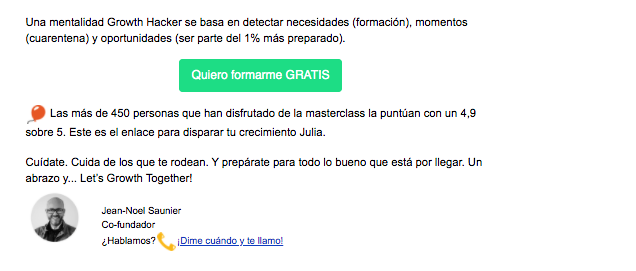
Growth Hacking Course email copy
9. Use everyday expressions
Of course! Your audience wants to feel that a real person is talking to them, and if it’s in their own language (the one they use every day), so much the better.
And shared expressions are a super easy way to connect, because they suggest that you share certain traits, such as age, personality, particular hobbies or even habits.
For example, take a look at this email from Fitbit. Its audience is mostly young, sporty people, which is why they use two expressions that connect with them: going out to burn off the cake, and going out to give it your all on the dance floor.
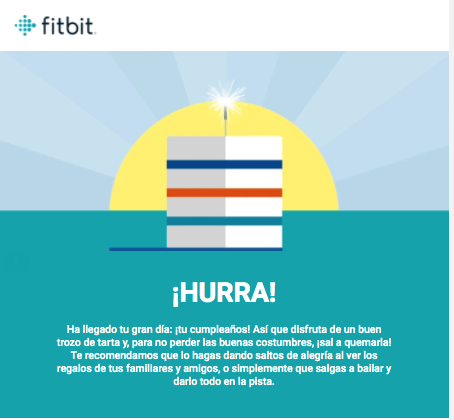 Fitbit email copy
10. Paint a picture
Sometimes you know perfectly well the main idea you want to get across to your audience, and it may be a wonderfully simple idea; there’s nothing wrong with that, quite the opposite.
But then you sit down to write your email, and suddenly simplicity becomes a problem: the copy sounds too simple, too direct… it’s like it’s missing that je ne sais quoi.
A quick trick to fix this problem is to paint a picture around the idea, such as a description or a short story.
And this works because, when readers can clearly see something in their mind, emotions quickly come into play, and that gives your message more power. The copy connects more.
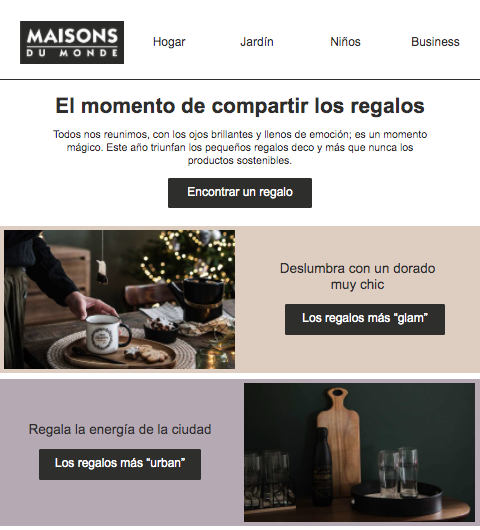
For example, home decor and furniture brands such as Maisons du Monde use this technique all the time in their emails. To see the difference, compare these two texts:
A. Christmas is a magical time
B. We all come together, eyes shining and full of excitement; it’s a magical time.
Option B doesn’t even mention the word Christmas. And yet it connects us much more with the images and emotions associated with the magic of Christmas.
 Maisons du Monde email copy
11. Sign off in a personal way
A collection of tips for improving your email copy couldn’t end any other way.
Let’s talk about how to close your email copy. Because we’re sure you’ve wondered more than once what the best way to sign off a sales email is.
“Hope all is well?” “Hugs?” “Regards?” “All the best?”
Obviously, there’s no single right answer, but there is a trick: make it personal.
That means an original sign-off that you can easily link to your brand; and to do that, in part, you’ll need to repeat it consistently in all your emails, even if not word for word.
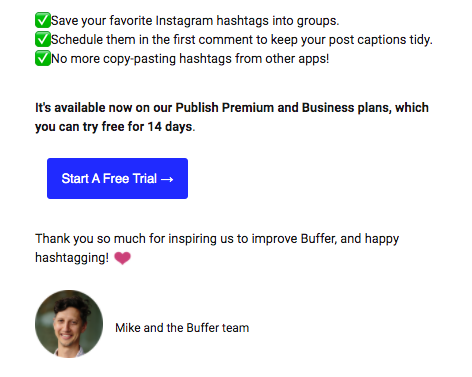
For example, all of Buffer’s emails, whether sales or marketing, always end more or less the same way: first by saying thank you in some way and then, in the signature, signing off on behalf of the person who sent the email and the whole team.
 Buffer email copy
How to improve an email before sending it
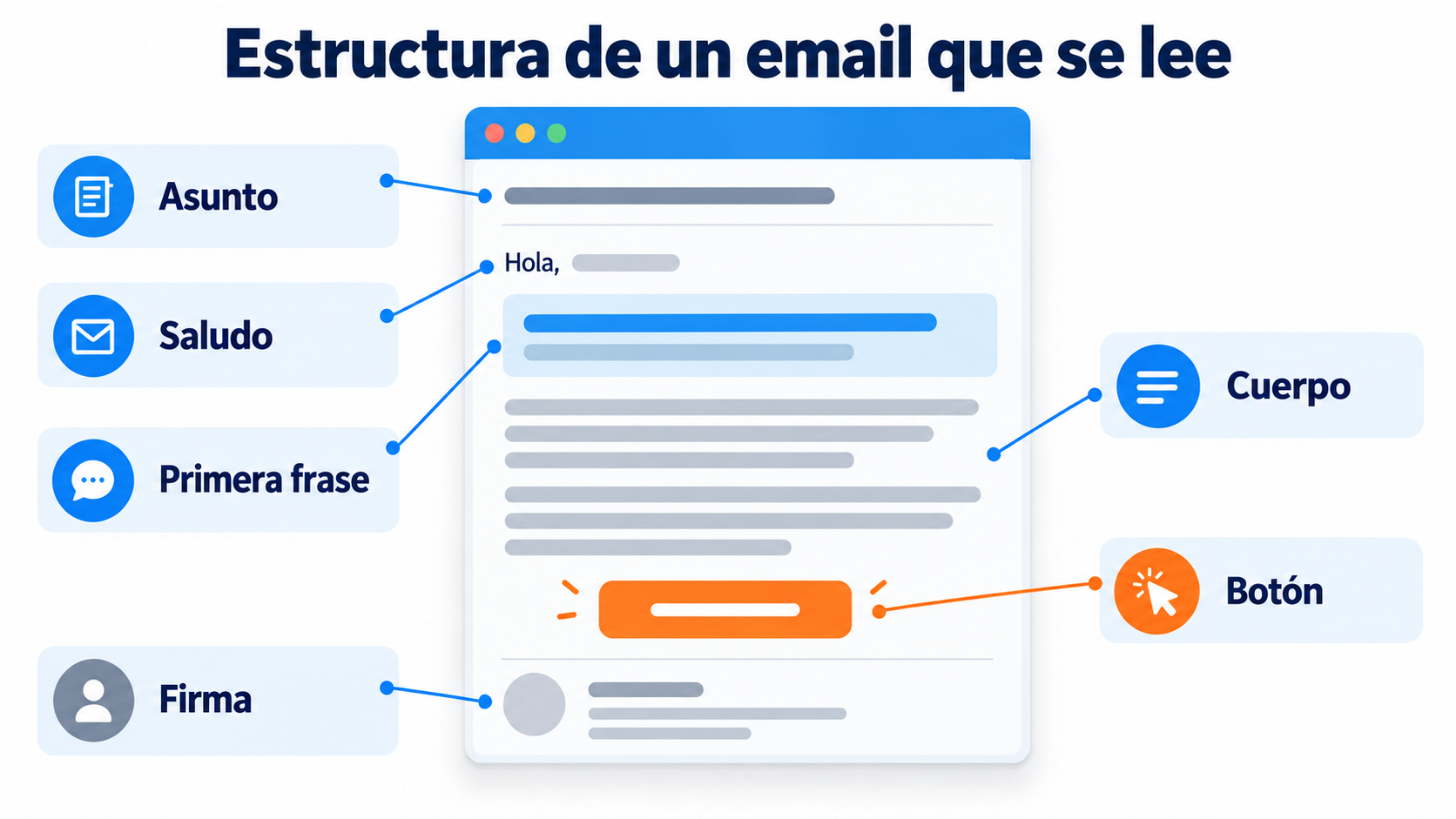
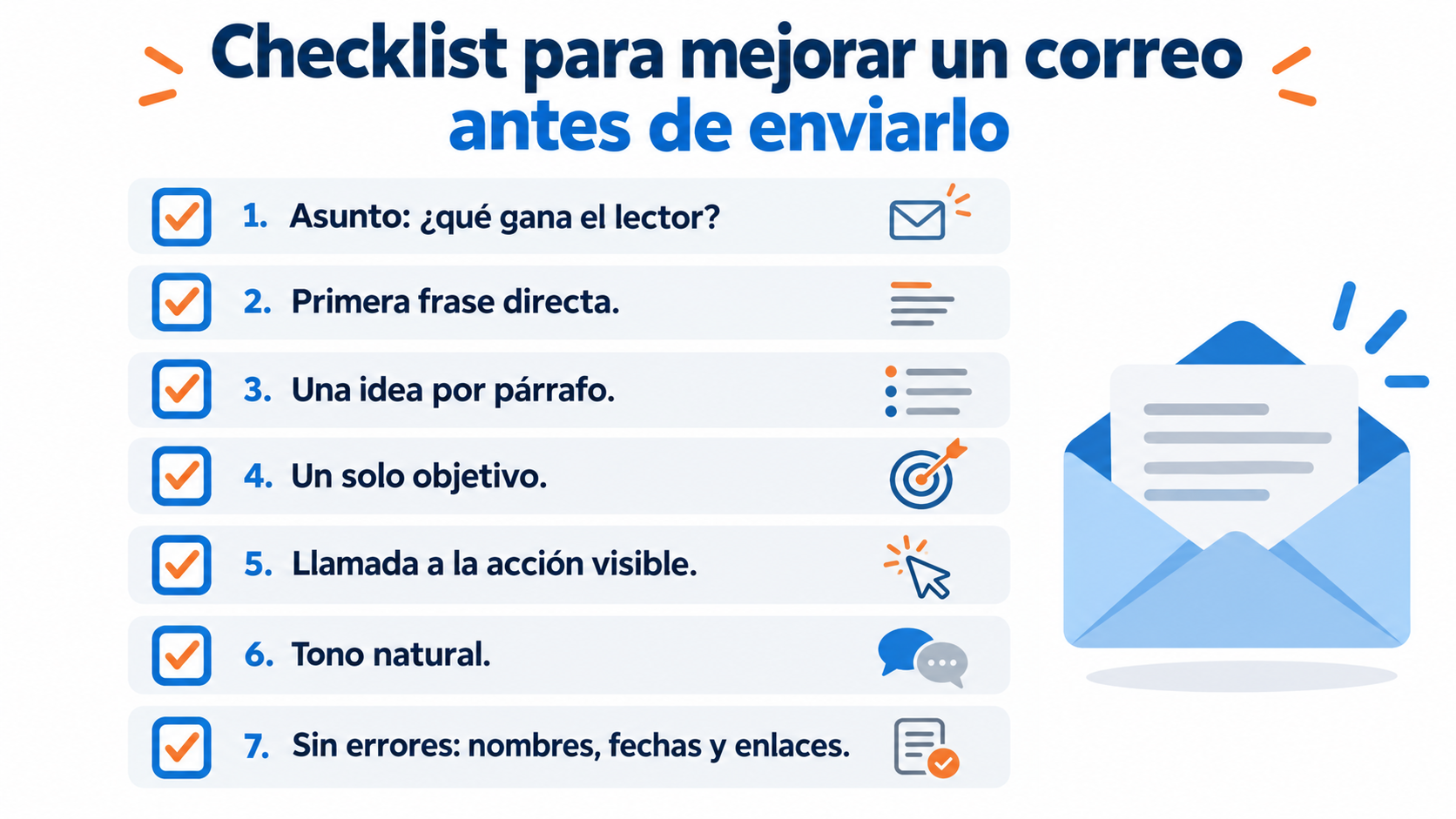
Have you written an email and you’re not happy with it? Before you hit “Send”, go over it with this checklist. It’ll take you two minutes.
- Subject line: does it say what the reader gains by opening it?
- First sentence: does it get straight to the point or start with a long greeting?
- One idea per paragraph: if a paragraph is longer than three lines, split it.
- A single goal: what do you want the reader to do? If it’s three things, pick one.
- Call to action: can you see it at a glance, and does it say what happens when you click it?
- Tone: read it out loud. If you wouldn’t say it that way in person, change it.
- Mistakes: check names, dates, links and spelling.
Example: before and after
Before: Dear customer: We are writing to inform you that, as every year, we have prepared a series of special promotions for our most loyal customers, including discounts on a wide selection of products from our catalog over the coming weeks.
After: Hi Laura, this week you get 20% off everything in the store, just for being a customer. The offer ends on Sunday. [View products]
The second text is shorter and uses the reader’s name. It says what they gain and until when, and it ends with a single button.
If you send the same email to lots of contacts, run an A/B test with two versions of the copy. That way you’ll know which one works best with your audience.
Test two versions and keep the one that works
With Mailrelay’s A/B tests, you send two versions of your copy to part of your list, and the best-performing version goes to the rest.
The importance of personalization in emails
Personalizing your emails is essential for building a stronger connection with your recipients and increasing the chances that they’ll be interested in your message and take action.
By tailoring the email content to each recipient’s needs and interests, you show that you care about their needs and offer them real value.
Personalize the greeting and the subject line
Starting with a personalized greeting that includes the recipient’s name is a great way to grab their attention from the start.
This creates a sense of closeness and makes the recipient feel more valued.
Likewise, personalizing the email subject line with the recipient’s name or with information relevant to them can significantly increase open rates.
Use relevant information about the recipient
Gather and use relevant information about your recipients to personalize your email content even further.
This can include details such as their geographic location, purchase history, interests and online behavior.
By using this information to tailor your email content, you can make sure you’re sending messages that are truly meaningful and useful to each recipient.
Tailor the content to the recipient’s preferences
Another way to personalize your emails is to tailor the content to the recipient’s preferences and behavior.
For example, if you know that a group of subscribers is interested in certain topics or products, you can create list segments and send them specific content related to those interests.
Likewise, if some subscribers have engaged with certain types of content in the past (for example, videos or blog articles), you can tailor your emails to include more of that type of content in the future.
By personalizing your emails in these ways, you’ll be able to offer your recipients a more engaging and valuable experience, which will increase the chances that they’ll be interested in your offers and become loyal customers.
Create urgency and scarcity to drive action
Adding elements of urgency and scarcity to your emails can be an effective strategy to motivate your recipients to act quickly and not miss out on valuable opportunities.
By presenting limited-time offers, limited availability of products or services and exclusive perks for early birds, you can increase your conversion rate and sales.
Limited-time offers
Limited-time offers are promotions or discounts that are only available for a specific period.
By including a countdown timer in the email or clearly stating the deadline to take advantage of the offer, you create a sense of urgency that can push recipients to make a decision and buy before time runs out.
Limited availability of products or services
Communicating the limited availability of products or services can also create scarcity and encourage recipients to act quickly.
You can let your subscribers know about the limited number of units available, seats at an event or slots for a specific service.
This gives the impression that the offer is exclusive and that, if they don’t act soon, they could miss out.
Exclusive perks for early birds
Offering exclusive perks to the first people to act is another way to create urgency and scarcity in your emails.
These perks can include early access to sales, extra discounts, gifts or exclusive content.
By making recipients feel part of a select, privileged group, they’ll be more motivated to take action quickly and grab the perks before others do.
By combining these elements of urgency and scarcity in your emails, you can encourage your recipients to act quickly and make your email marketing campaigns more effective.
Tips for optimizing the structure and format of your emails
The right structure and format are essential to keep your recipients interested and motivated to keep reading and take action.
Here are some tips for improving the structure and format of your emails and making them more effective:
Use subheadings and bullet points to make reading easier
Subheadings and bullet points help split your email content into sections that are easier to read and understand.
Subheadings let readers quickly identify the key topics, while bullet points sum up the important information clearly and concisely.
By making your emails easier to read, you increase the chances that recipients will read the whole email and feel more inclined to act.
Make sure your emails are responsive and look good on mobile devices
With more and more people checking their email on mobile devices, it’s essential that your emails are responsive and adapt properly to different screen sizes.
Make sure images resize automatically, text is legible and links and buttons are easy to tap on touchscreens.
By optimizing your emails for mobile devices, you improve the user experience and increase the chances that recipients will take action.
Call-to-action (CTA) links and buttons are essential for guiding recipients toward specific actions, such as making a purchase, registering for an event or downloading a resource.
Make sure these elements are prominent and easy to spot in your emails.
Use eye-catching colors, clear text and a design that makes your CTAs stand out.
It’s also a good idea to include CTAs in different parts of the email to increase the chances that recipients will click on them.
By following these tips for optimizing the structure and format of your emails, you can improve the user experience and make your email marketing campaigns more effective.
Write differently
Change your perspective
When writing your emails, try changing your perspective.
For example, instead of focusing on what you want to say, think about what the recipient needs to hear.
Ask yourself how you can solve their problems or meet their needs through the content of your email.
Adjust your tone and style
Consider adjusting the tone and style of your writing to your target audience and the purpose of your email.
For example, if you’re addressing professionals in a business setting, you might opt for a more formal and authoritative tone.
On the other hand, if you’re addressing a young audience, a more casual, laid-back style might be appropriate.
Experiment with different formats
Don’t be afraid to try different formats in your emails.
You can experiment with images, infographics, videos or even animated GIFs to get your ideas across in a more engaging and effective way.
You can also play with the structure of your emails, using numbered lists, bullet points or blocks of text separated by eye-catching subheadings.
Avoid common mistakes when writing emails
When writing emails, it’s crucial to watch out for certain common mistakes that can make your email marketing campaigns less effective. Here are some of these mistakes and how to avoid them:
Don’t be too promotional or “spammy”
Although the goal of your emails may be to promote products or services, it’s essential not to be too aggressive in your sales tactics.
Recipients may feel overwhelmed or annoyed if they sense that you’re only trying to sell them something instead of giving them value or useful information.
Make sure you balance your promotions with relevant, interesting content that benefits your readers and keeps them interested.
Avoid grammar and spelling mistakes
Grammar and spelling mistakes can give your recipients a bad impression and reduce your brand’s credibility.
Before sending your emails, carefully check for and correct any mistakes of this kind.
You can use online tools such as Grammarly or turn to a proofreader to make sure your emails are well written and error-free.
Don’t overwhelm the recipient with too much information
When writing emails, it’s important to be concise and focus on the key points. Don’t overwhelm your recipients with too much information, as this can make them lose interest quickly.
Instead, present the information clearly and directly, using simple, easy-to-understand language.
If you need to include more details, consider adding links to web pages or additional resources where recipients can find more information.
By avoiding these common email writing mistakes, you can improve the quality of your email marketing campaigns and increase the chances that your recipients stay engaged and take the actions you want.
And finally:

What should you write to sell?
There are different types of copy you can use in your sales emails to make them as effective as possible.
Here are some of the most popular and effective formats:
Promotional emails
These emails highlight special offers, discounts and promotions. Make sure the promotion is appealing and clearly highlighted in the email.
Product launch emails
These emails introduce a new product or service. Describe the product’s features and benefits, and explain how it can solve problems or improve recipients’ lives.
Educational or informational emails
These emails provide useful, relevant information related to your product or service. They can include tips, tricks, case studies and educational content to position your company as an industry expert.
Storytelling emails
These emails use exciting or inspiring stories to connect with recipients. They can include testimonials from satisfied customers, success stories or the origin of your product or service.
Follow-up or reminder emails
These emails are sent after an initial interaction and aim to keep recipients engaged and remind them of the offer. They can include additional offers, relevant information or a simple reminder of the promotion.
Thank-you or appreciation emails
These emails express gratitude to recipients for their loyalty, purchases or engagement. They can include exclusive offers for loyal customers, personalized thank-you messages or even small gifts.
Choose the type of copy that best suits your target audience and the message you want to get across. Don’t hesitate to try different formats and styles to see which one works best with your recipients. The key to success is tailoring your sales emails to your audience’s needs and preferences.
And if you’re interested in writing email copy…
Don’t miss these articles with templates, tips, tricks and example ideas to improve your email campaigns.
▶︎ 5 email templates inspired by examples from top startups
If you want to dig deeper into the fundamentals, here’s what copywriting is.
Write better, send more easily
Create your free account and send up to 80,000 emails a month to 20,000 contacts, with a template editor and statistics.

Jose Argudo
CMO at Mailrelay. Writes about email marketing, copywriting, and conversion for small businesses and entrepreneurs.