Slogan: what it is, characteristics, types and examples
What makes a phrase stick in people's minds, types of slogans and steps to create your own
A slogan is a short, easy-to-remember phrase that sums up what a brand, product or campaign offers. For example, “Red Bull gives you wings” or KFC’s “Finger lickin’ good”.
Its goal is for people to remember the brand and associate it with an idea, an emotion or a benefit.
What does “slogan” mean?
The Royal Spanish Academy (RAE) defines eslogan as a “short, original formula used for advertising, political propaganda, etc.”.
The word comes from the English slogan, which in turn comes from the Scottish Gaelic sluagh-ghairm: a clan’s battle cry. Today, that cry belongs to a brand, a political party or a social campaign.
In Spanish, it is spelled eslogan, with an initial e, and the plural is eslóganes. Forms such as “slogan”, “sloganes” or “eslógan” are common mistakes in Spanish.
Slogan, tagline, motto and claim: are they the same thing?
They are used almost as synonyms, but there are subtle differences:
| Term | What it is | How long it lasts | Example |
|---|---|---|---|
| Slogan | Advertising phrase for a brand, product or campaign | Can change with each campaign | “Red Bull gives you wings” |
| Tagline | Fixed phrase that accompanies the logo | Years | “Just Do It”, by Nike |
| Motto | Phrase that sums up the values of a person or organization | Very stable | “Citius, altius, fortius”, from the Olympic Games |
| Claim | The term agencies in Spain use for a campaign slogan | As long as the campaign lasts | The closing line of an ad |
In practice, many brands use their best-known phrase as a tagline for years.
Characteristics of a good slogan
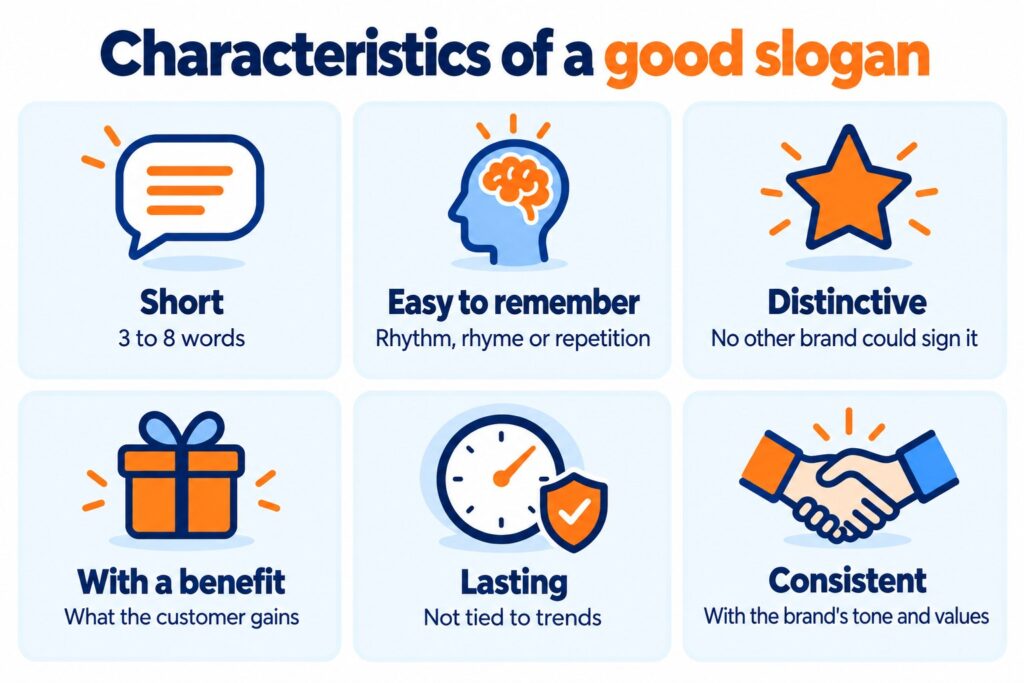
Short. Between three and eight words. The shorter it is, the easier it is to remember.
Easy to remember. Rhythm, rhyme or repetition help: “Have a break, have a KitKat”.
Distinctive. It should set the brand apart from its competitors.
With a clear benefit. It tells customers what they gain, even if it is an emotion.
Lasting. It doesn’t depend on a passing trend.
Consistent with the brand. It fits its tone, its values and its logo.
Put your slogan in every newsletter
Templates with your logo and brand line, and A/B testing to choose the best subject line. Free for up to 80,000 emails a month.
Types of slogans
| Type | What it does | Example |
|---|---|---|
| Descriptive | Explains what the product does | “Sheer Driving Pleasure”, by BMW |
| Emotional | Connects with a feeling | “Open Happiness”, by Coca-Cola |
| Imperative | Encourages action | “Just Do It”, by Nike |
| Benefit-driven | Promises a result | “Red Bull gives you wings” |
| Comparative | Measures itself against the competition | “We try harder”, by Avis |
| Values-based | Speaks to the customer’s identity | “Because I’m worth it”, by L’Oréal |
Famous slogan examples
Some of the most memorable ones:
- “A diamond is forever” (De Beers, 1947).
- “There are some things money can’t buy. For everything else, there’s MasterCard” (1997).
- “Think Different” (Apple, 1997).
- “I’m lovin’ it” (McDonald’s, 2003).
- “Finger lickin’ good” (KFC).
If you want to see why they work, on our blog we analyze the 10 best-known and most original slogans.
How to create a slogan step by step
- Define what makes you different. Start from your value proposition or USP.
- Think about your customer. Use their words, not your industry’s. Your buyer persona will help you.
- Write lots of options. Try different types: descriptive, emotional, imperative.
- Trim it. Remove adjectives and filler words until nothing is left over.
- Read it out loud. If it sounds forced or is hard to say, it won’t work.
- Check it. Make sure no other brand uses it and that it has no double meaning.
It is a piece of copywriting: every word counts.
Common mistakes when creating a slogan
Trying to say everything. Nobody remembers a phrase that lists three virtues. Choose a single idea.
Using empty words. Any company can say “quality”, “excellence” or “the best”. They don’t set you apart.
Copying the competition. If another brand in your industry could put its name to your phrase, it isn’t yours.
Promising what you don’t deliver. People notice, and the phrase turns against you.
Changing it every few months. Repetition is what makes a phrase stick in people’s minds. Give it time before replacing it.
Your slogan in email marketing
Your brand line also works in the inbox:
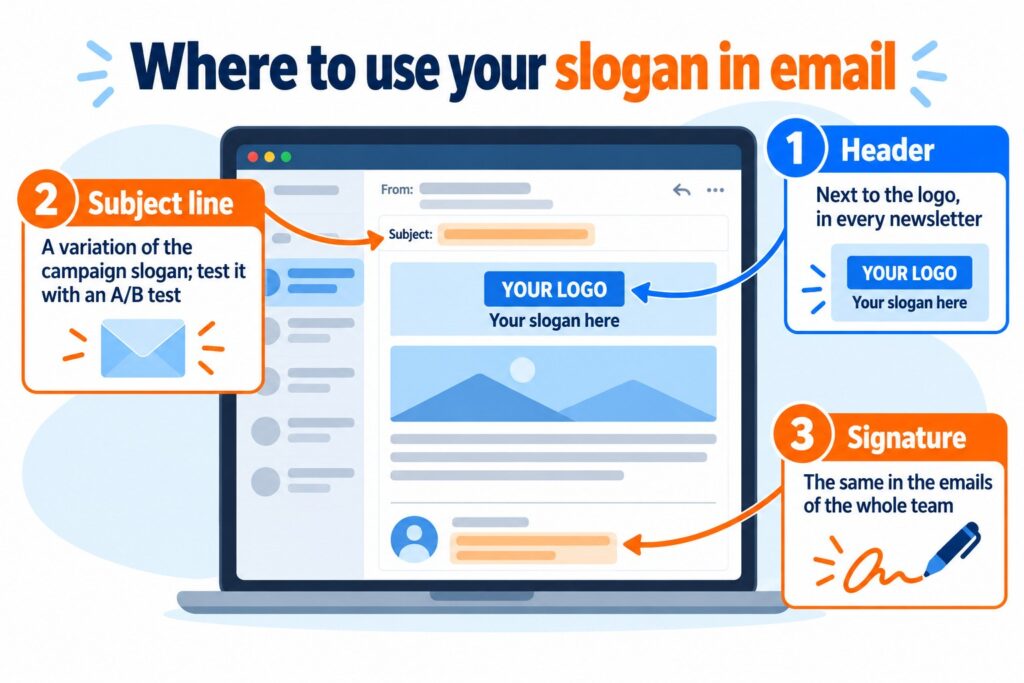
In the newsletter header, next to the logo, it reminds readers who is sending the email.
In the whole team’s email signature, it reinforces the brand in every message.
In the subject line, a variation of the campaign slogan can increase opens. Try it with an A/B test before sending it to your whole list.
How Mailrelay helps you
With Mailrelay, you create templates with your logo and brand line and use them in all your newsletters. With A/B testing, you compare two subject lines and send the winner to the rest of the list.
The free account includes up to 80,000 emails a month and 20,000 contacts, with human support in English on all plans.
Make your customers remember your brand with every email
Drag-and-drop editor and reusable templates, with human support in English on all plans.
Frequently asked questions about slogans
These are the most common questions.
What is a slogan?
A short, memorable phrase that sums up what a brand, product or campaign offers.
How is it spelled in Spanish: eslogan or slogan?
In Spanish, it is eslogan, with an initial e. The plural is eslóganes.
What is the difference between a slogan and a tagline?
A tagline is a fixed phrase that accompanies the logo for years. A slogan can change with each campaign.
How many words should a slogan have?
There is no rule, but the most memorable ones have between three and eight words.
Can a slogan be registered?
Yes, in Spain it can be registered as a trademark with the Spanish Patent and Trademark Office if it is distinctive.