Data mining
How to find valuable patterns in your data
Every campaign you send generates data: who opens, at what time, which links they click, what they buy afterwards. With a hundred subscribers you can review it by hand. With fifty thousand, you need another way to find what it hides. That’s what data mining is for.
What is data mining?
Data mining, known in Spanish as “minería de datos” or “minado de datos”, is the analysis of large volumes of information. Its goal is to discover patterns, relationships or trends that can’t be seen at a glance.
It is part of a broader process called KDD (Knowledge Discovery in Databases), or knowledge discovery in databases. The aim is to turn raw data into conclusions that are useful for making decisions.
To do so, it combines statistics, machine learning and analysis techniques that are applied automatically or semi-automatically.
Data mining, big data and data analysis
These concepts are often confused.
Big data refers to enormous and varied datasets that require special technologies to process them. Data mining is one way of extracting value from them. But it can also be applied to much smaller databases.
Traditional data analysis usually answers specific questions: how many clicks did the last campaign get? Data mining, on the other hand, looks for answers to questions you hadn’t asked yet.
Want to go deeper into the phases of the process and success stories? We explain it in detail in our guide on what data mining is.
Main techniques
There are many techniques, but almost all fit into one of these families:
- Classification: assigns each record to a known category. For example, predicting whether a subscriber is likely to unsubscribe.
- Clustering: groups similar records without predefined categories. This way you discover groups of customers with similar behavior.
- Association rules: detect which items frequently appear together. It’s the technique behind the classic “customers who bought this also bought that”.
- Regression: estimates a numerical value, such as a customer’s expected spend over the coming months.
- Anomaly detection: identifies data that falls outside the norm, such as a spike in bounces or possible fraud.
Today many of these techniques come built into marketing tools, so you don’t always need a team of data scientists to take advantage of them.
How to apply it to email marketing
Your sending platform accumulates a huge amount of information. Well analyzed, it helps you send better and sell more.
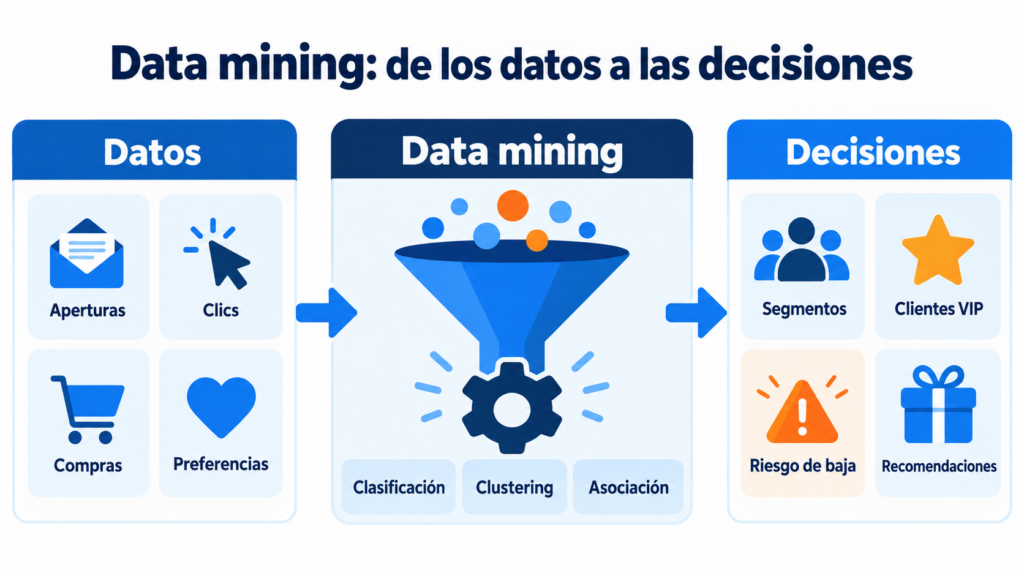
Segment more precisely. Clustering lets you discover groups of subscribers you hadn’t defined. For example, contacts who only open on weekends or who only buy with a discount. This way, your segmentation stops relying on assumptions.
Identify your best customers. An RFM analysis classifies contacts according to when they last purchased, how often and how much they spend. It’s a simple form of data mining that any business can apply.
Anticipate unsubscribes. Classification models detect signals that come before churn, such as a progressive drop in opens. That way you can act sooner with a re-engagement campaign and reduce your churn rate.
Recommend products. Association rules tell you which items are usually bought together. With that information, your emails can suggest complementary products and boost cross-selling.
Choose the best send time. By analyzing each contact’s open history, you can send when they are most likely to read your emails.
What data you can use
You don’t need complicated sources to get started. You have these at hand:
Behavior data from your campaigns: opens, clicks, unsubscribes and complaints. They help you understand email marketing metrics beyond the average.
Purchase data from your store or your CRM: orders, amounts, products and frequency.
And the data customers voluntarily give you, such as their preferences or interests. These are known as zero-party data, and they tend to be the most reliable.
Privacy and best practices
Working with personal data comes with responsibilities. In Europe, the GDPR and the LOPD require you to tell people what you use their information for. And you need a legal basis to process it.
But legal compliance is only part of it. It’s also advisable to collect only the data you will really use and to protect it well. And to check that the models don’t lead to unfair or discriminatory decisions.
One last tip: quality matters more than quantity. A database with invalid addresses, duplicates or outdated information will give unreliable results, however sophisticated the technique.
How we help you at Mailrelay
At Mailrelay we make it easy for you to get the most out of your campaign data. You can view detailed statistics on opens and clicks and segment your list based on each contact’s behavior. You can also create automations that react to what your subscribers do.
All of this on a free plan of up to 80,000 emails a month and 20,000 contacts. If you want to try it, you can create your Mailrelay account today.
Frequently asked questions about data mining
What is the difference between data mining and “minería de datos”? None. They are the English term and its Spanish translation; “minado de datos” is also used.
Do I need to code to do data mining? Not always. Many marketing tools include segmentation and analysis features that apply these techniques in a simple way.
Does data mining have anything to do with cryptocurrencies? No. Cryptocurrency “mining” is a different process, related to validating transactions on networks such as Bitcoin.
In conclusion
Data mining helps you find answers hidden in your data. Which customers are worth the most, who is about to leave, or which products sell together.
And you don’t have to be a big company to take advantage of it. With the data your campaigns already generate and a good tool, you can make much better-informed decisions.
Related entries
Discover how Mailrelay can help you with your email marketing strategy.