Kaomoji: what they are, meaning and the most popular ones to copy
What they are, where they come from and how to use them to add a fun touch to your campaigns
A kaomoji is a little face made of text characters that you read horizontally, without tilting your head, like (^_^) or ¯\_(ツ)_/¯. It was born in Japan in the 1980s and today it is used in chats, on social media and also in emails and text messages to set a friendlier tone.
Unlike an emoji, it is not an image: it is a combination of letters, signs and symbols. That is why you can copy and paste it almost anywhere.
What does kaomoji mean?
The word comes from Japanese: kao (顔) means “face” and moji (文字) means “character”. A kaomoji is, literally, a face made of characters.
The first one, (^_^), is credited to Yasushi Wakabayashi from Japan, in 1986. It spread on the forums of ASCII NET, one of Japan’s first online services.
Its most recognizable feature is in the eyes. Western emoticons, like :-), are read sideways and focus on the mouth. Kaomojis are read straight on and the emotion is in the eyes: (^_^) is joy, (T_T) is crying and (O_O) is surprise.
Kaomoji, emoji and emoticon: the differences
All three are used to express emotions, but they are not the same thing.
| Kaomoji | Emoticon | Emoji | |
|---|---|---|---|
| What it is | Face made of characters | Face made of punctuation marks | Image or pictogram |
| How you read it | Straight on | Tilting your head | You see it as a picture |
| Example | (^_^) | 🙂 | 😊 |
| Origin | Japan, 1980s | United States, 1982 | Japan, late 1990s |
| Appearance | Same on every device, depending on the font | Same on every device | Varies by system |
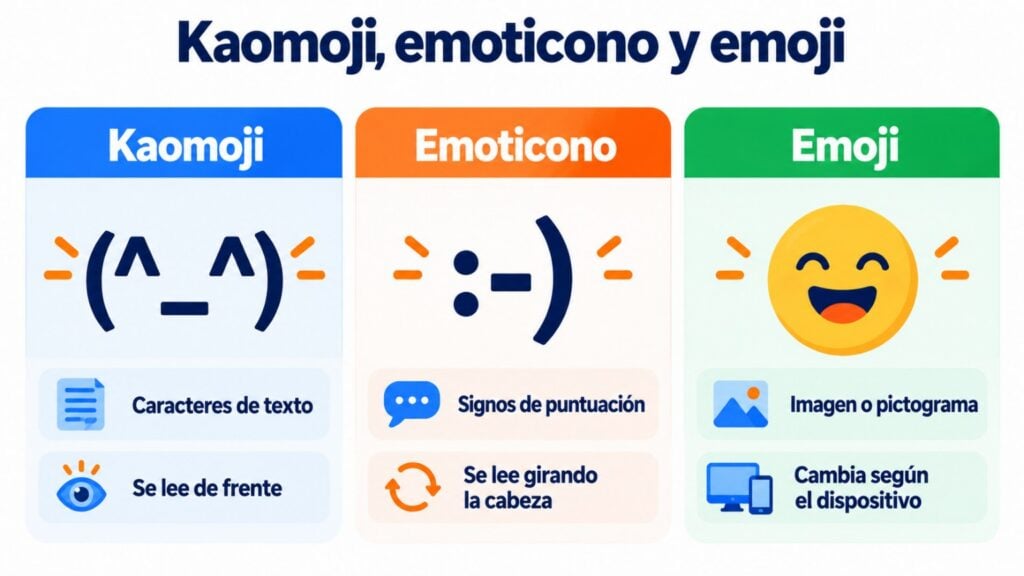
Emojis are easier to understand at first glance. Kaomojis have a more handcrafted, playful touch, and that is exactly their charm.
Give your subject lines personality
Try kaomojis and emojis in your campaigns and find out which ones your subscribers prefer.
Kaomojis to copy
These are some of the most popular kaomojis, sorted by emotion. Just select and copy them.
| Emotion | Kaomojis |
|---|---|
| Joy | (^_^) · (≧▽≦) · \(^o^)/ · (◕‿◕) |
| Love | (♥ω♥) · (♡˙︶˙♡) · (っ˘з(˘⌣˘ ) |
| Surprise | (O_O) · (⊙_⊙) · Σ(°ロ°) |
| Sadness | (T_T) · (╥﹏╥) · (。•́︿•̀。) |
| Anger | (╬ Ò﹏Ó) · ヽ(ಠ_ಠ)ノ |
| Table flip (frustration) | (╯°□°)╯︵ ┻━┻ |
| Shrug | ¯\_(ツ)_/¯ |
| Greeting | (^_^)/ · (・ω・)ノ |
| Celebration | ٩(◕‿◕)۶ · ヽ(•‿•)ノ |
| Cuteness (UwU) | (U ᵕ U) · (。◕‿◕。) |
| Cat | (=^・ω・^=) · ฅ^•ﻌ•^ฅ |
| Apology | (シ_ _)シ · m(_ _)m |
Have you seen “UwU” and don’t know what it is? It is a cute little face: the U’s are closed eyes and the w is the mouth. It is used to show tenderness or affection.
How to use kaomojis in your emails and text messages
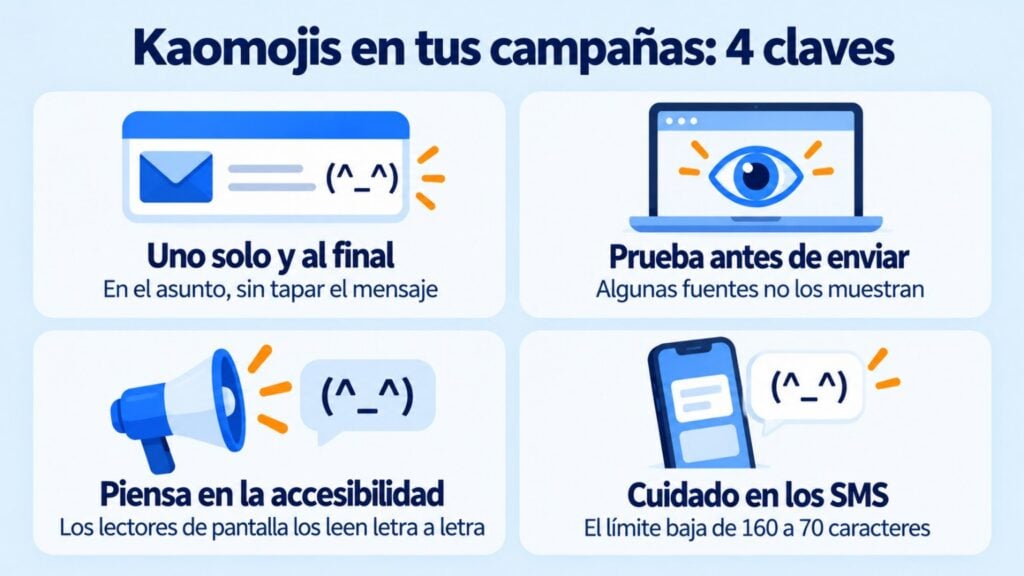
A well-chosen kaomoji gives a message personality. Used badly, it looks odd or doesn’t show up at all. Keep these key points in mind:
Just one, at the end. In the email subject line, a kaomoji at the end grabs attention without taking space away from what matters. At the start, it can look like a mistake.
Test before you send. Some characters don’t exist in every font and show up as squares. Send a test to Gmail, Outlook and a phone before sending it to your whole list.
Think about accessibility. Screen readers read each character separately: (^_^) may sound like “parenthesis, caret, underscore…”. If you care about accessible email, use them as decoration, never to convey information.
Be careful with SMS. A single character outside the basic alphabet switches the SMS to Unicode, and the limit drops from 160 to 70 characters. Most kaomojis do this. If you want to use them in your SMS marketing campaigns, check the SMS character limit first so you don’t pay for double messages.
Make it fit your brand. A kaomoji works great for a gift shop or a leisure newsletter. In a billing notice or a reply to a complaint, better not.
Examples of subject lines with kaomojis
These subject lines combine a clear message with a kaomoji that reinforces the tone:
| Type of email | Subject line |
|---|---|
| Welcome | You’re part of the family now \(^o^)/ |
| Abandoned cart | Your cart is waiting for you… (。•́︿•̀。) |
| Black Friday | Prices that make you want to flip the table (╯°□°)╯︵ ┻━┻ |
| Birthday | It’s your day and we have a gift for you (≧▽≦) |
| Apology for a mistake | We got it wrong, sorry m(_ _)m |
If you can’t decide between a kaomoji and an emoji, run an A/B test and let your subscribers decide. And if you’re looking for more ideas to add humor to your campaigns, check out these funny email examples.
How Mailrelay helps you
With Mailrelay you can try kaomojis in your campaigns without any hassle:
Test sends. Check how the subject line looks in your inbox before sending it to your whole list.
A/B tests. Compare a subject line with a kaomoji against one without, and keep the one that gets more clicks.
Email and SMS in the same tool. Prepare your email campaigns and your mass SMS from the same dashboard.
And with the free account you can send up to 80,000 emails a month to 20,000 contacts, with human support on every plan.
Send emails and text messages that don’t go unnoticed
Create your free account and send up to 80,000 emails a month to 20,000 contacts.
Frequently asked questions about kaomojis
What is a kaomoji?
It is a little face made of text characters that you read straight on, like (^_^). The name comes from Japanese and means “character face”.
How is a kaomoji different from an emoji?
A kaomoji is made of letters and symbols, and you can type it on a keyboard. An emoji is an image that each system draws in its own way.
How do you type the shrugging face?
Like this: ¯\_(ツ)_/¯. The easiest way is to copy and paste it, because it uses characters that are not on the keyboard.
What does UwU mean?
It is a kaomoji that expresses tenderness. The U’s are closed eyes and the w is the mouth.
Can I put kaomojis in an email subject line?
Yes, just like any emoji or special character. Use just one, ideally at the end, and send a test to check that it displays correctly in the main email clients.