Latinisms in email: Latin expressions to copy into your emails
From grosso modo to sine qua non: Latin expressions for work email, written correctly
Latinisms are Latin words and expressions that Spanish uses unchanged, such as a priori, grosso modo or ad hoc.
In a work email, they save words and add a touch of precision. But a misspelled latinism stands out more than any typo.
Here you’ll find what each one means, an example sentence for each, and a table at the end to copy and paste.
What are latinisms?
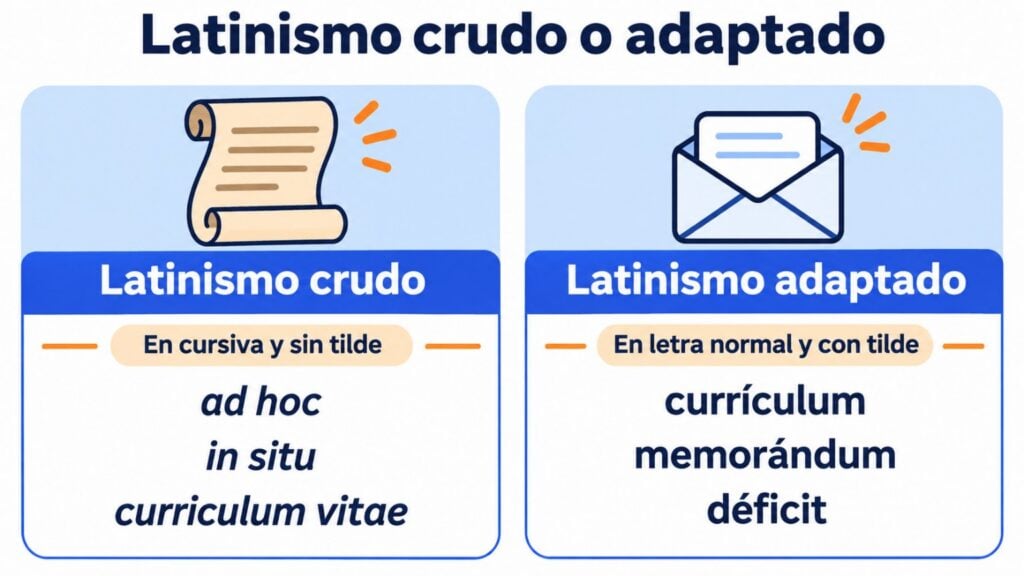
A latinism is a word that Spanish borrowed from Latin after it had formed as a language. The Ortografía de la lengua española (RAE, 2010) distinguishes two groups.
Adapted latinisms already follow Spanish spelling rules: they’re written in regular type and take an accent mark when the rules call for one. Examples are currículum, memorándum, déficit and ítem.
Raw latinisms keep their Latin form. This group includes almost all the Latin expressions you’ll see in an email: ad hoc, in situ, motu proprio.
They’re written in italics (or in quotation marks if you can’t use italics) and never take an accent mark, because Latin didn’t have them.
Write emails that are understood the first time
Create and send your campaigns with Mailrelay, with human support on every plan.
How do you write latinisms?
In Spanish, four rules help you avoid almost every mistake:
- Italics and no accent marks: curriculum vitae, not “currículum vítae”.
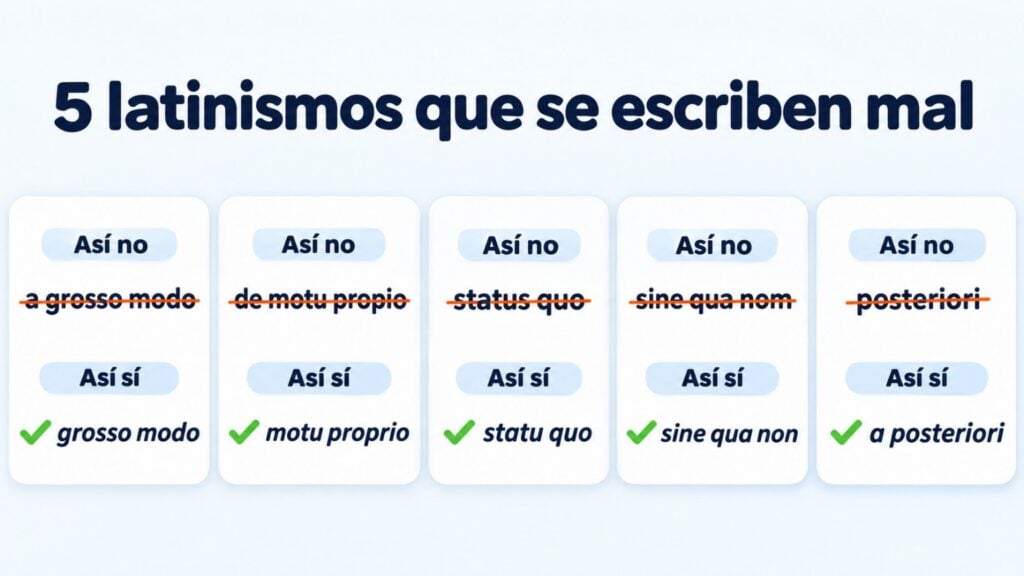
- No extra prepositions: grosso modo and motu proprio, with no “a” or “de” in front.
- Latin spelling: proprio, not “propio”; statu quo, not “status quo”.
- No change in the plural: “two sine qua non conditions”, “several ad hoc committees”.
Is it a grosso modo or grosso modo?
The correct form is grosso modo, without the “a”. It means ‘broadly speaking’ or ‘approximately’, and the “a” slips in by analogy with “a grandes rasgos” (Spanish for ‘broadly speaking’).
The mistake is so common that people search Google for “a grosso modo” more often than for the meaning of the expression itself.
Motu proprio or de motu propio?
The correct form is motu proprio, with an “r” after the second “p” and no preposition. The Diccionario panhispánico de dudas considers both “de motu proprio” and “por motu proprio” incorrect. It means ‘on one’s own initiative’: “I checked it motu proprio.”
Statu quo or status quo?
The Latin form is statu quo (‘the state of things at a given moment’). Fundéu points out that in Spanish “status quo” is a common mistake, even though it often appears in the press.
Latin expressions to use in your emails
These are the ones that appear most often in work email. Each comes with a sentence you can adapt and paste into your message.
A priori and a posteriori
A priori means ‘before examining the matter’ and a posteriori, ‘afterwards’. Both always keep the “a”.
Example: “A priori, the 15th works for us. I’ll confirm it a posteriori, once we finalize the budget.”
Ad hoc
It means ‘for a specific purpose’ or ‘made specially for something’.
Example: “We’ve prepared an ad hoc report for your Christmas campaign.”
In situ
It means ‘in the place itself’. There’s no need to add “in”: “check it in situ“, not “check it in in situ“.
Example: “If that works for you, we’ll inspect the installation in situ on Thursday.”
Per se
It’s equivalent to ‘by itself’. It lets you add nuance without sounding blunt.
Example: “The price isn’t a problem per se; what worries us is the timeline.”
Ipso facto
It means ‘on the spot, immediately’. It doesn’t take a preposition in front either.
Example: “As soon as we receive the payment, we’ll activate the account ipso facto.”
Sine qua non
It’s the condition without which something doesn’t happen. It almost always goes with the word “condition”.
Example: “Signing the contract is a sine qua non condition for getting started.” Watch out for “sine qua nom” with an “m”: it’s another common typo.
Grosso modo
You already know it goes without the “a”. It works well when you give an approximate figure or plan.
Example: “Grosso modo, the project will take six weeks.”
Latin abbreviations in email
Some Latin expressions show up in emails in abbreviated form. Before you use them, check whether there’s a clearer way to say it:
- etc. (et cetera, ‘and the rest’): goes after a comma and with a single period, never “etc…”.
- i. e. (id est, ‘that is’): in an email, “that is” or “specifically” is easier to understand.
- e. g. (exempli gratia): common in English; in Spanish, use “p. ej.” or “v. gr.” (verbi gratia).
- N. B. (nota bene, ‘note well’): draws attention to a detail, but in an email it sounds old-fashioned.
- P. S. (post scriptum): in Spanish it’s written P. D., from “posdata”.
If you’re unsure about the acronyms common in work email (FYI, ASAP, EOD), you’ll find them in email abbreviations. And for expressions like “XD” or “LOL”, check out internet slang.
Table of latinisms to copy and paste
Here are 20 latinisms with their meaning and a sentence ready for your email.
| Latinism | Meaning | Sentence for your email |
|---|---|---|
| a priori | before examining it | A priori, the proposal works for us. |
| a posteriori | after examining it | We’ll assess it a posteriori, with the data. |
| ad hoc | for a specific purpose | We’re sending you an ad hoc offer. |
| ad honorem | unpaid | They’re helping with the project ad honorem. |
| alter ego | trusted person who acts on someone else’s behalf | Marta is my alter ego this week: write to her. |
| bona fide | in good faith | We did it bona fide, without knowing about the change. |
| de facto | in fact | She is, de facto, the project manager. |
| grosso modo | broadly speaking | Grosso modo, it will take us a month. |
| in extremis | at the last moment | We made the deadline in extremis. |
| in situ | in the place itself | We’ll check it in situ on Monday. |
| ipso facto | on the spot | I’ll forward it to you ipso facto. |
| modus operandi | way of working | This is our modus operandi for orders. |
| motu proprio | on one’s own initiative | I corrected it motu proprio. |
| mutatis mutandis | changing what needs to be changed | The same contract applies, mutatis mutandis. |
| per se | by itself | The design isn’t a problem per se. |
| sine qua non | essential condition | Payment in advance is a sine qua non condition. |
| statu quo | current situation | We’d rather keep the statu quo until January. |
| stricto sensu | in the strict sense | It isn’t, stricto sensu, a mistake. |
| sui generis | unique, out of the ordinary | They’re a somewhat sui generis client. |
| vox populi | something everyone knows | That we’re moving offices is already vox populi. |
If your email editor doesn’t allow italics, put the expression in quotation marks. It’s the alternative the RAE accepts.
Latinisms in email marketing?
In a personal email to a client, a well-used latinism adds precision. In a newsletter that reaches thousands of people, the rule changes: not everyone understands them, and people who hesitate don’t click.
Latinisms still show up in campaigns sent with Mailrelay, often with one of the mistakes covered on this page.
Why use latinisms instead of the usual English expressions? It’s a way to add variety to your emails. They’re words we often know, but because they’re different, they still have a certain ability to catch attention, and that’s useful when selling by email. The key thing: only use them if you know your audience will understand them.
Jose Argudo, CMO at Mailrelay
Avoid them in the email subject line, where every word counts. Besides, you can’t use italics there, so the expression loses the formatting that marks it out.
In the body, use them sparingly. A useful copywriting rule: if an everyday word says the same thing with less effort, choose the everyday word. “Custom-made” is understood faster than ad hoc.
And if you use one anyway? Check the spelling before you send. An “a grosso modo” in a campaign can’t be fixed afterwards; at most, with an errata notice.
How Mailrelay helps
With Mailrelay, you can check whether your text works before you send it. A/B testing lets you send two subject lines to part of your list and keep the one with the most opens.
That way you know, with data from your own subscribers, whether an expression sounds natural to them or holds them back.
The free account includes up to 80,000 emails a month and 20,000 contacts, with human support on every plan. You can see the other options on the pricing page.
Find out which subject line works best
Run an A/B test on your subject line with your own list and keep the one that gets more opens.
Frequently asked questions about latinisms
These are the questions that come up most often when someone writes a latinism in an email.
Is it curriculum or currículum?
Both forms are correct in Spanish, but they’re written differently. Currículum is an adapted latinism: it’s written in regular type with an accent mark, and its plural is “currículums”. Curriculum vitae is a Latin phrase: it goes in italics and without an accent mark.
Do latinisms take accent marks?
Only those adapted to Spanish, such as déficit or memorándum. Unadapted Latin expressions, such as per se or vox populi, never take an accent mark.
Is it correct to use latinisms in a formal email?
Yes, as long as they’re spelled correctly and the recipient understands them. In a formal email they can add precision, but they’re no substitute for a clear sentence.
The rules of netiquette point the same way: write so you’re understood the first time.
Related posts
To learn more about what you’ve seen here, you can continue with these posts: