GivingTuesday: what it is, when it falls in 2026 and how to prepare your campaign emails
Dates, figures and an email calendar so your nonprofit or your company can make the most of the global day of generosity
GivingTuesday is a global movement that devotes a day to generosity. It takes place on the Tuesday after Thanksgiving, right after Black Friday and Cyber Monday.
The idea is simple: after several days devoted to buying, one devoted to giving. In 2026 it falls on Tuesday, December 1.
What is GivingTuesday?
The name means, roughly, “the Tuesday for giving”. It was born in 2012 at the 92nd Street Y, a cultural center in New York, created by Henry Timms and Asha Curran.
In 2019 it became an independent nonprofit organization. Today it has official movements in more than 100 countries, according to GivingTuesday itself (2025).
In the Spanish-speaking countries of Latin America it is known as #UnDíaParaDar, and in Brazil as Dia de Doar. In Spain it has been promoted for years by organizations such as Cruz Roja, ACNUR, Educo and the Asociación Española de Fundaciones.
Taking part costs nothing and requires no registration. Any organization can use the logo and the #GivingTuesday hashtag.
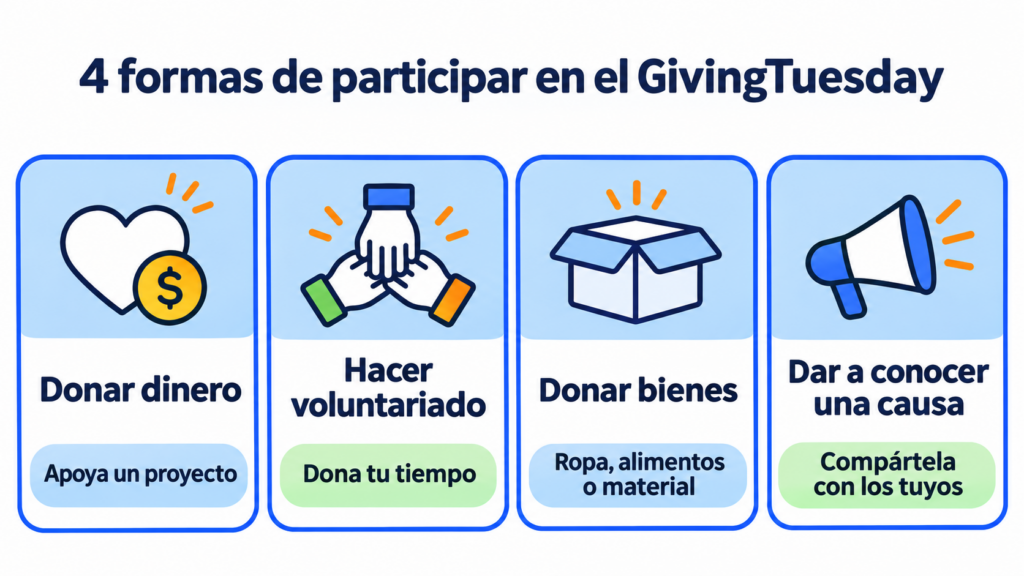
And it is not just about money. Donating time as a volunteer, donating goods or raising awareness of a cause also count.
When is GivingTuesday 2026?
GivingTuesday 2026 is on Tuesday, December 1. The date changes every year, because it depends on Thanksgiving in the United States (the fourth Thursday of November).
| Year | Black Friday | Cyber Monday | GivingTuesday |
|---|---|---|---|
| 2026 | November 27 | November 30 | December 1 |
| 2027 | November 26 | November 29 | November 30 |
| 2028 | November 24 | November 27 | November 28 |
That place in the calendar is both its great advantage and its challenge.
It arrives when people are already thinking about Christmas shopping, and after several days of inboxes full of deals.
Does a charity email get lost among so many? Not if it arrives on time and doesn’t look like just another one. On that day, a message that sells nothing stands out.
GivingTuesday in numbers
The most complete data comes from the United States. In 2025, $4 billion was donated there in a single day, 13% more than in 2024.
38.1 million people took part, and 11.1 million volunteered, 20% more than the year before (GivingTuesday, December 2025).
The day is part of the strongest season of the year for nonprofits. According to the M+R Benchmarks 2026 study, in December 2025 US organizations raised 37% of their online donations for the year.
The same study gives another useful figure. Email accounted for 11% of nonprofits’ online revenue, with about $54 for every 1,000 fundraising emails. Few channels deliver so much for so little.
How to prepare your GivingTuesday campaign emails
Don’t wait until the Tuesday itself.
If you only send one email on the day, you will be competing with many other causes in the same inbox.
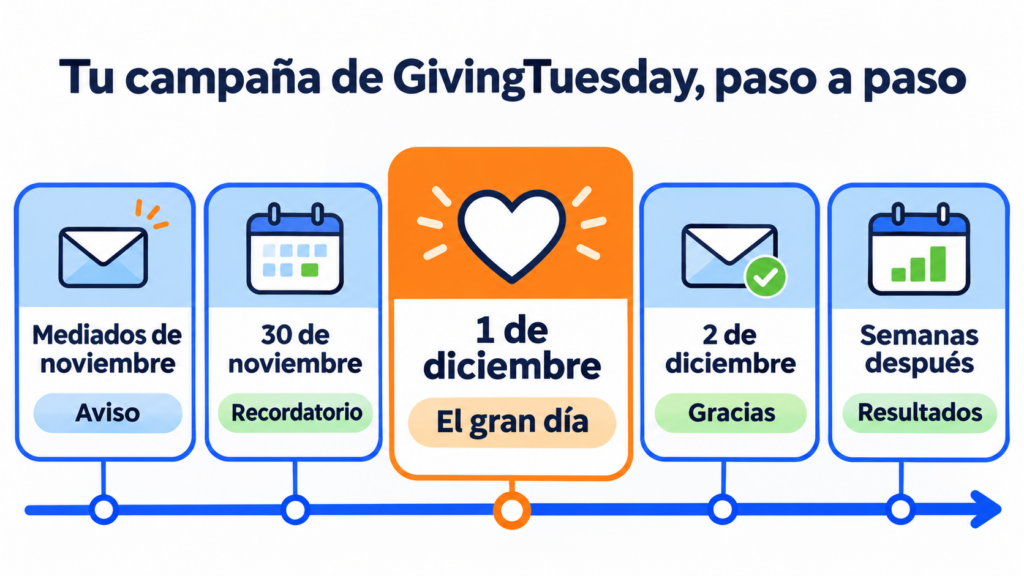
What works best is a short series, with a clear goal and the same thread running through every message. Here is a sample calendar for 2026:
| When | What you send | What for |
|---|---|---|
| Mid-November | Heads-up: “On December 1 we need you” | Introduce the goal and save the date |
| Monday, November 30, afternoon | Reminder: “Tomorrow is GivingTuesday” | Keep it top of mind for the next day |
| Tuesday, December 1, morning | The main email, with the goal and a single button | Raise the donations |
| Tuesday, December 1, afternoon | Progress update: “We’re at 60%” | Encourage those who haven’t donated yet |
| Wednesday, December 2 | Thank-you to those who donated | Share what was achieved and build a bond |
| A few weeks later | What you have done with the donations | Get them to give again |
Prepare your GivingTuesday emails for free
Create the series, separate members from donors and schedule each send, with up to 80,000 emails a month on the free account.
The afternoon email should only reach those who haven’t donated yet. To do this, move donors to another group as soon as they give, by hand or with an automation.
And the thank-you is not a formality. It is the email that does the most to bring a one-off donor back the following year or turn them into a member.
If you want to stay in touch after GivingTuesday, a newsletter with news about your projects keeps that bond alive.
Tips to get more donations from your emails
A few ideas that make a difference in an email fundraising campaign:
- A specific, visible goal. “We want to raise €3,000 for 100 school kits” works better than “help us”. If you can, turn each amount into something tangible: “€30 buys a kit”.
- A story, not a list of figures. Tell the story of one person or one family. Storytelling makes the cause understood in seconds.
- A single button. One email, one action. If you ask people to donate, share and volunteer all at once, the reader will do none of them. See how to write a good call to action.
- Different messages for different audiences. A member is not the same as a long-time donor or a subscriber who has never given. Segmentation lets you ask each of them for what makes sense.
- Other ways to help. To those who can’t donate, offer volunteering or spreading the word about the campaign. That counts too.
- Tested subject lines. Run an A/B test on the subject line of the main email with part of your list and send the winner to the rest.
That said, only write to people who have given you permission. The rush of a date like this does not justify using lists without consent.
The GDPR also applies to charitable causes, and a double opt-in subscription gives you proof of that permission.
What if you’re not a nonprofit? GivingTuesday for companies
GivingTuesday is not just for nonprofit organizations. More and more companies are joining in, and they do it in several ways:
- donating a percentage of the day’s sales to a cause;
- matching their customers’ or employees’ donations, euro for euro;
- organizing a volunteering day for their staff.
Join donation campaigns if it makes sense for your brand. Don’t make it look like you’re jumping on the bandwagon just to gain visibility. If it comes naturally to your brand, use it. Otherwise, it makes no sense and can put people off.
Jose Argudo, CMO of Mailrelay
If you do it, tell your subscribers transparently: which organization you are helping, how much and how they can check it.
A charitable action that is poorly explained looks like just another promotion.
Told well, it strengthens your corporate social responsibility and trust in your brand. Our post on cause marketing has more ideas.
How Mailrelay helps you
With Mailrelay you can prepare the whole campaign without paying anything.
The free account includes up to 80,000 emails a month and 20,000 contacts, enough for most small associations.
You can create a landing page for the campaign and a subscription form for those who want to receive news.
With subscriber groups you separate members, donors and supporters. And with an automation, the thank-you goes out on its own as soon as someone joins the donors group.
To reinforce Tuesday’s reminder, you can also send an SMS from the same account, with SMS credit. And if you have a question, there is human support on every plan.
If you are choosing a tool for your organization, our guide to email marketing for nonprofits and the post on email marketing for associations can help.
Your cause deserves to reach the inbox
Landing pages, forms, automations and human support on every plan, including the free account.
Frequently asked questions
These are the most common questions about GivingTuesday.
What is GivingTuesday called in Spanish?
It translates as “martes de dar” or “martes de la generosidad” (“Tuesday of giving” or “Tuesday of generosity”). In Latin America the movement uses the name #UnDíaParaDar, while in Spain the English name is usually kept.
Is GivingTuesday celebrated in Spain?
Yes, on the same day as in the rest of the world. It is driven by large nonprofit organizations and foundations, and any nonprofit, company or individual can join without registering.
Does GivingTuesday have anything to do with Black Friday?
It was born as a response to it. After Black Friday and Cyber Monday, devoted to consumption, GivingTuesday proposes devoting a day to giving. That is why it takes place on the very next Tuesday.
Retail calendar
These are the year’s main retail dates covered in our glossary, in order. Prepare each campaign a few weeks in advance.
| Date in 2026 | Retail date | Where it is celebrated |
|---|---|---|
| February 14 | Valentine’s Day | International |
| From October 9 | Big Billion Days | India |
| October 31 | Halloween | United States, Spain and Latin America |
| November 8 | Diwali | India |
| November 11 | Singles’ Day | China and international online retail |
| November 13–17 | El Buen Fin | Mexico |
| November 27 | Black Friday | International |
| November 30 | Cyber Monday | International, especially online |
| December 1 | GivingTuesday | International |
| December 7 | Little Candles Day | Colombia |
| December 25 | Christmas | International |
| December 26 | Boxing Day | United Kingdom, Canada and Australia |