Custom fields
The contact data that turns a bulk send into a tailor-made message
You have a list of 5,000 contacts. For each one you know the email address and, with luck, the first name. But you don’t know which city they live in, what they bought or when their birthday is. Without that data, everyone gets the same message. Custom fields are how you store that information so you can use it in your campaigns.
What are custom fields?
Custom fields are extra pieces of data you add to each contact’s record, beyond their email address. They work like additional columns in your email database: “city”, “last product purchased”, “sign-up date” or “customer tier”, for example.
Each field has a name, a data type and a tag that your email tool uses to insert it into your messages.
Don’t confuse them with custom fields in WordPress, which add metadata to posts and pages on a website. Here we’re talking about data about your subscribers.
Default fields and custom fields
Every email marketing platform comes with a set of built-in fields. In Mailrelay, for example, each contact can already have an email, name, address, city, state or province, country, language, birthday and website.
Custom fields cover everything else. A training academy will need “course of interest”; a sports shop, “favourite activity”; a software company, “subscribed plan”. You decide which data is useful to you.
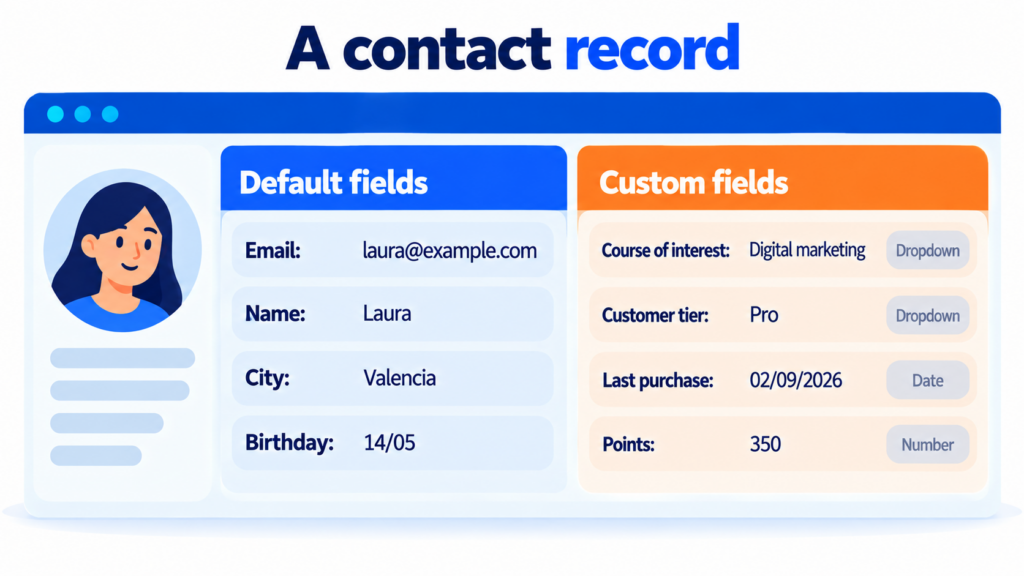
Types of custom fields
The field type defines what data it accepts and how you can use it later. Choosing it well avoids errors when you import and segment.
| Field type | What it stores | Example | Typical use |
|---|---|---|---|
| Text | Free words or phrases | Company: “Lopez Garage” | Personalizing the greeting or signature |
| Number | Figures | Loyalty points: 350 | Segmenting by ranges |
| Date | Day, month and year | Sign-up date: 03/12/2026 | Anniversaries and reminders |
| Dropdown | One option from a closed list | Tier: basic, pro, business | Clean segments with no variants |
| Checkbox | Yes or no | Accepts partner offers | Filtering consents or preferences |
| Multiple choice | Several options at once | Interests: running, yoga | Content based on interests |
A practical tip: whenever you can, use dropdowns instead of free text. If people type their city by hand, you’ll end up with “London”, “london” and “Londn” in the same list.
And segmenting like that is a headache.
What custom fields are used for
Storing data has no value on its own. The value lies in what you do with it in every send:
- Personalizing content: inserting the first name, company or last product purchased into the subject line or body, just like a mail merge.
- Segmenting: creating groups based on a value, such as “customers in Manchester” or “pro plan”, and sending them different campaigns. We explain how in our entry on segmentation in email marketing.
- Automating: triggering a birthday email or a reminder from a stored date.
- Showing or hiding blocks: displaying a running image only to people who selected that interest, with dynamic content.
- Scoring contacts: adding points based on industry or job title in a lead scoring system.
Is it worth the effort? According to McKinsey, 71% of consumers expect companies to deliver personalized interactions and 76% get frustrated when that doesn’t happen. Personalization also typically drives a 10% to 15% revenue lift.
Store the data you actually use
With Mailrelay you create custom fields on every plan, including the free one, and use them to personalize and segment your campaigns.
Create a free accountCustom field examples by type of business
An online shop can store size, favourite category and date of last purchase. With that, it sends new arrivals in the right size, wins back people who haven’t bought in 90 days and celebrates the anniversary of their first order. If the shop is connected, it can also trigger an abandoned cart email with the exact product.
A training centre usually needs the course of interest, the format (in person or online) and the start date. That way it only sends information about the course each person cares about.
In B2B, the most useful ones are industry, company size and job title. Because a finance director and a technician don’t respond to the same message, even if they work at the same company.
How to collect your contacts’ data
The most common source is the sign-up form. Each form field is saved into its custom field. But every extra question reduces sign-ups, so only ask for what you’ll use soon.
Another route is importing. If you already have the data in a spreadsheet or in your CRM, export it to a CSV file and map each column to its field when you import. You can also sync data with other tools through an API.
And don’t forget the data subscribers share with you because they want to: preferences, interests or preferred frequency. This is known as zero-party data, and it’s usually the most reliable information you’ll have.
Remember GDPR, too. Its data minimisation principle (Article 5(1)(c)) requires you to collect only data that is adequate and necessary for the purpose you’ve explained. Avoid asking for sensitive data, such as health or political opinions, unless you have a clear legal basis.
Best practices for custom fields
Decide first what you’ll use each piece of data for. If you can’t think of a single campaign for it, don’t create it.
Use clear names and short tags, with no spaces or special characters: “course_interest” works better than “Student’s course of interest”. That makes them easier to insert without mistakes.
Always set a default value. If a contact has no first name, the greeting should say “Hi” —or “Hi there”— rather than “Hi ,”. It looks like a minor detail, but it’s the mistake people notice most.
Review the data from time to time. Good email list hygiene includes fixing misspelled values and deleting fields nobody uses.
And test before you send. Send yourself one test version with a contact whose fields are empty and another with the fields filled in. Our entry on A/B testing shows why small changes in personalization can make a big diffrence to open rates.
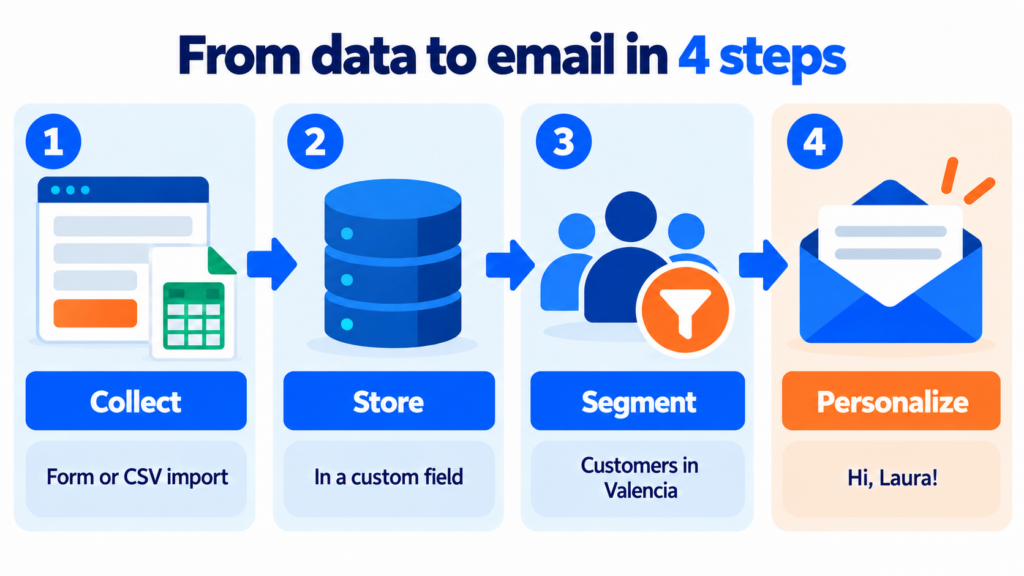
How Mailrelay helps you with custom fields
In Mailrelay, custom fields are included in every plan, including the free one. You create them from the Subscribers → Custom fields menu and add a new one. You choose the field type (text, number, dropdown, checkbox…), the display name, the tag, whether it’s required and its default value.
You can then ask for them in your forms and landing pages, fill them in when you import contacts and use them to build segments. When you edit an email, the “Variables” dropdown inserts them for you. A built-in field looks like {{ subscriber.name }} and a custom one like {{ subscriber.custom_fields.sport }}.
With conditions such as {% if subscriber.custom_fields.sport == "Karate" %} you can show a block only to people with that value. You’ll find the step-by-step guide, with screenshots, in our article on how to use dynamic variables to personalize your emails.
All of this with up to 80,000 emails a month and 20,000 contacts for free, automations with birthday and date triggers, and support by chat, ticket and phone on every account.
Personalize every send without the hassle
Custom fields, segments, variables and automations with up to 80,000 emails a month for free and support by chat, ticket and phone.
Try Mailrelay for freeCustom fields FAQ
What is a custom field in email marketing? It’s an extra piece of data you store in each contact’s record, such as their city or the product they bought, to personalize and segment your campaigns.
What’s the difference between a custom field and a tag? A field stores a value (for example, “Manchester”). A contact tag only marks the contact as part of something (for example, “attended the webinar”). Fields are for personalizing text; tags are mainly for classifying.
How many custom fields should I create? The ones you’ll use in the coming months. It’s better to start with three or four well-filled fields than with twenty empty ones.
What happens if a contact’s field is empty? The default value you’ve set is shown. If you haven’t set one, the gap stays blank, so it’s always worth defining it.
Can I use custom fields in the subject line? Yes. A subject line with the contact’s name or city usually stands out in the inbox, but use it sparingly so it doesn’t lose its effect.