Digital marketing strategies: 12 examples for small businesses and how to choose yours
What to do, what it costs and how to measure it: the strategies that work for small businesses, with a sample 3-month plan
What to do, what it costs and how to measure it: the strategies that work for small businesses, with a sample 3-month plan
Do you post on social media, send the odd email and pay for an ad now and then, but without a clear plan? That’s the norm for most small businesses. And it’s why so many efforts don’t pay off.
A good strategy isn’t about being everywhere. It’s about choosing two or three channels, doing them well and measuring what works.
In this guide you’ll find 12 digital marketing strategies, each with a small-business example, what it costs and how to measure it. But first, the 5 steps to build your own.
A digital marketing strategy is the plan that defines how you’ll use online channels. Its purpose is to reach a business goal: more customers, more sales or more repeat customers.
Don’t confuse it with a tactic. The strategy is the what and the why: “get 200 leads a month with useful content”. The tactic is the how: a weekly post, a lead magnet and a newsletter.
If you want to review the basic channels, you’ll find the definition of digital marketing in our glossary.
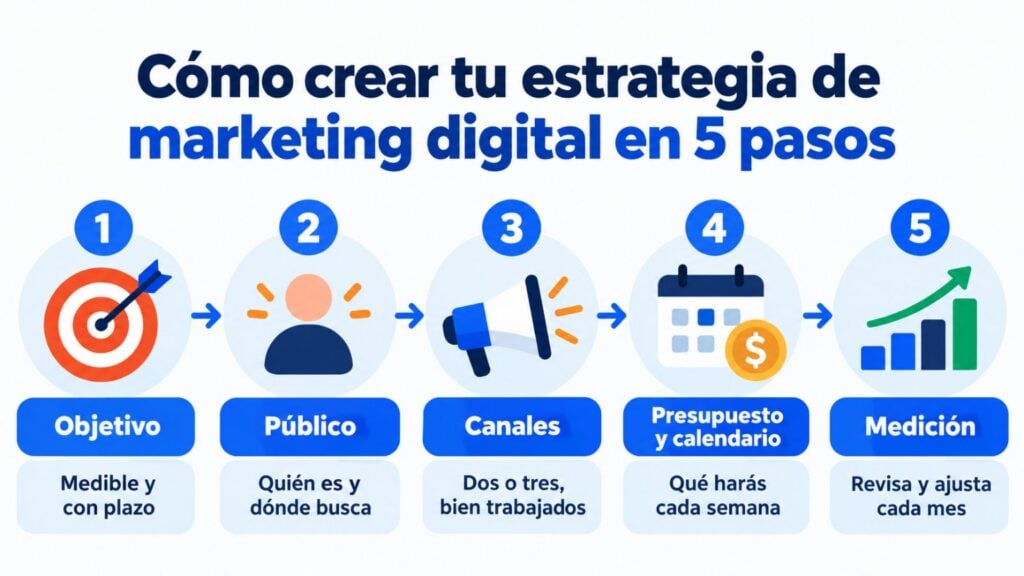
Before choosing your digital marketing strategies, get clear on your starting point. These five steps fit on a single page.
1. Set a measurable goal. “Sell more” won’t do. “Win 50 new customers in three months” will, because you’ll know whether you’ve achieved it.
2. Know your audience. Describe your ideal customer: what they need, where they look for information and what holds them back. That’s your buyer persona.
3. Choose just a few channels. Two or three channels done well perform better than six done halfway. Choose where your audience already is.
4. Set a budget and a schedule. Decide how much time and money you’ll put in each month, and what you’ll do each week. Our marketing plan template can help.
5. Measure and adjust. Choose two or three KPIs per channel and review them every month. Whatever isn’t working, change it.
These are the digital marketing strategies that work best for small businesses. You don’t have to use them all: choose based on your goal.
Get found by people searching nearby. Local SEO is about showing up when someone searches for “physiotherapist in Valencia” or “bike shop near me”.
Example: a physiotherapy clinic completes its Google Business Profile, asks its patients for reviews and creates a page for each treatment.
Cost and measurement: almost free, it just takes time. Measure calls, profile views and direction requests.
Attract people with useful answers. Content marketing creates articles, guides or videos that answer your customers’ questions before they buy.
Example: a coffee shop publishes guides such as “how to choose a coffee maker” and “which grind to use for each brewing method”.
Cost and measurement: writing time. Results take months. Measure organic visits and subscribers coming from the blog.
The channel you own. With email marketing you talk directly to people who already know you, without depending on algorithms. It’s one of the digital marketing strategies with the best return for small businesses.
Example: a training academy sends a fortnightly newsletter with tips and a welcome automation for each new subscriber.
Cost and measurement: very low; some tools have a generous free plan. Measure opens, clicks and attributed sales. Learn how to plan it in our email marketing strategy guide.
Trade something useful for an email address. A lead magnet is a free resource (a guide, a template, a discount) given in exchange for subscribing.
Example: an accountant offers a downloadable “tax calendar for freelancers” and uses it to grow their list.
Cost and measurement: the time it takes to create the resource. Measure the conversion rate of the download page. Here are 20 lead magnet ideas to get you started.
Be where your audience spends its time. Choose one or two networks, not all of them. Instagram and TikTok for visual products, LinkedIn for B2B services.
Example: a bakery posts short videos showing how its cakes are made and replies to every comment.
Cost and measurement: time and, at most, a scheduling tool. Measure reach, engagement and website visits, not just followers.
Fast results in exchange for budget. Digital advertising on Google or social media lets you reach a very specific audience from day one.
Example: a driving school runs Google ads for “driving school in” its city during the summer season.
Cost and measurement: you pay per click or per impression. Measure cost per click, cost per customer and return.
Reach past visitors again. Remarketing shows ads or sends emails to people who came close to buying.
Example: an online store sends an abandoned cart reminder email and shows an ad for the product on social media.
Cost and measurement: cheaper than reaching a new audience. Measure the recovery rate and the sales that come back.
Launch your email marketing strategy for free
Forms, landing pages, and welcome and abandoned cart automations, with 80,000 emails a month on the free account. No credit card required.
Messages that get read right away. WhatsApp Business and SMS are useful for reminders, urgent notices and last-minute offers.
Example: a hair salon sends an SMS reminder the day before each appointment and cuts down on no-shows.
Cost and measurement: you pay per message. Use them with permission and in moderation. Measure clicks, replies and confirmed appointments.
Recommendations from someone they trust. Influencer marketing doesn’t have to be expensive. A local profile with a few thousand followers often has a more loyal audience.
Example: a natural cosmetics brand sends its product to five local creators in exchange for an honest review.
Cost and measurement: product or a small fee. Measure with a discount code for each creator.
Let others speak for you. Customer reviews carry more weight than any ad. It’s the digital version of word-of-mouth marketing.
Example: a restaurant sends an email after each booking asking for a Google review and replies to all of them, including the negative ones.
Cost and measurement: free. Measure the number of reviews and the average rating every month.
Messages that fit each customer. Artificial intelligence helps you write variants, analyze data and tailor the message to each segment.
Example: a sports store uses purchase data to send running offers only to customers who bought running shoes.
Cost and measurement: many AI tools have a free plan. Measure the difference in clicks between personalized and generic sends.
Sell again to people who already trusted you. Customer loyalty usually costs less than winning new customers.
Example: an optician sends an email a year after the purchase to suggest an eye test, and a winback campaign to customers who haven’t been back in a while.
Cost and measurement: low if you already have the list. Measure the repeat purchase rate and the value of each customer over time.
This table compares the 12 digital marketing strategies so you can choose based on your resources.
| Strategy | Cost | Time to see results | Difficulty |
|---|---|---|---|
| Local SEO | Low | 1-3 months | Low |
| Content marketing | Low (time) | 3-6 months | Medium |
| Email marketing | Low | Weeks | Low |
| Lead magnets | Low | Weeks | Medium |
| Social media | Low (time) | 1-3 months | Medium |
| Advertising | Medium or high | Days | Medium |
| Remarketing | Medium | Days | Medium |
| WhatsApp and SMS | Per message | Immediate | Low |
| Micro-influencers | Low or medium | Weeks | Medium |
| Reviews | Free | 1-3 months | Low |
| AI-powered personalization | Low | Weeks | Medium |
| Loyalty | Low | Weeks | Low |
Timeframes are approximate and depend on your industry and what you already have in place.
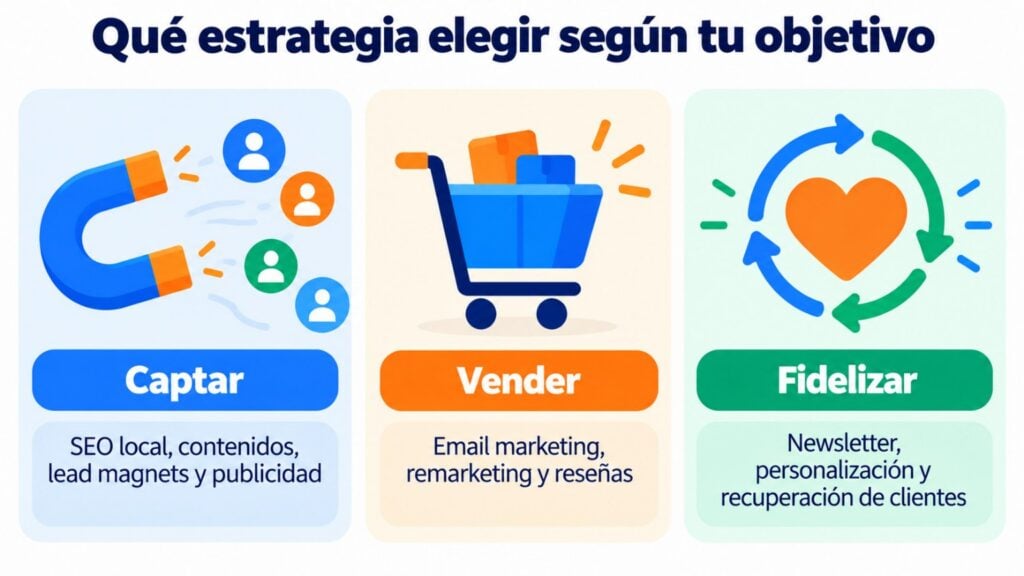
If you don’t know where to start, first decide what you want to achieve. Each goal has its own most effective digital marketing strategies.
| Goal | Most useful strategies |
|---|---|
| Win new customers | Local SEO, content, lead magnets, advertising and micro-influencers |
| Turn them into sales | Email marketing, remarketing, reviews and WhatsApp or SMS |
| Build loyalty | Newsletter, AI-powered personalization and win-back campaigns |
A common combination for a small business: content or local SEO to attract, a lead magnet to capture the email address and an email sequence to convert. It’s a simple, low-cost sales funnel.
Let’s see how several digital marketing strategies come together in a real small-business case. A yoga gear store with its own website wants to go from 20 to 50 orders a month.
Goal: 50 orders a month within three months, with a budget of €300 a month.
Audience: women aged 25 to 45 who practice yoga at home and are looking for quality gear.
Month 1: lay the groundwork. The store creates a downloadable guide, “10 poses to get started at home”, as a lead magnet. It puts it on a landing page with a form. It also sets up a three-email welcome sequence: the guide, the best-selling products and a first-purchase discount.
Month 2: drive traffic. It publishes two blog posts a month, such as “which yoga mat to choose for your practice”. It shares short videos on Instagram and puts €200 into ads that lead to the guide. It sends samples to three micro-influencers in the sector.
Month 3: convert and build loyalty. It turns on the abandoned cart email and a fortnightly newsletter with routines and new products. It asks every customer for a review a week after their order arrives.
Results it measures: new subscribers per month, the welcome sequence’s conversion rate, orders that come from email and the cost per customer from ads.
Notice how everything revolves around the email list. The ads, social media and influencers lead to the guide. And email converts and builds loyalty.
Without measurement, you don’t know which strategy to keep and which to change. You don’t need a complicated dashboard: just review these metrics every month.
| Strategy | What to measure |
|---|---|
| SEO and content | Organic visits, rankings and subscribers from the blog |
| Email marketing | Opens, CTR, unsubscribes and attributed sales |
| Social media | Engagement and website visits |
| Advertising | Cost per click, cost per customer and return |
| Loyalty | Repeat customers and average value per customer |
Always compare against the previous month and against your goal. If a strategy doesn’t improve within two or three months, adjust it or replace it with another. In the end, what counts is the return on investment of each action.
These are the most frequent mistakes small businesses make when launching digital marketing strategies:
To choose the software for each channel, check out our guide to digital marketing tools by category.
Several of these digital marketing strategies go through email: the lead magnet, the welcome, cart remarketing, reviews and loyalty. Mailrelay brings them together in one account.
You get forms and landing pages to capture leads, automations for welcome and win-back, segmentation to personalize, and SMS and WhatsApp for urgent notices.
The free account includes 80,000 emails a month and 20,000 contacts, no credit card required, with human support on every plan.
To launch your digital marketing strategies, choose one goal for the next three months. Then pick one strategy to attract and another to convert. For example, local SEO plus email marketing.
Put them into action, measure every month and add a third once the first two are working.
Start with the channel you own: your email list
Capture subscribers, turn them into customers and keep them coming back from a single account, with human support on every plan.
These are the most common questions when planning a small business’s digital marketing strategies.
It’s the plan that defines which online channels you’ll use, for what goal and how you’ll measure the results. It includes the audience, budget, schedule and metrics.
The ones that cost little and deliver measurable results: local SEO, email marketing, lead magnets, reviews and customer loyalty. Advertising works fast, but it needs an ongoing budget.
A welcome automation, a newsletter with useful content, interest-based segmentation and campaigns to recover carts and inactive customers.
It can start out almost free if you put in the time and use tools with a free plan. Costs go up mainly with advertising and hiring professionals.
Advertising and email can deliver results within days or weeks. SEO and content marketing usually need three to six months.

Jose Argudo
CMO at Mailrelay. Writes about email marketing, copywriting and conversion for small businesses and entrepreneurs.