A digital marketing strategy is nothing without the essential digital tools to implement it. And that’s what I want to talk to you about today.
There are many great ones on the market. Some have a Freemium version, others have affordable plans, and others come with a high price tag. We also find them classified by the different areas of our profession, from Community Management to digital analytics.
In this post you’ll find a review of some of the ones I consider essential, but I always say the best thing you can do is try them out and stick with the one you feel most comfortable with or the one that helps you most with the goal you’re after.
I’m not going to cover too many so I don’t overload you with options, but I will share the ones I consider essential and think you’ll be interested in knowing about.
Let’s take a look at them.
· Digital Tools for content curation
I started out as a Community Manager, so this is the first group I want to focus on. This professional’s main job is managing social media in general, and publishing quality content in particular.
This takes up a lot of time. You need to select the content that fits the editorial calendar for that date, both your own and other people’s, and the latter is the one that requires the most care.
- You can’t end up promoting your competition.
- You have to filter carefully so you don’t fall into information overload.
Here are the digital tools I recommend:
◆ Feedly
I can’t live without Feedly. It’s the second thing I do every morning (the first is replying to comments on my social profiles and checking in on clients).
For me, it’s the best content curation tool out there. It’s free for most of its features (if you’re a business, take a look at its paid version for creating teams). It’s an RSS reader that delivers posts from the blogs or websites you want to stay up to date with.
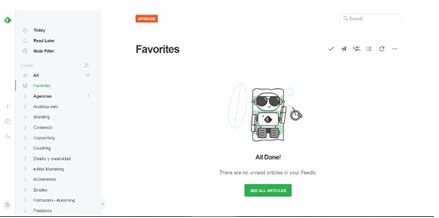
As you can see in the image below, in the column on the left you can sort them into folders to make them easier to find.
Tag ideas:
- Keep track of the followers of your blog that you have here.
- Stay up to date with news in your industry.
- Create folders around your clients’ topics so you can properly share the digital content marked out in your Social Media Plan.
- See what your competitors are publishing.
- Curate quality content, of course.
100% recommended. Use it every day!
How many times has this happened to you: browsing the internet, coming across content that catches your attention, but it’s not the moment to stop and read it? To me, every day.
You have two options: never close the browser window until you have 70-80 tabs open at once, or use Pocket. (I do both 😋.) Let’s be sensible and avoid accidents. If your browser closes and you can’t recover that history, it’s enough to give you a heart attack (this has happened to me too 😅).
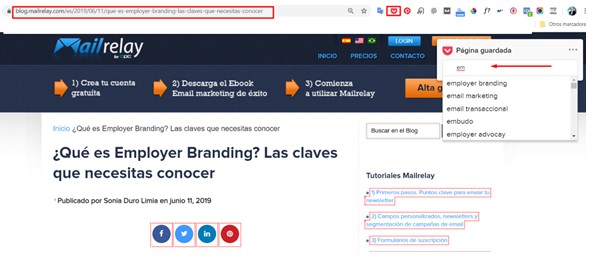
Pocket has a Chrome extension that puts you just one click away from saving a page you like, tagging it, and reading it later. It’s free. Make the most of it!
◆ Bloguers.net
More than just a tool, bloguers.net is a portal where you can find posts and content on every topic.
And that’s not all — as well as helping us find useful content for our social media, we can also request exchanges, where the author of a post shares our posts on their social media, and we share theirs.
This way you can get a lot more visibility for your content, while also curating interesting content for your own social media.

· Digital Tools for scheduling content on Social Media
I’ll continue with the tools that help my beloved, underrated Community Managers. If curating content already takes up your time, now comes the next thing your work will be judged on: scheduling posts on social media.
There are 3 fundamental reasons why you need to use these tools:
- Because your boss or your client will probably want to review what you’ve planned before it’s published.
- Because you can’t spend your life on social media, watching the clock and waiting for the right time to click “publish.”
- Because you need to save time and focus on managing people — the people in your community. This is more important.
Here are 4 tools I use that help me meet these 3 requirements. (I’ll leave Metricool, which would be the 5th, for the analytics section.)
◆ Buffer
My favorite digital tool for scheduling. It’s useful, practical, intuitive, convenient, visually pleasant, and free for up to 10 scheduled posts per social network (3 free). But what I especially like about Buffer is that it lets you remove links and keep your post looking cleaner.
On Twitter you can’t remove them, true, but you can on your fan page and, best of all, on LinkedIn.
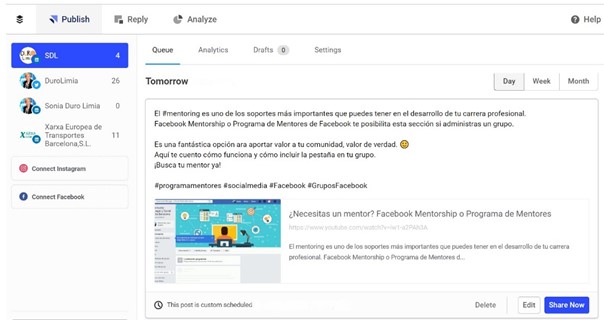
Do you see any visible URL in this image? No, but that content is linked. That’s what I mean.
Highly recommended!
◆ Hootsuite
Hootsuite is a classic. I started out in Digital Marketing with this tool, until I discovered Buffer.
It’s not as intuitive and can be tricky at first, but it has going for it that it’s one of the official tools for scheduling on Instagram. It’s widely used by professional marketers and by community managers at companies. I think you should know about it, if only for the sake of digital tool literacy.
Do you know what I like it for, more than for scheduling? For monitoring Twitter. That’s the use I currently give it.
◆ Facebook Creator Studio
Speaking of scheduling on Instagram, Mr. Zuckerberg gives us his own digital tool for scheduling on Facebook and Instagram. It’s missing some features, but it will probably add them little by little.
Advantages?
- It’s native to Facebook and you don’t need to use any other external tool.
- It’s easy to use.
- You can schedule on IGTV.
- Targeting your Facebook audience is available here and not in other publishing tools.
If your strategy is focused on these social networks, it’s worth trying out. You can access it from your fan page.
◆ BlogsterApp
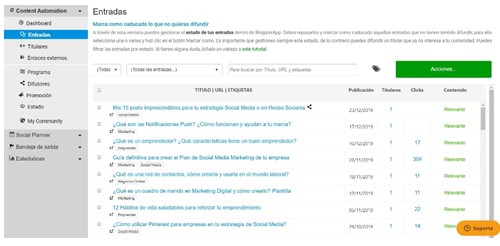
Of these 4 tools, BlogsterApp is the least known, but it’s the most different and extremely useful if you have a blog. I liked it even before I created my blog. Now it’s my inseparable companion, because it’s the only digital tool (that I know of) that really helps you automate the distribution of your blog posts.
And note that automated doesn’t mean impersonal, since you create the copy yourself, with whatever hashtags you want. Just as if you were posting directly on the social network yourself.
Its algorithm goes through your blog, from the oldest posts to the newest, and publishes them according to the schedule of times and places you decide.
Ask them for help with customization, because this Canary Islands team has really great customer support. You get a 15-day trial and a very affordable plan that costs less than €10 a month.
◆ Dlvr.it
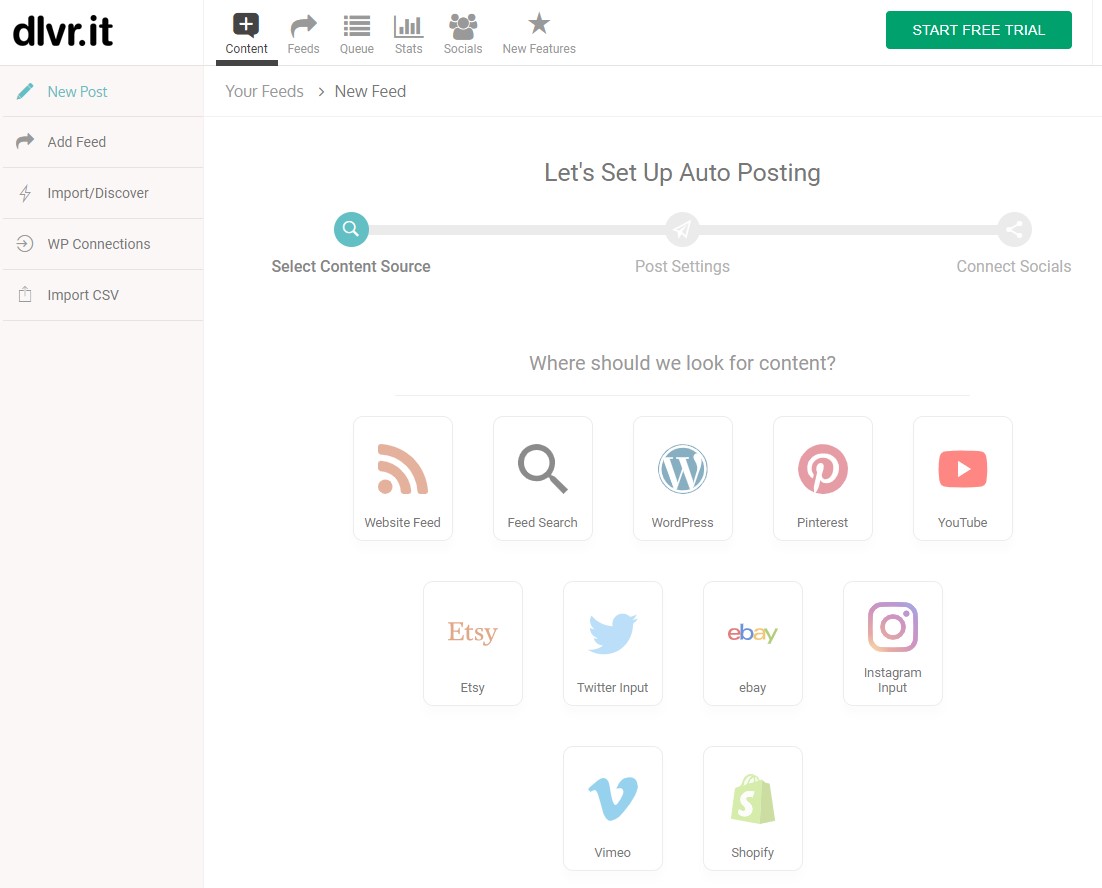
A perhaps lesser-known tool, dlvr.it has very powerful features, such as the ability to import content from an RSS feed, or add multiple feeds to share content from other blogs.
It also includes something not all these tools have: the ability to automatically share the new videos we publish on our YouTube channel.
Try its free version — it won’t disappoint you:
· Digital Email Marketing Tools
Let’s continue with promoting your content and take one more step in your marketing strategy. Although we thought emails were a thing of the past, the truth is that they’re still necessary in business, in both business-to-business and business-to-consumer communication (B2B and B2C).
As a guest on this blog, I’m not going to explain what Email Marketing is, but I can tell you it’s increasingly used to convert business goals.
◆ Mailrelay
Of course I couldn’t skip this digital tool in a post published on this very blog, which is all about it.
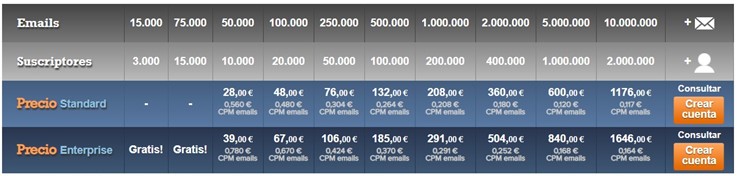
Mailrelay is an email marketing software with one big advantage: its price. You can send up to 80,000 emails a month for free.
But let’s be a little critical too, since they’re letting me 😉: the skin isn’t very pretty, and that sometimes makes users hesitant. By the way, they’ve improved this quite a bit with their new version.
Either way, for me the question is obvious: do you want price or design?
Let it be known: I use Mailrelay.
◆ Other Email Marketing tools
Mailrelay has competitors, of course, but allow me not to talk about them here, on its own turf. That would be pretty rude of me, and I want to keep writing on this blog! Hehe.

· Digital Tools for Content SEO
Keyword research tools (or tools for finding users’ search intent) are one more technical step in your Content Marketing strategy. The ones we usually find in this area have either a Freemium version with a few queries a day, or a straight-up paid version.
The most relevant ones, in my view, are:
◆ Ahrefs
An excellent link-based app that easily shows you your website’s and its pages’ rankings and domain authority, from different angles.
Intuitive, with a manageable learning curve for any user who knows a bit about SEO.
◆ SEMrush
More than a single app, SEMrush is a suite of them that includes scheduling, SEO, and content analysis. It’s very comprehensive and probably one of the most specialized in the industry (which is why its learning curve is steep).
You get a 14-day free trial by invitation.
◆ Answer The Public
What are the questions your target audience is asking about a specific topic? This is an excellent way to lay the groundwork for your blog post titles.
Do your first searches for free!
· Digital Analytics Tools
A digital marketing strategy is nothing if you don’t analyze it regularly (at least once a month). For that, we have the analytics side of the tools I’ve mentioned in this post, plus some other specific ones I want to highlight.
◆ Metricool
I’ll start with a homegrown Spanish app. They’re from Madrid, and besides creating a super useful tool, they’re a lovely team.
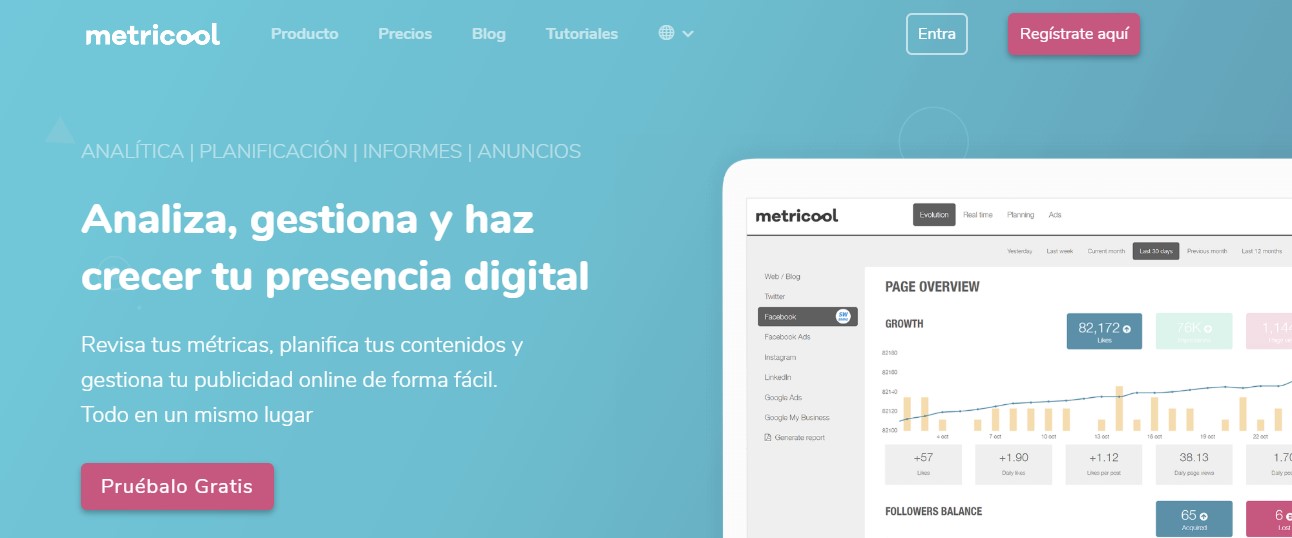
I mentioned earlier that Metricool is a great option for scheduling on social media. What sets it apart is its color-coded calendar that shows you the best times to post on each social network. Its autolists are also a really notable feature that I recommend you try.
That said, while there are other competitors in that space, these guys definitely help you create reports that capture the analytics of the actions you’ve carried out over a period of time.
And they do it in a really useful way for you: in a PDF or PPT that you can customize with your logo. In other words, you create this document in a single click, ready to send to whoever needs it. Fantastic!
You can also track the evolution of your social profiles, where it gives you the results for the main social media KPIs. At a glance, you know how you’re doing on them.
· Native Social Media Insights
Social networks have an analytics section that gives you excellent data to help you assess the progress of your strategy. With them, you can go really deep and get the exact KPI you’re looking for in your project, since (almost) all of them let you download the data as a CSV or Excel file.
Each one has its quirks — for example, Instagram only gives you results from the last 7 days, and LinkedIn has an API that makes it harder for external tools to access it — but these, along with Facebook (the most complete), Twitter and Pinterest, are outstanding in this respect.
So what do I recommend?
- If you’re just starting out in analytics, get to know them so you understand where the data comes from and how it’s shown. Then, once you’ve mastered them, you can move on to external tools that save you time and make your job easier. You can always go back to the native Insights to find a relevant figure you need.
- If you already have experience in digital analytics, you can turn to the reports provided by external tools and pull the native Insights you need from them.
- My golden rule with clients is to create a personalized report for each one. Create the format or template that best fits each project and fill it with the information that tools and Insights give you.
◆ Google Analytics
Everything is different with Google Analytics. Analyzing what happens on your website is the key to developing the rest of your digital marketing strategy.
It’s a 100% free digital tool, and one you absolutely need to know how to use, even if only at a basic user level. Make sure it’s linked to your website, and don’t stop pulling the metrics it offers you, at least once a month.
Es-sen-tial.
Put on your digital tools hat and block out some time in your schedule to try all the ones I’ve mentioned here… and any others you discover out there! By the way, which one would you recommend to us?
All these tools fit within a broader digital marketing strategy.