Email marketing for real estate agencies: emails for buyers, owners and clients
From the first enquiry on a property portal to the signing at the notary: what to send at each stage so you don't lose a single prospect
Email marketing for real estate agencies is the use of email to keep in touch with buyers, tenants, owners and past clients. It is the cheapest way to stay present during the months a purchase usually takes.
People looking for a home don’t decide in a week. They view properties, compare, wait for their mortgage to be approved and sometimes put it off until later.
If the only agency writing to them with properties that match what they are looking for is yours, you are well ahead.
What makes real estate email marketing different?
The first thing that sets it apart from other sectors is that the sales cycle is long. Months can pass between the first contact and the signing, and email lets you stay in the picture without having to call every week.
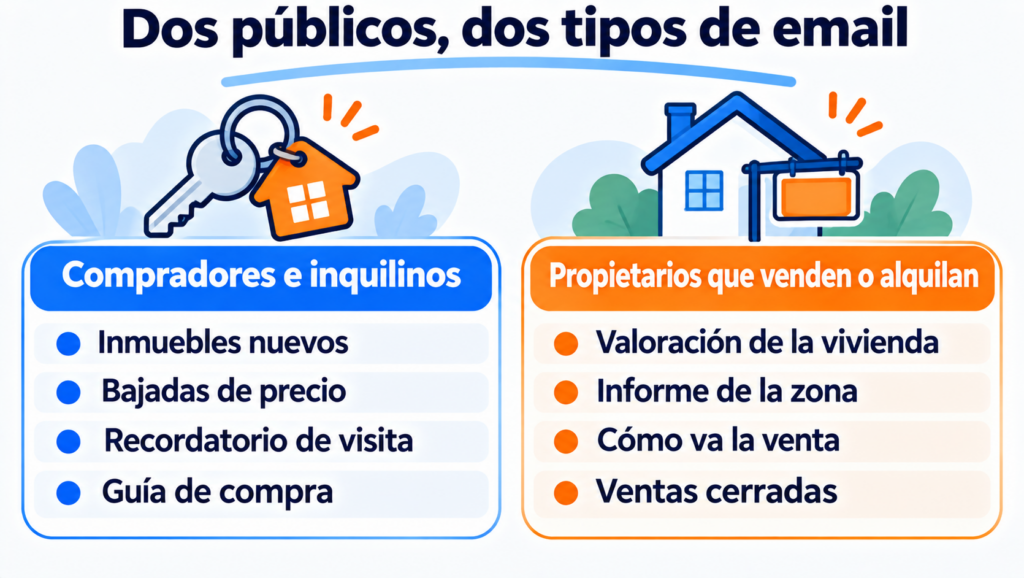
On top of that, you have two audiences with opposite interests. Buyers and tenants are looking for a property; owners are looking for someone to sell or rent out theirs. Each needs different messages.
And what each contact is interested in depends on very little data: area, budget, property type, number of bedrooms and whether they want to buy or rent. If you store it properly, every email you send will be relevant.
That is why, at a real estate agency, a well-segmented list works better than a one-size-fits-all newsletter.
What emails can a real estate agency send?
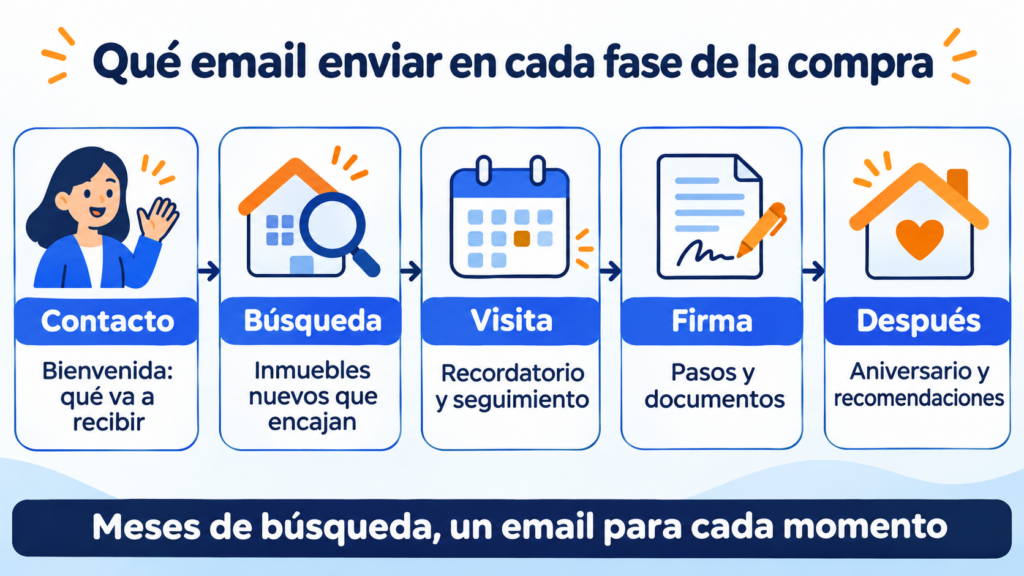
These are the most useful ones, in the order they are sent:
| To whom | When | Sample subject line | |
|---|---|---|---|
| Welcome | New contact | Right after sign-up | “Here’s what you’ll receive from us” |
| New properties | Buyers and tenants | When a matching property comes in | “3 new flats in your area, from €180,000” |
| Price drop | Anyone who showed interest in that property | When the price changes | “The flat on Calle Mayor is now €10,000 cheaper” |
| Viewing reminder | Anyone who has booked a viewing | The day before | “See you tomorrow at 6 pm” |
| Post-viewing follow-up | Anyone who has viewed a property | 1 or 2 days later | “What did you think of the flat? We have similar ones” |
| Property valuation | Owners | When they show interest in selling | “How much is your home worth today?” |
| Area report | Owners and buyers | Every month or every quarter | “How prices have moved in your neighbourhood” |
| Purchase steps | Anyone who has put down a reservation | Between the reservation and the signing | “What you need for the signing at the notary” |
| Anniversary and referrals | Clients | One year after the deal | “One year in your new home already” |
You don’t need to start with all of them. The welcome email, new properties and the post-viewing follow-up cover the basics.
You’ll find a general guide to each format in types of email marketing.
For the new properties email you can start from two free templates: New property listing, a more classic one, or Pixel art flat listing, if you want to grab attention. And for the viewing reminder you can use the appointment reminder template.
Buyers and owners: two different strategies
The most common mistake in a real estate agency’s email marketing is sending the same properties to every contact.
An owner who wants to sell isn’t interested in other people’s flats, and a tenant has no use for a house for sale.
With buyers and tenants, the goal is for them to think of your agency again every time something comes in that matches what they are looking for. Send few properties, but well chosen.
A good photo, the price, the square metres and a button to request a viewing are worth more than a long listing sheet.
With owners, the goal is for them to choose you to sell or rent out their property. It is a lead nurturing process that can last months.
What works here is content that shows you know the area: how prices are evolving, how long it takes to sell or what buyers are asking for.
And to those who have already entrusted their property to you, send a short report on how it is going: viewings, interest and next step.
Let each prospect know about the properties that match them
Store each contact’s area, budget and property type and send everyone only what they are looking for. Free up to 80,000 emails a month.
How do you segment a real estate agency’s list?
This is the data worth storing for each contact:
| Data | Examples | What it’s for |
|---|---|---|
| Contact type | Buyer, tenant, owner, client | Deciding which type of email they receive |
| Transaction | Buy or rent | Not mixing offers |
| Area | Neighbourhood, town or postcode | Sending only nearby properties |
| Budget | Up to €150,000, from €150,000 to €250,000… | Filtering the properties they can afford |
| Property type | Flat, house, commercial premises, garage | Fine-tuning alerts |
| Stage | Searching, has viewed, has reserved, has bought | Sending the right email at each moment |
Store them as custom fields and ask for them in your agency’s subscription form. Two or three questions are enough: area, budget and whether they want to buy or rent.
Consent: replying to an enquiry is not the same as sending advertising
Many contacts come from property portals or from the form on your website, and ask about a specific property.
Replying to that enquiry doesn’t require any special permission.
Adding that person to your newsletter or regularly sending them other properties is a different matter. For that you need their consent, under the GDPR and article 21 of Spain’s LSSI.
The exception is clients you have already had a contract with. You can offer them similar services, always with an easy way to unsubscribe.
The practical solution is to add an unticked checkbox to the form, such as “I want to receive new properties that match what I’m looking for”. If you want to play it safe, use double opt-in.
And don’t buy contact lists: they are a legal risk and damage your deliverability and your sender reputation.
A real example: RE/MAX
RE/MAX, the international real estate franchise network, uses Mailrelay in its offices in Spain, Portugal, Brazil, Mexico, Argentina, Colombia, Peru, Chile and other countries.
With so many offices sending at the same time, their sending reputation suffered and some messages ended up blocked.
With help from Mailrelay’s support team, they fixed their server configuration and improved the design of their newsletters. Today their offices deliver promotions to the inboxes of people who want to buy or sell.
Metrics to measure a real estate agency’s email marketing
Opens are useful for comparing subject lines, but in real estate email marketing what counts is what happens next. Keep an eye on these metrics:
- Clicks on each property (CTR). They tell you what really interests people and whom to call first.
- Viewing requests that come from the email.
- Valuations requested by owners.
- Unsubscribes. If they go up after a send, you probably sent properties that didn’t match.
A click on a specific property is a clear sign of interest. Use it to call that contact at the right moment.
Common mistakes
Some mistakes come up again and again at agencies getting started with email. The most common is sending every property to the whole list, when each contact is only interested in a few. Another is writing only when there is something to sell and disappearing for the rest of the year.
Many problems start with the form: if you don’t ask for the area or the budget, you won’t be able to segment later. And don’t forget clients who have already signed, because they are your best source of referrals.
Finally, take care of the format. A photo, the price and a button to request a viewing work better than a very long listing sheet with every detail of the property.
How Mailrelay helps you
With Mailrelay you can store each contact’s area, budget and property type in custom fields, or import them from your CRM. Then you create segments to send everyone only what they are looking for.
The editor has mobile-friendly templates to present properties with a good photo and a clear button.
Automations, included in the free account, send the welcome email, the post-viewing follow-up or the anniversary email without you having to remember.
If your agency’s website publishes new properties in an RSS feed, you can also send an automatic newsletter with them.
And with open and click statistics, available in the free account and in Enterprise, you know which contacts clicked on each property.
For viewing reminders, you can also send SMS from the same platform.
The free account lets you send up to 80,000 emails a month to 20,000 contacts, with no daily limit and with human support on every plan.
Your client portfolio, always up to date
Automate the welcome, the alerts and the follow-up for every buyer and owner from a single dashboard.
Frequently asked questions about email marketing for real estate agencies
These are the most common questions.
What is real estate email marketing?
It is the use of email to attract and keep in touch with buyers, tenants and owners. It includes alerts about new properties, viewing follow-ups, area reports and emails to clients after the purchase.
How often should a real estate agency send emails?
It depends on the type of email. Property alerts, whenever something comes in that matches what the contact is looking for. For a newsletter or an area report, once a month is usually enough.
Can I send properties to contacts who come from property portals?
You can reply to their enquiry about the property they asked about. To send them other properties on a regular basis you need their consent. Ask for it in your first reply or in the form on your website.
What should a new properties email include?
A few properties, from one to five, that match the contact’s area and budget. For each one, a photo, the price, the square metres, the bedrooms and a button to request a viewing.
Related articles
If you work with email in other sectors or want to fine-tune your database, carry on with these articles.