How can you apply Maslow’s hierarchy of needs in your company? And how can it help your business grow?
Psychology and business have always gone hand in hand, and this theory is a great example. By applying the right psychological techniques to each stage of the pyramid (you’ll see them below), the benefits for the company, its customers and its employees can be huge.
At Mailrelay, we walk you through it step by step.
Understanding your audience’s needs also improves your emails
Just as Maslow’s pyramid helps you understand what motivates your employees, knowing your customers’ needs is key to creating email marketing campaigns that connect. See how with Mailrelay.
Discover MailrelayWhat is Maslow’s pyramid and what is it used for?
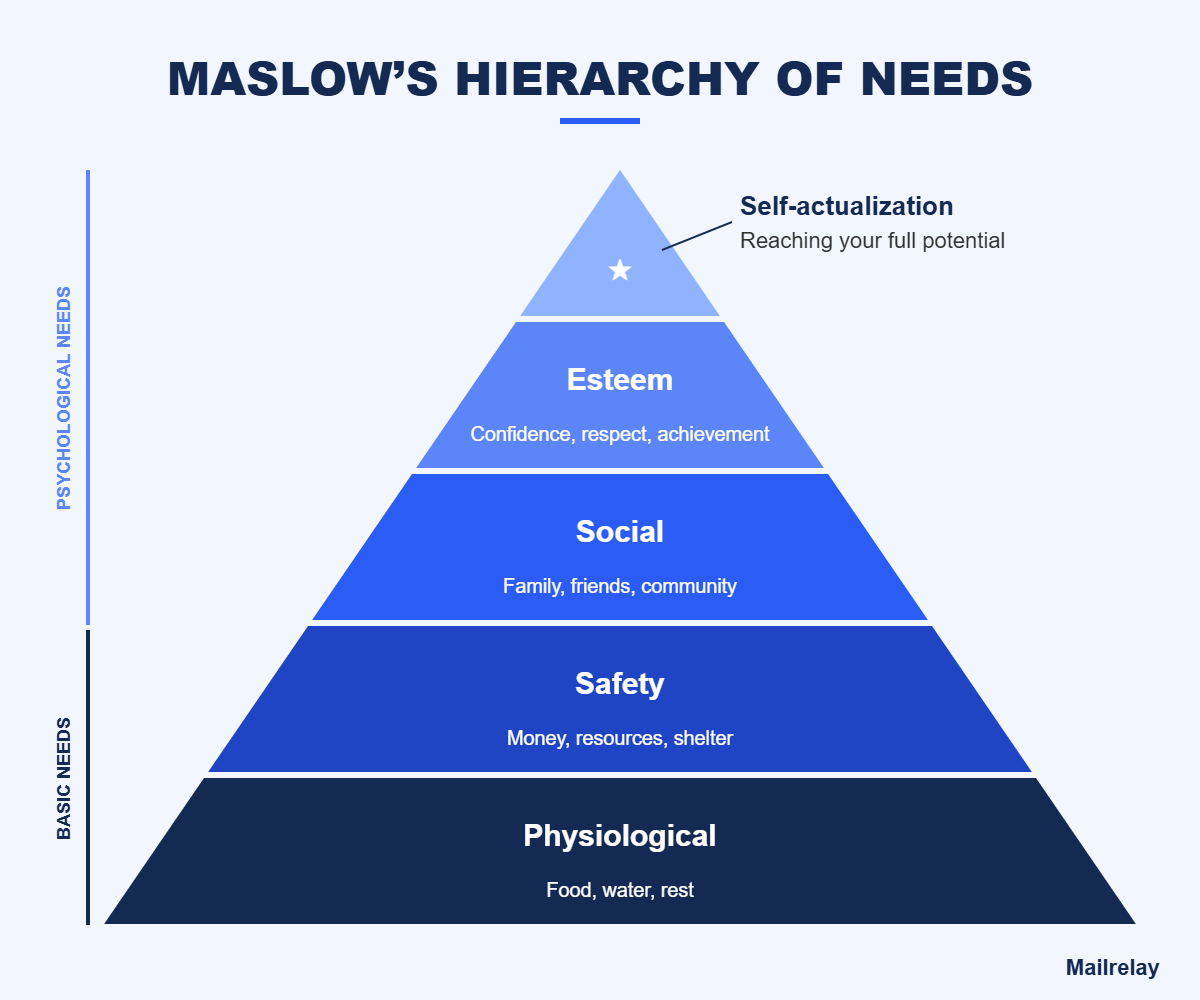
Maslow’s pyramid is a psychological theory that covers human needs from the most basic (such as physiological needs) to the most complex (such as self-actualization).
What is Maslow’s hierarchy of needs?
Maslow’s pyramid is a psychological theory proposed by the humanist psychologist Abraham Maslow (Brooklyn, April 1, 1908) in 1943.
Also known as the hierarchy of needs, the pyramid represents the vital needs that human beings seek to satisfy in order to survive and feel fulfilled.
To make the theory easier to understand, it is shown as a pyramid: as people satisfy their most basic needs and ambitions, new desires appear, and these sit higher up the pyramid.
Below, we’ll look at the levels of the pyramid and the types of needs found at each one.
If you already have a better idea of what Maslow’s pyramid is but still don’t see how it can help your business, keep reading.
Before we continue, you may also be interested in these related articles:
What is Maslow’s pyramid used for?
The purpose of Maslow’s pyramid is to describe and understand the different needs human beings have and what drives them to satisfy those needs.
Companies around the world have long used this theory in business to better understand the behavior of potential customers.
After all, people buy out of need, impulse, motivation or desire, so understanding the psychology behind their choices helps us target products and services more effectively.
But Maslow’s pyramid isn’t just about sales. It’s also useful for:
- Employee motivation: once a manager understands their employees’ needs, it’s easier to apply effective motivation techniques that boost performance and productivity.
- Improving products and services: knowing your customers’ needs, starting with the most basic ones, helps you understand how to reach your target audience effectively.
- Organizational culture: companies that value cooperation, social interaction and professional and personal recognition tend to attract valuable professionals and retain talented employees.
So, Maslow’s pyramid can help your company understand the human needs of your customers and your team, improve your business culture, offer better products and services and manage the workplace better.
In short:
It sets out a scale of human needs, from the most basic to the most complex, such as self-actualization and transcendence.
Types of needs in Maslow’s pyramid applied to the workplace
Now let’s look at the types of motivation in Maslow’s pyramid, with practical examples of companies that can benefit from each stage:
Physiological needs
These are the most basic needs, which is why they sit at the base of the pyramid.
They include everything that is essential for survival as an individual.
We’re talking about health, rest, breathing, food and so on.
Examples of companies that can use physiological motivation
- Supermarkets: companies that offer a wide variety of food, so you can cover all your food needs in one place.
- Home delivery services: they bring the food you need straight to your door, without you having to leave home.
- Restaurants: getting food that is already cooked and ready to eat also satisfies this basic human need.
Safety and security needs
Once the first level is satisfied, we move on to the second level of the pyramid.
Everyone needs to feel safe and protected.
This includes factors such as having a job, a home, family security and so on.
Anything that provides stability for a person falls into this level of the pyramid.
Examples of companies that can use safety motivation
- Security and surveillance companies: they offer CCTV, anti-theft systems, alarm monitoring and police alerts to protect people and their property.
- Insurance companies: life, health and home insurance give you peace of mind if something goes wrong.
- Information technology: cybersecurity and data protection are growing concerns, so these companies help other organizations feel safe from possible attacks.
- Security product manufacturers: locksmiths and companies that provide access control systems for businesses (the classic alarm) also belong to this level of the pyramid.
Social needs
Now we reach the third level of the pyramid: living alongside others, feeling accepted, taking part in activities, building relationships, loving and being loved.
These needs make up the emotional side of every person.
- Digital media: social networks and blogs let people interact with others and react to the posts and news shared on these platforms. They help satisfy the need to connect.
- Clubs: sports organizations help people stay in touch with others, share interests and build relationships.
- Event companies: businesses that organize conferences, concerts, festivals and so on create opportunities for people to socialize.
Recognition can be built by email too
A thank-you email, a birthday message or a personalized offer can meet your customers’ need for recognition. With Mailrelay, you can automate these messages and make every customer feel valued.
Get started with MailrelayEsteem needs
At the fourth level we find social recognition: success, gratitude, appreciation, reputation and the attention we receive from others all play an important role.
All these factors influence self-worth and self-esteem, so there are also companies that can work with the human needs of this stage.
Examples of companies that can use recognition
- Social media platforms: once again, networks such as LinkedIn, Instagram and TikTok play a key role. Users can show off their skills and strengths so others can see and recognize them.
- Award organizers: depending on the industry (film, music, sport, culture and so on), they hold awards throughout the year to reward effort and publicly recognize a job well done.
- Customer loyalty programs: this type of strategy rewards people for their loyalty with discounts, promotions or preferential treatment.
Self-actualization needs
This is the top of the pyramid. Here we find the desire to reach our full personal and professional potential.
Understanding the meaning of life, learning to manage our emotions, making sense of our problems…
These are the most complex human needs and, directly or indirectly, they affect all the other levels. That’s why they sit at the top of the pyramid.
Examples of companies that can use self-actualization
- Personal development professionals: through their services, they help others discover their life purpose, set realistic goals or boost their personal or professional growth.
- Wellness companies: professionals who help others live a more balanced and healthier lifestyle.
- Training services: they offer educational programs that help people gain deeper knowledge and develop new skills in their field.
- Entrepreneurship programs: they provide resources and support for entrepreneurs who want to turn their ideas into reality.
Benefits of Maslow’s pyramid for your company
Now that you’ve seen the different levels of Maslow’s pyramid, let’s look at the benefits of applying this psychological theory to your business.
- You increase your employees’ productivity.
- You reduce absenteeism.
- You improve the working environment.
- You increase satisfaction and motivation.
- You encourage professional and personal growth.
- You foster a collaborative environment.
- You retain talent within your company.
- You adapt to market trends.
- You stand out by understanding your customers’ needs and their buying experience.
- You build a relevant brand by applying Maslow’s needs to your business.
- You increase customer satisfaction by understanding their human needs.
How to apply Maslow’s pyramid in a company
Maslow’s theory can be applied at work. For an employee, the process starts when their basic needs (physiological and safety) are met. Salary is usually a major concern for anyone looking for a job.
To help you understand this, let’s see where the general stages of working life fit into the pyramid.
In most cases, an employee cares about the salary they’ll earn to make a living, their working hours and days off, and their working conditions.
This covers the physiological needs of the employee or future employee.
Once these needs are covered, it’s time to provide job stability: clear company policies that guarantee a stable environment, free from insecurity.
As you can guess, this is where the need for safety comes in.
With the first two levels covered, employees want a pleasant, collaborative environment where they get on well with their colleagues and teamwork happens naturally.
This is the stage of belonging we mentioned earlier.
Moving up to the higher levels of the pyramid, over time employees will want to challenge themselves and grow, especially if the lower levels are covered.
An employee who feels appreciated by colleagues and managers gains confidence, and this is where esteem comes into play.
Finally, at the top, self-actualization happens when employees want to grow personally and professionally.
With the previous stages covered, they’ll want to push themselves and reach bigger goals.
The company must be ready for employees who want to grow and challenge themselves, with all the benefits this brings to both the company and the employee.
Maslow’s pyramid: an example in a company
Now let’s look at a possible example so you can see how Maslow’s pyramid would apply to a company in practice.
Imagine that I, Alex Castro, run a content writing business and want to expand, so I’m looking for new professionals.
I need to cover the basic physiological needs of my future employees, such as a competitive salary, flexible hours and a healthy work-life balance.
With that, we’ve covered some key points of the first level.
Moving on to the safety stage, I need to offer a clear, transparent contract that matches the working conditions.
I also need to reassure them that their privacy will be respected at work, that they can share their ideas without fear, that there will be no discrimination of any kind and that their job will be stable.
I’ll support my employees’ social needs (the third level) by offering group training sessions by video call, encouraging us to attend in-person marketing events together and holding brainstorming sessions to improve team productivity.
At the esteem stage, I’ll celebrate my employees’ achievements and goals both publicly and privately.
Professionalism should be rewarded, not taken for granted as “just part of the job”, because I really want to retain quality employees.
Finally, to cover self-actualization, over time I’ll give them more challenging projects so they don’t get stuck in a routine and can see that their work is rewarded with bigger challenges that are also better paid. That way, we both grow.
Maslow’s pyramid: summary
As you can see, human beings have universal needs that apply to everyone.
Knowing each stage will help you create better company policies, strengthen your products or services and offer effective solutions.
Depending on your priority, you’ll approach the pyramid in one way or another.
We hope this article helps you start putting it into practice.
Are you going to build a Maslow pyramid for your company?
Bring Maslow’s pyramid into your email marketing strategy
You now know how to motivate your team and your customers. Take the next step: communicate those benefits with professional email marketing campaigns created with Mailrelay.
Visit Mailrelay