Sales pipeline: what it is, its stages and how to move your opportunities forward
From first contact to close: how to organize your opportunities and know how much you'll sell
A sales pipeline is a visual representation of your open sales opportunities, organized by the stage of the sales process each one is in.
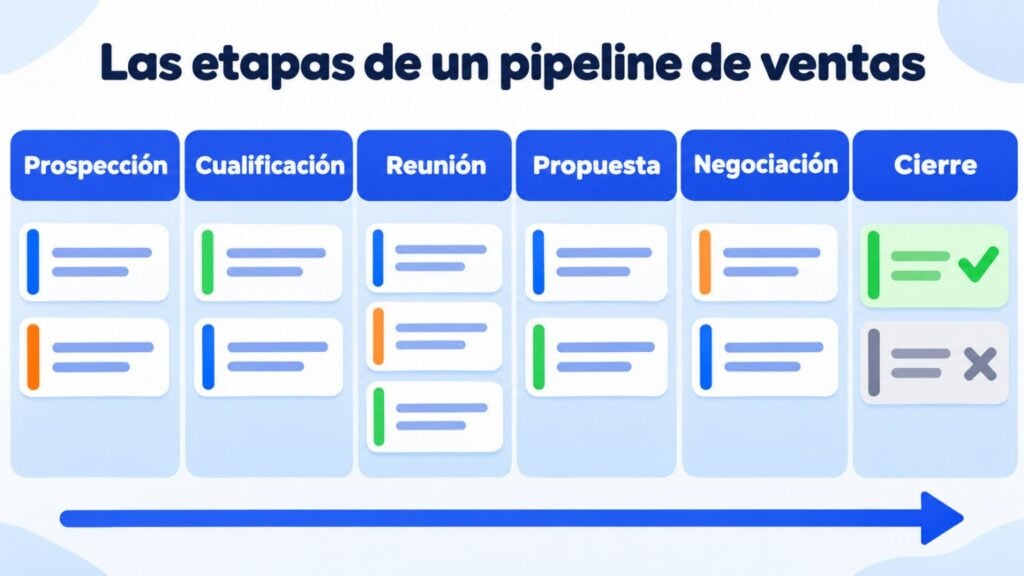
Picture a board with columns: “first contact”, “meeting”, “proposal sent”, “negotiation”. Each potential customer is a card that moves from column to column.
At a glance, you know how many deals are in progress, how much they’re worth and where they get stuck.
The word pipeline literally refers to a pipe, which is why it’s also used in IT and industry. Here we’re talking about the sales pipeline, the one that lives in your CRM.
What is a sales pipeline and what is it for?
It’s the sales team’s working tool. It doesn’t measure how many people visit your website, but which specific opportunities exist, who is handling each one and what the next step is.
It tells you what to do today: who to call, which proposal to follow up on, which contract to close. It also lets you forecast revenue for the coming months with more than just gut feeling.
And, above all, it helps you spot the stage where deals are lost and share out the work so that no opportunity gets forgotten.
In a small business, it can be a spreadsheet or a board with cards. Once you have more than a few dozen opportunities, it’s usually managed in a CRM, especially if you sell to businesses (B2B).
What are the stages of a sales pipeline?
Every company defines its own, but almost all follow a structure similar to this one:
| Stage | What happens | How email helps |
|---|---|---|
| Prospecting | A prospect is identified and first contact is made | A personalized first email or a well-segmented cold email |
| Qualification | You check whether they have the need, the budget and the authority to decide | Useful content to gauge their interest: guides, case studies, a newsletter |
| Meeting or demo | The solution is presented, tailored to their case | Meeting confirmation and reminder, with the agenda |
| Proposal | An offer with pricing and terms is sent | Sending the proposal and a follow-up email a few days later |
| Negotiation | Terms are adjusted and objections are addressed | Answers to questions, testimonials, comparisons |
| Close | The deal is won or lost | A welcome email if it’s won; if it’s lost, a follow-up later on |
What matters isn’t copying these stages, but making sure each one has a clear entry criterion.
For example: an opportunity moves to “proposal” when the customer has asked for a quote, not when the salesperson thinks they’re interested.
Make sure no opportunity goes without follow-up
Automate the emails for each stage with Mailrelay and connect it to your CRM.
Sales pipeline vs. sales funnel: what’s the difference?
They’re often used as synonyms, but they look at the process from different angles. The sales funnel counts how many people move from one phase to the next, from the moment they discover you until they buy.
The sales pipeline tracks each specific opportunity, with its value and its owner.
In other words: the funnel is marketing’s snapshot, with volumes and conversion rates; the pipeline is sales’ to-do list.
At the top of the funnel are the leads who haven’t spoken to anyone yet, the result of your lead generation. The pipeline begins when a lead becomes an opportunity.
Along the way, the lead usually goes from MQL (of interest to marketing) to SQL (ready for sales). That’s when it enters the pipeline.
How do you build a sales pipeline step by step?
If you’re starting from scratch, these steps give you a pipeline that works from the first week:
- Describe how you sell today. Go over your last ten sales and note the steps that repeat.
- Define between four and seven stages, with an entry criterion for each one.
- Choose where you’ll manage it. A spreadsheet is fine to start with; a CRM once the volume grows. If you don’t want to pay, check out these free CRM options.
- Load your open opportunities with their estimated value, their owner and the date of the next step.
- Review it every week with the team: what has moved forward, what has been stalled for a while and what should be dropped.
A pipeline full of dead opportunities is misleading. Marking a deal that isn’t going to happen as lost is also part of managing the pipeline well.
Which sales pipeline metrics should you measure?
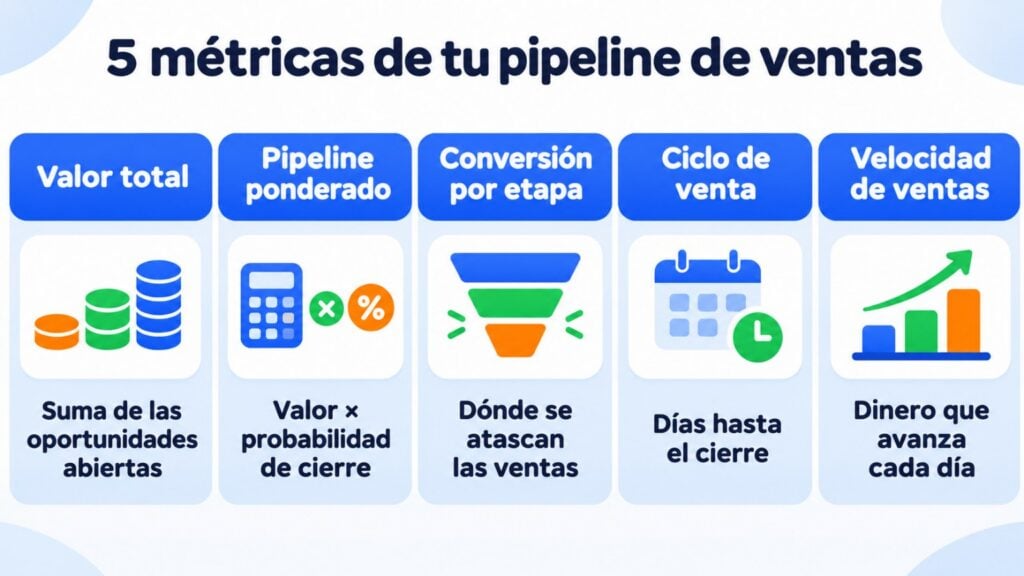
These five metrics give you a fairly complete picture:
Total value. The sum of the amounts of all open opportunities.
Weighted pipeline. The value of each opportunity multiplied by its probability of closing based on its stage. It’s a more realistic forecast than the gross value.
Conversion rate by stage. The percentage of opportunities that move from one stage to the next. It tells you where the process gets stuck.
Sales cycle length. The average number of days it takes an opportunity to close.
Sales velocity. It’s calculated by multiplying the number of opportunities by the average value and the close rate, and dividing the result by the cycle length. It shows how much money moves toward closing each day.
A simple example: an agency has 20 open opportunities with an average value of €3,000, closes 25% of them and takes 40 days on average.
Its velocity is 20 × 3,000 × 0.25 / 40 = €375 per day. If it manages to close 30%, that rises to €450 without needing any more opportunities.
These figures are your sales KPIs. Together with customer acquisition cost and customer lifetime value, they tell you whether the business is profitable.
Common mistakes when managing a pipeline
- Stages that everyone understands differently. If each salesperson decides when to move a card, the pipeline is no longer reliable.
- Opportunities with no next step. Every card should have a date and an action; otherwise, it gets forgotten.
- Not recording why deals are lost. It’s the most useful information for improving.
- Doing all the follow-up by hand. Reminders and repetitive emails can be automated.
Sales pipeline and email marketing
Email is the thread that keeps opportunities alive between one call and the next. Many deals aren’t lost because of a “no”, but because nobody wrote back.
In the early stages, lead nurturing feeds useful content to contacts who aren’t ready yet. Lead scoring helps you see which ones are warming up.
In the final stages, email is used to send the proposal, answer questions and remind people of deadlines.
And when an opportunity is lost, it doesn’t have to be forever. A reactivation campaign a few months later can reopen the conversation.
If you win the deal, a good onboarding series gets the relationship off to a good start.
How Mailrelay helps you
Mailrelay isn’t a CRM. What it does is connect to yours so that email works at every stage:
- Groups and automations. When a contact joins a group (for example, “proposal sent”), an automatic follow-up sequence can start.
- Segmentation and subscriber reputation. You can separate contacts who open and click from those who don’t, and tailor the message.
- API, webhooks and Make, to connect Mailrelay to your CRM and move contacts between groups as their stage changes. You’ll find an example in how to integrate CRM and email marketing.
And you can start with the free account, with up to 80,000 emails per month and 20,000 contacts.
Put email to work in your sales process
Groups, automations and API, free for up to 80,000 emails per month.
Frequently asked questions
Two questions that often come up when setting up your first pipeline.
How many stages should a sales pipeline have?
Between four and seven is usually enough. With fewer, you lump very different situations together; with more, the team wastes time deciding where each opportunity goes.
What’s the difference between a pipeline and a forecast?
The pipeline shows the open opportunities and which stage they’re in.
The forecast is the sales projection calculated from it, usually using the value weighted by the probability of closing.