
Advertising is part of our daily lives. Traditional marketing and the widespread use of social media mean we come across ads in almost every medium.
“In such a competitive advertising environment, you need to know your audience very well and apply a strong dose of creativity to stand out from the rest.”
You also need to know the online marketing tools you’ll use to reach that audience.
Among all the online resources we can use to reach it, one option is to launch original ads. The kind you don’t see every day.
However, you’ll agree that inspiration for this kind of ad doesn’t strike every day. So why don’t we define the concept and look at some creative examples?
I’m sure they’ll give you ideas for your email marketing campaigns, because bulk email is, in the end, a form of advertising too.
We explain it all at Mailrelay. Let’s go!
· What is an ad? Definition
Before we start analyzing examples of creative ads, let’s begin at the beginning and look at the theory first, shall we?
Email, your most profitable advertising channel
Compared with other ads, email marketing offers one of the best returns on investment. See for yourself with Mailrelay.
Discover Mailrelay► What is an advertisement?
“An advertisement is a piece of communication created with the clear goal of promoting a product, a service or an event.”
In other words, it’s a message launched with the clear aim of advertising, not just informing about a topic. And being “advertising” doesn’t necessarily mean it has to be “commercial”.
An ad is commercial if it tries to sell something or complete a financial transaction. However, it isn’t commercial if what’s being advertised is, for example, a public service.
An ad can be launched in almost any format:
- TV commercials.
- Print ads.
- Outdoor advertising.
- Radio spots.
- Movie trailers.
- And many more.
► What makes the best ads?
Ads can be made up of many different elements, depending on the channel used to share them: a slogan, a graphic element, an audio file…
Whatever the case, certain characteristics make an ad much better and help it reach users more easily:
● Credibility:
An ad must always be credible if it wants to influence its audience. Even with the exaggeration typical of advertising, it should convey a realistic message that people can believe.
● Originality:
As I mentioned at the beginning, if you want to create the best ad, remember that it should include something different that sticks in people’s minds (we’ll see how later).
● Simplicity:
Some commercials play with the abstract to spark reflection through confusion, but I prefer to keep things simple. Give information clearly and concisely, and your ad will be off to a great start.
● Truthfulness:
Even if it creates a parallel reality or a fictional universe, a good ad generates empathy through real stories backed by truthful information.

► What are the functions of advertising?
Clearly, if you don’t invest in powerful marketing campaigns but your competitors do, your brand is more likely to be forgotten.
But there are more good reasons to launch your own ads, because they have several functions:
● Informative:
This is the most basic function of advertising: it tells users about something they may not know exists.
● Persuasive:
This is the function we all look for in advertising: attracting users and convincing them of the benefits of our product.
● Economic:
As a result, ads are one of the key elements for increasing sales by attracting potential customers.

· The 15 best ads in history
Defining what an ad is and what its functions can bring to your marketing strategy is useful, but the best way to get inspired is to look at other original ads that have already worked.
Careful! I don’t mean basing your campaign on copying other people’s creative work, which could damage your brand’s reputation, but generating new ideas from other examples.
Below, I’ve put together a list of all kinds of ads that are sure to help you. Shall we take a look?
► Examples of advertisements
As I said, I’ve selected some examples of ads that I personally like and that worked very well at the time, helping the companies behind them achieve their goals.
On the Mailrelay team’s recommendation, I’ve grouped them as follows:
- Funny ads (which can give you ideas for funny emails).
- Creative ads with slogans.
- Food ads.
- Other famous ads.
► Funny ads
Among the emotional marketing techniques we can apply to an ad, several approaches work very well: nostalgia, love, empathy and so on.
Humor is one of the secret ingredients in many of today’s most successful ads.
The ones I’ve called “funny” here are precisely those that use humor as a communication tool to reach users.
“Appealing to feelings and emotions is one of the best ways to connect with your audience and make them part of a certain mood.”
The first funny ad I’ve chosen as a source of inspiration is this one from Nescafé:
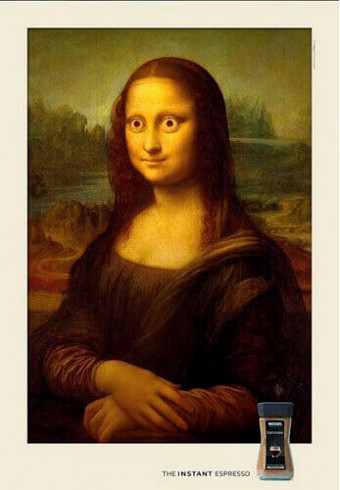
It uses classical art and humor to convey the strength of its espresso. Creativity and humor in a single image!
The next ad in this category belongs to a marketing campaign for a design magazine, launched when it stopped publishing its print edition in favor of a new digital version.

In this image, Design Elementales shows us the other side of the mobile screen, and with a lot of humor we see the reaction to its new magazine.
The last funny ad is from a gym that specializes in CrossFit.

Just one image and a short line turn it into a funny, original piece, don’t you think?
► Creative ads with slogans
The slogan is an important part of an ad because it represents the brand and, when used well, it’s catchy and easy to remember.
“A slogan is simply the set of words that will put the brand on consumers’ shortlist.”
However, not every company includes a slogan in its campaigns. And some use one but don’t manage to make it catchy.
On the other hand, some brands have made their slogan part of everyday language. In fact, some of these phrases are still used long after the campaigns have ended.
In Spain, for example, the Scattergories TV commercial from the 1990s is still remembered decades later for its line “we accept boat (or octopus) as a sea animal”.
BMW made many people use expressions like “be water, my friend” (borrowed from Bruce Lee) thanks to its mid-2000s Spanish campaign for the X3.

The art of creating good slogans goes back a long way, practically to when products first began to be advertised, long before today’s modern media.
Among those created in the TV era, one of the longest-lived in Spain is “Busque, compare y si encuentra algo mejor, cómprelo” (“Look around, compare and, if you find something better, buy it”), from a 1980s detergent commercial.
► Food ads
Food ads can be very varied, from an objective view of what’s on offer to emotional appeals, sometimes even with a jab at the competition.
There’s no script in this sector: each brand chooses to share its message in the way that best suits its goals and target audience.
The first one is a very creative ad that represents the concept perfectly in a simple image. It offers onion-flavored bagels, so it merges both elements in a very visual way.

From originality to lifestyle. This organic food brand uses its ads to share a way of understanding food and how important it is for the human body.

We end this section with humor, thanks to this light mayonnaise ad. It’s so light that it can’t tip the scale.

► Other famous ads
A strong dose of creativity clearly helps a campaign stick in our memory and become part of history. But that’s hard to control in advance.
Users’ tastes sometimes surprise us: lower-quality ads end up being a hit, while others that were carefully crafted are quickly forgotten.
If anything helps an ad become famous, it’s having something catchy and easy to remember: the slogan (as we’ve seen), the jingle or a conversation between the characters.
Let’s start with a Spanish campaign that has become a modern classic. Minute Maid’s “Limón & Nada” surprised everyone with its catchy “un palo” line, repeated by many people.
BMW’s ads often fit into two of the categories in this post: creative because of their slogans, and popular.
In any case, its ads have always been surprising and have known how to connect with users. With the Spanish campaign “¿Te gusta conducir?” (“Do you like driving?”), BMW marked a turning point in car advertising.
I haven’t mentioned MTV yet, another brand that always takes risks with its campaigns and surprises with almost everything it does.
With its Spanish campaign “Amo a Laura” (“I love Laura”), it created huge buzz and broke the mold of traditional advertising.
Measure the effectiveness of your campaigns
With Mailrelay, you can track the CTR, opens and conversions of every email marketing campaign.
Get started with Mailrelay► A creative outdoor advertising example
I wanted to end this section with outdoor advertising, because it often goes unnoticed, but when originality is the star, it grabs everyone’s attention.
In fact, outdoor ads don’t always reach people, because we’re so used to being surrounded by them that we often don’t even notice them.
But when outdoor ads are good, nobody stays indifferent. These three surprising pieces are a great example:
Siemens and its blender made from a building’s revolving doors.

Smart and its car so small it almost fits in a bus shelter poster.

Absolut and its customized bus stop.

Looking quickly at this selection of creative ads, we can say that many of them marked a turning point in the history of communication and advertising.
In other words, creativity is clearly key to standing out from the competition (especially today).

· Types of advertisements
Ads can take many formats and use many media, each with its own features and advantages. Here are some common types:
► Print ads:
These ads appear in print media such as newspapers, magazines, brochures and billboards. Print ads can be effective for reaching a local, specific audience.
Print advertising can also have a longer shelf life, since readers can keep and revisit printed publications over time.
► TV ads:
TV commercials are a popular and effective form of advertising, since they combine visual and audio elements to tell a story or present a product.
TV can reach a mass audience, but it can also be expensive in terms of production and airtime.
► Radio ads:
Radio ads are a traditional form of advertising that uses audio messages to promote products or services.
Radio can be an efficient, affordable medium, especially for reaching local and specific audiences.
► Digital advertising:
Digital ads appear on online platforms such as websites, social media, mobile apps and search engines.
Digital advertising offers a wide range of formats, such as display ads, video ads, search ads and native ads.
It also allows precise targeting and measurement, making it easier to track ad performance and optimize campaigns.
► Outdoor advertising:
This type of advertising includes billboards, transit ads, street furniture posters and other formats placed in public spaces.
Outdoor advertising is effective for building brand awareness and reaching a broad audience on the move.
► Point-of-sale (POS) advertising:
Point-of-sale advertising takes place where the purchase happens, such as retail stores, supermarkets and shopping malls.
These ads can include product displays, special promotions and free samples to boost sales of specific products.
These are just some of the types of ads companies can use in their marketing campaigns. The choice of format and medium will largely depend on the campaign goal, the budget and the target audience.

· Advertising strategies
Companies use a range of strategies to promote their products or services and reach their target audience. Here’s an overview of some of them:
► Emotional marketing:
Emotional marketing is based on the idea that purchase decisions are largely driven by emotions.
This strategy involves creating ads that trigger specific emotions in the audience, such as happiness, nostalgia, surprise or sadness, to build an emotional connection with the brand and increase the likelihood of purchase.
► Guerrilla marketing:
Guerrilla marketing is an unconventional advertising strategy that aims to surprise and grab the public’s attention with creative, unexpected tactics, often on a small budget.
It can include interventions in public spaces, stealth marketing and flash mobs, among other actions.
► Influencer marketing:
This strategy is based on partnering with influential people on social media and other digital channels who have a large following and a relationship of trust with their audience.
Influencers can promote the brand’s products or services through posts, videos or live events, which can increase the brand’s visibility and credibility.
► Content marketing:
Content marketing involves creating and distributing relevant, valuable and consistent content to attract and retain a clearly defined audience and, ultimately, drive profitable customer action.
This content can take many forms, such as blog posts, videos, podcasts, infographics and social media posts.
► Native advertising:
Native advertising is a type of online advertising that blends seamlessly and unobtrusively into the content and design of the platform where it appears.
It often resembles editorial content and can include sponsored articles, social media posts and in-app ads.
► Segmentation and personalization:
Segmentation and personalization involve identifying and analyzing different audience segments to deliver ad messages and offers tailored to their needs, interests and behavior.
This can improve the relevance and impact of ads, increasing the likelihood of conversion.
These are just some of the advertising strategies companies can use to reach their target audience and promote their products or services.
The right strategy will depend on factors such as the campaign goals, the budget, the market and the specific characteristics of the target audience.

· How effective is advertising?
Measuring the success and effectiveness of an ad is essential to optimize campaigns and get the best possible performance.
Here are some key metrics and concepts related to advertising effectiveness:
► Return on ad spend (ROAS):
ROAS measures the revenue generated for every unit of currency spent on advertising.
It’s calculated by dividing the revenue obtained by the total cost of the ad campaign. A higher ROAS means a more profitable advertising investment.
► Cost per acquisition (CPA):
CPA is a metric that represents the average cost of acquiring a new customer through an ad campaign.
It’s calculated by dividing the total cost of the campaign by the total number of conversions (sales, sign-ups, etc.).
A lower CPA suggests greater efficiency in acquiring new customers.
► Cost per thousand impressions (CPM):
CPM is a metric that measures the cost of showing an ad a thousand times.
It’s calculated by dividing the total cost of the campaign by the total number of impressions (ad views) and multiplying the result by a thousand.
A lower CPM means it costs less to reach the same number of people.
► Click-through rate (CTR):
CTR measures the proportion of people who click on an ad compared with the total number of impressions.
It’s calculated by dividing the total number of clicks by the total number of impressions and multiplying the result by 100 to get a percentage.
A higher CTR suggests the ad is more attractive and relevant to the audience.
► Conversion rate:
The conversion rate is the proportion of people who take a desired action (such as a purchase or a sign-up) after clicking on an ad.
It’s calculated by dividing the total number of conversions by the total number of clicks and multiplying the result by 100 to get a percentage.
A higher conversion rate means the ad is effective at driving specific actions.
► Reach and frequency:
Reach is the total number of unique people who have seen an ad, while frequency is the average number of times each person has seen it.
These metrics help you understand how far an ad has penetrated the target audience and whether it’s being shown too often to the same people.
Compare the effectiveness of a company’s ads with those of its competitors and assess its market share.
· Advertising trends
► Personalization:
Personalization is the process of tailoring ad messages and offers to consumers’ needs, interests and behavior.
With the help of technology and data collection, brands can offer more relevant and meaningful experiences, improving the effectiveness of their campaigns and increasing customer loyalty.
► Native advertising:
As mentioned above, native advertising is a type of online advertising that blends seamlessly and unobtrusively into the content and design of the platform where it appears.
This trend keeps growing, because consumers tend to respond better to ads that blend in with the content they’re consuming than to ads that interrupt their experience.
► Artificial intelligence (AI):
Artificial intelligence is transforming the advertising industry on many levels.
AI is used to analyze large amounts of data and extract valuable insights into consumer behavior, improve audience targeting, optimize ad creative and automate the buying and management of ad space.
► Virtual reality (VR) and augmented reality (AR):
These emerging technologies are changing the way brands communicate with their audiences by offering immersive experiences.
VR and AR can be used in advertising for product demos, interactive brand experiences and virtual tours, among other applications.
► Video marketing:
Video remains a key trend in advertising, since it’s a format that attracts users and generates high engagement.
Brands are investing more and more in video content for platforms such as YouTube, Facebook, Instagram and TikTok, taking advantage of their popularity to reach their audiences.
For example, including video in your email marketing strategy can give you a competitive edge when it comes to convincing customers to convert.
► Programmatic advertising:
Programmatic advertising uses algorithms and automated technology to buy and sell ad space in real time.
This trend lets brands optimize their ad campaigns, improve targeting and reduce costs.
► Voice marketing and virtual assistants:
With the growth of voice devices and assistants such as Amazon Alexa and Google Assistant, brands are looking for ways to use this technology to reach their audiences through audio advertising and apps built for these devices.
These are just some of the current and future trends in advertising. The industry keeps evolving fast, and brands need to stay on top of the latest innovations and changes to remain relevant and competitive.
What other ads have surprised you with their creativity and would you share with us?
At Mailrelay, we can help with our email marketing services. Sign up for a free account and send up to 80,000 emails to 20,000 contacts!
Many of these ads work so well because they’re built on a solid branded content strategy.
Launch your next campaign with Mailrelay
Design ads that also work inside your email marketing campaigns.
Try Mailrelay for free