Marketing quotes in movies: 12 scenes that teach you how to sell (and how to apply them to your emails)
From Mad Men to The Devil Wears Prada: what movies teach us about selling and how to bring it to your next campaign
From Mad Men to The Devil Wears Prada: what movies teach us about selling and how to bring it to your next campaign
How many times have you watched a movie and thought “this is pure marketing”? For decades, cinema has been telling stories about salespeople, advertisers and entrepreneurs.
Some of those marketing quotes are cited in sales meetings today as if they were textbooks. Others are remembered for exactly the opposite reason: for showing what not to do.
Here are 12 marketing quotes from movies and TV series, with what they teach and how to apply them to your email marketing campaigns. Every quote is given as it was said in the original English version.
We start with three marketing and sales movies starring salespeople. Their sales quotes are the most cited in sales training, sometimes as a good example and sometimes as a warning.
Jordan Belfort (Leonardo DiCaprio) slides a pen across the table and asks his friends to sell it to him. They all talk about the pen. Except one: he asks Belfort to write his name on a napkin.
Belfort has nothing to write with, and his friend finishes: “Supply and demand.” The scene is so well known that “sell me this pen” is now used as a test in sales job interviews.
What Belfort shows is that people buy the solution to something they need at that moment; the pen hardly matters.
It’s the same idea that separates needs and wants.
That said, the movie also teaches what not to do.
Creating false urgency is manipulation, and in an email it shows: the reader gets defensive. The difference is explained in Cialdini’s principles of persuasion.
In your email: before describing your product, describe the situation in which your reader misses it. “Has this ever happened to you…?” works better than a list of features.
In Spain it was released as Éxito a cualquier precio. Alec Baldwin plays Blake, an executive who shows up at a real estate sales office to humiliate the salesmen. His motto: “A-B-C. Always be closing.”
It’s one of the most quoted sales scenes, and also one of the most debated. “Always be closing” has aged badly as a pressure tactic, but it leaves a useful idea: every contact needs a next step.
In your email: give every send a single goal and a clear call to action.
You don’t need to close a sale in every email. It’s enough for the reader to know what to do next and move forward in your sales funnel.
The movie’s most famous line is “Show me the money!”. But the most interesting one for marketing comes at the beginning.
Jerry, a sports agent, writes a mission statement in the middle of the night: fewer clients and less money, so he can give them more attention. He titles it The Things We Think and Do Not Say. He gets fired for it.
The scene makes it clear that the personal relationship is an asset, and that it stops being one the moment you treat every client the same.
It’s the foundation of customer loyalty.
In your email: personalization is how you give attention to many people without losing the personal touch. Segment your list and write to each group about what matters to them.
Write emails people remember
Create your first campaign with Mailrelay: up to 80,000 emails a month for free and human support on every plan.
The next three marketing quotes are about why we buy what we buy. And the first one is probably the best marketing lesson cinema has ever given.
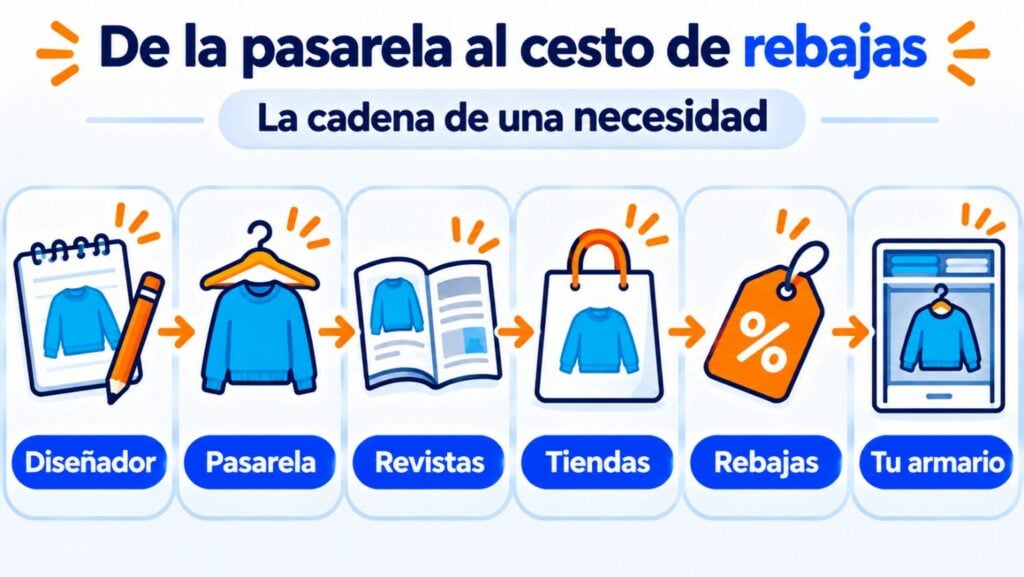
Andy (Anne Hathaway) laughs at two belts that look identical to her. Miranda Priestly (Meryl Streep) answers with a monologue about Andy’s own blue sweater.
It’s not blue, it’s cerulean. And that color, Miranda explains, trickled down from the great designers’ collections to the bargain bin Andy picked it out of.
Miranda says it cruelly, but she’s right: many decisions we think are personal come from a marketing chain we don’t see.
The detail is fictional (the script made up those collections), but the mechanism is real. We cover it in does marketing create needs?.
In The Devil Wears Prada we see, in the blue sweater monologue, how need creation works even in ways most people don’t notice. Something as trivial as a color, if it can be called trivial, generates a chain of new needs that become so blurred they’re no longer even perceived as needs. But at the start of the chain there were consumers who believed they needed a cerulean product. It’s striking when you think about it.
Jose Argudo, CMO at Mailrelay
In your email: think about where your brand sits in that chain.
Do you create the trend, interpret it or bring it to the end customer? Your newsletter can tell that story, as Miranda does, and give your product a context the reader didn’t know about.
The movie tells how Nike signed Michael Jordan in 1984. The line that keeps coming back is this one: “A shoe is just a shoe until somebody steps into it.”
A product gains value when a person gives it meaning. Without Jordan, the shoe would be just a shoe.
Nike wasn’t selling a shoe, it was selling the idea of playing like Jordan. In the movie, his mother corrects the line: the shoe is just a shoe until her son steps into it.
In your email: show people using what you sell.
A customer story or a real photo says more than the best product page. And tell your value proposition from the point of view of the person who enjoys it.
Nick Naylor (Aaron Eckhart) is a spokesman for the tobacco industry. To show his son how he works, they argue over whether chocolate or vanilla ice cream is better.
Nick doesn’t defend vanilla: he shifts the topic to freedom of choice. And he concludes: “If you argue correctly, you’re never wrong.”
Nick Naylor wins the argument because he picks the ground: whoever controls the frame of the conversation controls the conclusion.
The movie is a satire, and Nick is an example of what not to do. But the technique exists, and consumer psychology explains it.
In your email: the frame is the email subject line.
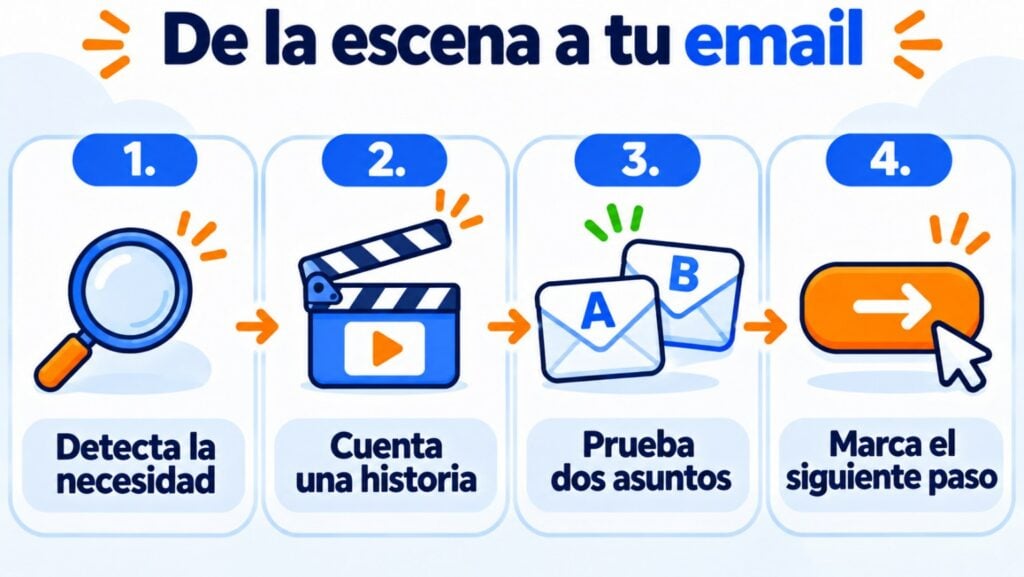
The same discount sounds different as “save €20” or as “your first month is on us”. Try both with an A/B test and let your data decide.
Mad Men (2007-2015) follows Don Draper (Jon Hamm), creative director at a New York agency in the sixties. It’s a series, not a movie, but no list of advertising quotes is complete without it.
In the first episode, Lucky Strike can no longer say its cigarettes are healthy. Draper finds the way out in the manufacturing process: the brand’s tobacco is toasted.
Everyone does it, but no one says so. His slogan: “It’s toasted.”
Don Draper turns it into a slogan: you can stand out by telling something your competitors also do, but don’t talk about.
It’s a cheap way to create a competitive advantage. Interestingly, the series takes some creative license: Lucky Strike had been using that slogan since 1917.
In your email: review your process and look for what you take for granted. How you prepare an order or how you choose a supplier could be your next slogan or the topic of your next newsletter.
In the last episode of the first season, Kodak presents a slide projector with a circular tray. They expect a campaign about technology.
Draper turns off the lights, projects photos of his family and presents it as a time machine. He names it “Carousel”.
Nostalgia is one of the emotions that sells best, and Draper uses it to turn a projector into a memory machine.
Draper doesn’t talk about the wheel: he talks about the memories it holds. It’s storytelling at its purest.
In your email: emotional marketing isn’t just for big brands. A customer anniversary email or a year-in-review with their own data has the same effect on a small scale.
Sean Parker (Justin Timberlake) meets Mark Zuckerberg and, as they say goodbye, gives him some advice on the name: drop the article from “TheFacebook”. “Just Facebook. It’s cleaner.”
Parker’s advice works for any brand: a short, easy-to-remember name works for you.
The scene is the movie version of a real change: the company went from TheFacebook.com to Facebook.com in 2005. It’s basic branding.
In your email: apply it to your sender name and your subject line.
A recognizable name and a subject line without filler words get read first in a crowded inbox. If you’re torn between two versions, go with the shorter one.
The last three sales quotes are about what lies behind the sale: how it’s made, how the customer is attracted and how they’re made an offer.
Ray Kroc (Michael Keaton) discovers the McDonald brothers’ burger stand in 1954. What fascinates him isn’t the burger, it’s the system.
In the best scene, the brothers draw the kitchen in chalk on a tennis court. They rehearse every move with their employees until they can serve in seconds.
What turns that stand into a benchmark is that the customer experience is designed step by step, leaving nothing to improvisation.
Kroc didn’t invent the system; he saw that it could be repeated in any city.
In your email: your “tennis court” is your automations. Design your welcome email and a short lead nurturing sequence once, test them and let them run on their own with every new subscriber.
Ray Kinsella (Kevin Costner) hears a voice in his cornfield: “If you build it, he will come.” He builds a baseball field in the middle of nowhere.
Almost everyone quotes the line in the plural, “they will come”, but the original refers to a single person.
It’s a lovely line, but in marketing building isn’t enough: someone has to know you exist.
Ray’s field is magical; your website isn’t. Without a way to bring in and retain visitors, nobody shows up.
In your email: your subscriber list is how you get them to come back. A form on every page and a newsletter with useful content turn a visit into a relationship.
Don Vito Corleone (Marlon Brando) promises his godson that he’ll persuade a movie producer with an offer he can’t refuse. We know how he pulls it off, and it isn’t with discounts.
Outside the mafia context, the idea holds: an irresistible offer is one that delivers so much value that saying no seems like a mistake.
The line has become a sales expression, but the scene is a reminder of the line you don’t cross: pressuring isn’t persuading. We explain it in persuasion or manipulation.
In your email: a good offer can be explained in one sentence. If you need three paragraphs to justify it, review the offer before the copy.
If you want to go over the scenes before your next sales meeting, here’s the summary.
| Movie or series | Year | Quote | Lesson for your email |
|---|---|---|---|
| The Wolf of Wall Street | 2013 | “Sell me this pen” | Describe the need before the product |
| Glengarry Glen Ross | 1992 | “Always be closing” | One goal and one next step per email |
| Jerry Maguire | 1996 | “Fewer clients, less money” | Personalize to give attention to many |
| The Devil Wears Prada | 2006 | The cerulean sweater | Tell the chain behind your product |
| Air | 2023 | “A shoe is just a shoe…” | Show people using what you sell |
| Thank You for Smoking | 2005 | “If you argue correctly…” | Test different frames in the subject line |
| Mad Men | 2007 | “It’s toasted” | Tell what your competitors don’t |
| Mad Men | 2007 | The Kodak Carousel | Use emotion and memories |
| The Social Network | 2010 | “Just ‘Facebook'” | Short names and subject lines |
| The Founder | 2016 | The tennis court | Design your automations |
| Field of Dreams | 1989 | “If you build it, he will come” | Building isn’t enough: grow a list |
| The Godfather | 1972 | “An offer he can’t refuse” | An offer explained in one sentence |
All these marketing quotes have something in common: a well-told story, at the right moment, to the right person. That’s what a good email does.
With Mailrelay you segment your list so each group gets its own story. You test two subject lines with an A/B test. And you automate your welcome, like the McDonald brothers’ system.
The free account includes up to 80,000 emails a month and 20,000 contacts, with human support on every plan. Check the options on the pricing page.
Your next scene, in the inbox
Test subject lines with an A/B test and measure which story works best with your list.
Movies exaggerate, simplify and sometimes glorify salespeople who shouldn’t be role models. But their best marketing quotes get the basics right: understand what the person in front of you needs and tell it to them well.
Pick one of these 12 marketing quotes and apply its lesson in your next send. If you want more ideas, here are 20 email marketing examples to copy and adapt, and some famous Philip Kotler quotes for your next presentation.
These are the most common questions about the sales and marketing quotes cinema has left us.
It’s a sales test popularized by The Wolf of Wall Street: the candidate has to sell an everyday object. What’s being evaluated isn’t the pen, but whether the salesperson first asks what the customer needs.
The most cited are The Wolf of Wall Street, Glengarry Glen Ross, Jerry Maguire, The Founder and Air, plus the series Mad Men for advertising. Each one teaches something different: closing, the customer relationship, the system or the brand.
In marketing, “It’s toasted”, the slogan Don Draper pitches to Lucky Strike in the first episode. It shows how to stand out by telling a detail of the process that competitors don’t explain.
A brief reference to a well-known movie can grab attention in a subject line or an introduction, as long as your audience recognizes it. Avoid using stills, posters or protected characters without permission, and don’t copy long stretches of dialogue.
Murphy’s law in email marketing
20 laws that come true in your campaigns, so you can laugh at the mistakes.
Philip Kotler, the father of marketing
His most quoted ideas and sayings, explained.
Product placement
How brands appear in movies and series, and when it works.
Copywriting
What it is and how to write to persuade and sell.

Jose Argudo
CMO at Mailrelay. Writes about email marketing, copywriting and conversion for small businesses and entrepreneurs.