Subliminal advertising: what it is, real examples and why it’s banned
Why advertising’s most famous technique almost never works and what to use instead

Why advertising’s most famous technique almost never works and what to use instead
Have you ever heard the story about the popcorn at the movies? A researcher flashed the messages “Eat popcorn” and “Drink Coca-Cola” during a film, so fast that nobody could see them. And sales shot up.
It’s the most famous anecdote about subliminal advertising. It’s also false: the experiment never happened, and its author ended up admitting it.
In this article we explain what subliminal advertising is, what types there are and four real examples with their sources.
You’ll also see what studies say about whether it works, why it’s banned in Spain and which persuasion techniques you can use instead, in plain sight.
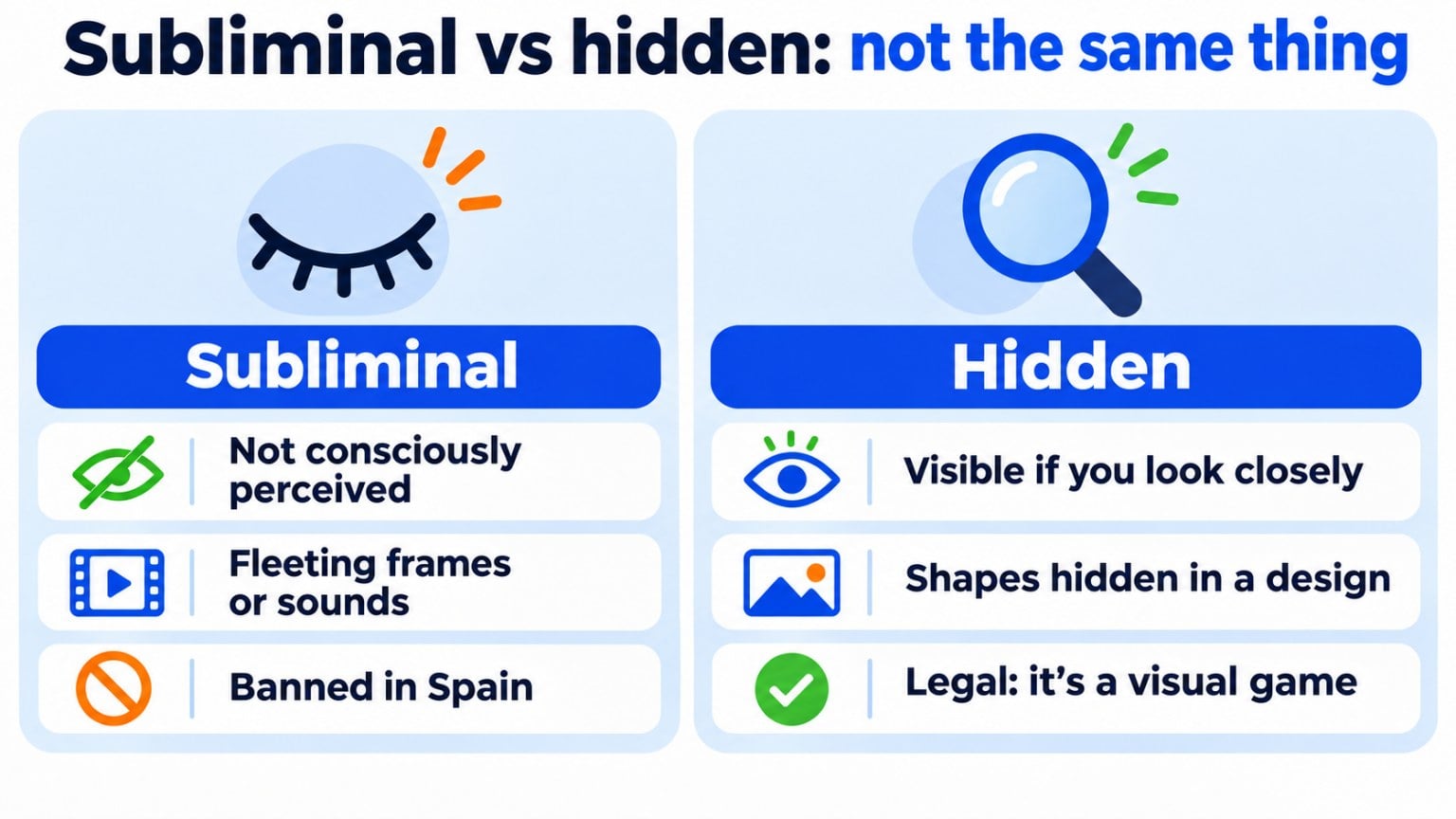
Subliminal advertising is advertising that tries to influence people with stimuli they don’t consciously perceive. For example, an image that appears for a fraction of a second, a sound below the hearing threshold or a word hidden in a drawing.
The word comes from the Latin sub (below) and limen (threshold). A subliminal message is, literally, one that sits below the threshold of what your senses consciously register.
Spanish law defines it in a similar way.
According to article 4 of Spain’s General Advertising Law (Ley 34/1988), subliminal advertising is advertising that, through stimuli at the limit of what the senses can pick up, can act on the public without being consciously perceived.
That nuance matters: if the message can be seen, even if you have to look closely, it’s no longer subliminal.
The types of subliminal advertising depend on the channel used to hide the message. Here are the five most cited ones and whether they really fit the definition:
| Type | How it works | Is it really subliminal? |
|---|---|---|
| Hidden frames in video | An image or word appears for a fraction of a second between the normal frames | Yes, if it isn’t perceived |
| Audio messages | Words or sounds below audible volume, or mixed into the music | Yes, if they can’t be made out |
| Embedded images | Shapes or words hidden in a photo, which you only see if you look for them | It depends: if you see them when you look closely, it’s a hidden message |
| Words inside other words | A word that’s part of a longer one and stands out for an instant | It depends on how long it’s visible |
| Logos with hidden messages | A figure hidden in a logo’s design | No: it’s visible to the naked eye, even if not everyone notices it |
As you can see, much of what’s called “subliminal advertising” is really advertising with hidden messages. It’s a design game that the audience can discover, not an attempt to bypass their awareness.
The internet is full of supposed examples of subliminal advertising that nobody has been able to verify. These four are documented.
In September 1957, market researcher James Vicary announced that he had flashed the messages “Eat Popcorn” and “Drink Coca-Cola” for 1/3,000 of a second in a movie theater in Fort Lee (New Jersey).
According to him, 45,699 moviegoers saw them. Popcorn sales, he said, rose by 57.5%, and Coca-Cola sales by 18.1%.
The news went around the world and caused real panic about manipulation.
But Vicary never published the details, nobody could replicate his results and the theater manager said no test had ever been run there.
In 1962, Vicary himself admitted in an interview with Advertising Age that the study had been “a gimmick.” By then, the myth was already unstoppable.
What it teaches: a spectacular figure without a source is just a good story. Before repeating a number in a campaign, check where it comes from.
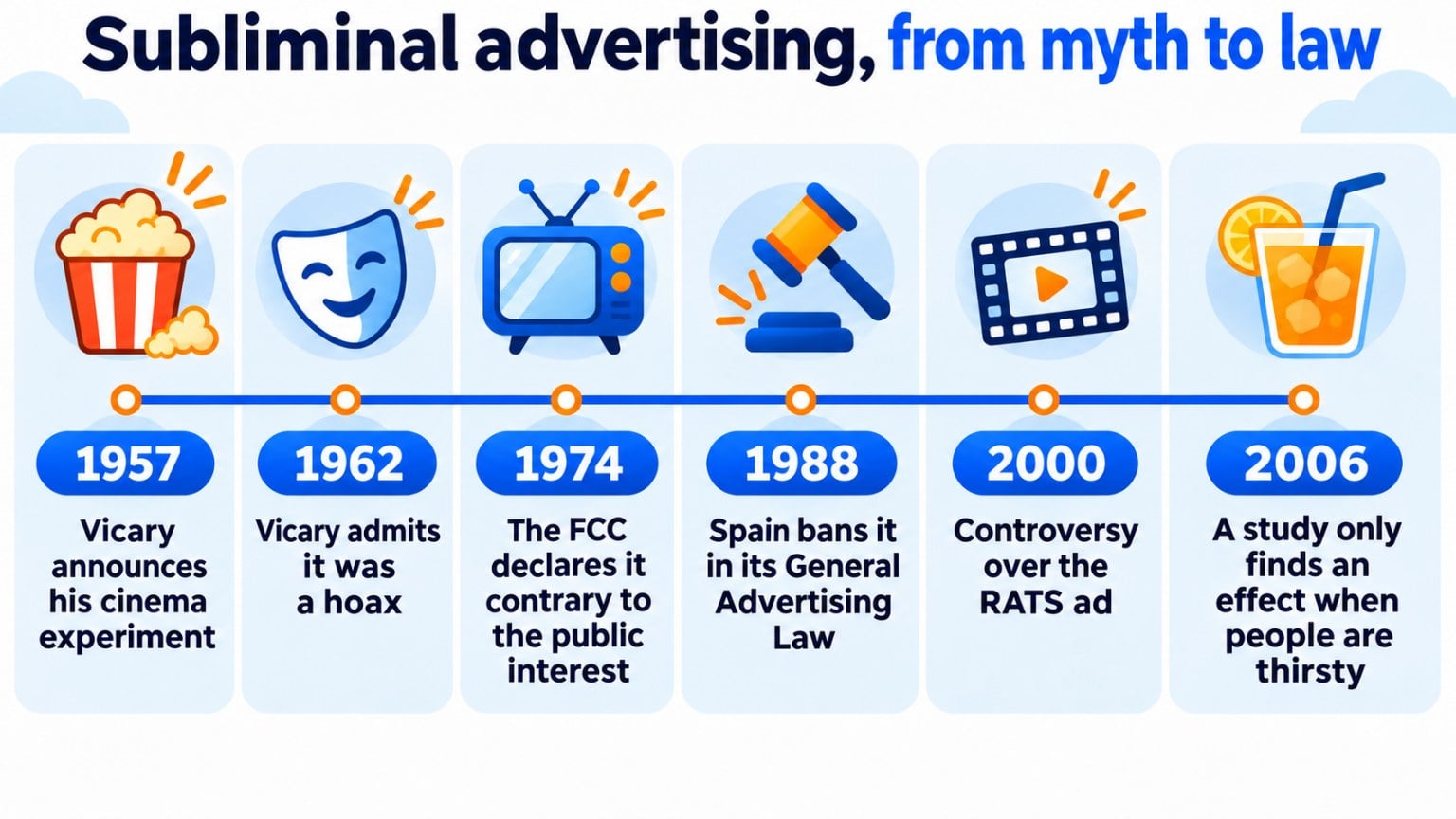
In 2000, during the US presidential campaign, the Republican Party aired an ad criticizing Al Gore’s prescription drug plan.
At one point, the word “BUREAUCRATS” appeared on screen, and for one frame only its ending was visible: “RATS.”
After watching it frame by frame, two Democratic senators asked the FCC, the agency that regulates communications in the United States, to investigate.
Bush’s team denied it was intentional, and the candidate played it down, calling it “one frame out of 900.” The ad stopped airing, according to its creators, because that had already been planned.
What it teaches: even if intent isn’t proven, the suspicion of manipulation is enough for a campaign to make the news for the wrong reasons.
The most cited experiment in favor of subliminal messages is the one by psychologists Johan Karremans, Wolfgang Stroebe and Jasper Claus, published in 2006 in the Journal of Experimental Social Psychology.
They showed the name of Lipton Ice tea subliminally to a group of people and then let them choose between two drinks.
The effect appeared, but only in those who were already thirsty. For those who weren’t thirsty, the message did nothing.
What it teaches: at best, a subliminal message can give a small nudge toward something you already wanted. It doesn’t create desires or convince anyone to buy what they don’t need.
Some of the best-known logos hide a figure.
In FedEx’s, for example, the white space between the “E” and the “x” forms an arrow.
In Amazon’s, the arrow going from the “a” to the “z” suggests they sell everything and, at the same time, draws a smile.
It isn’t subliminal advertising: the message is in plain sight and is part of the design.
But it proves something that does work: people love discovering hidden details and sharing them.
If you’re interested in brand design, you’ll find more ideas in our entry on the logo and in the story of Comic Sans, the most hated typeface.
What it teaches: a good hidden detail strengthens your brand image because it rewards those who notice, not because it fools those who don’t.
Persuade in plain sight, not in secret
Send clear campaigns to people who want to receive them, with up to 80,000 emails a month for free.
The short answer is: very little, and under lab conditions. Serious studies, like the Lipton Ice one, find small, short-lived effects, and only when the message matches a need the person already had.
In real life there’s too much noise.
A hidden frame competes with the rest of the ad, with your phone, with the conversation next to you and with everything you already know about the brand.
That’s why brands don’t spend their budget on hidden messages: it’s much more effective for the message to be seen.
What is proven is that we’re influenced by things we see without paying attention to them: the repetition of a slogan, colors, context or our mind’s biases.
That’s what neuromarketing studies, and none of it needs to be hidden.
In Spain, no. Article 3 of the General Advertising Law (Ley 34/1988) includes subliminal advertising in its list of unlawful advertising, alongside misleading advertising or advertising that undermines people’s dignity.
Article 4 gives the definition you saw above.
In the United States, the FCC declared in 1974 that subliminal advertising techniques are contrary to the public interest, after receiving complaints about an ad that used them.
Be careful, though: not everything that goes unnoticed is illegal. Product placement, logos with hidden figures and visual nods are legal because they can be seen, even if not everyone notices them.
What the law prohibits is influencing someone without them being able to realize it.
Email marketing works the same way with other rules: permission, sender identification and easy unsubscribe. You’ll find them summarized in our guide to legal email marketing.
If what you want is for your message to stick, you don’t need to hide it. We also explain this in our guide to email copywriting. The persuasion techniques that work are the ones the reader sees and accepts.
Here’s how to bring what subliminal advertising promises into your emails:
| What the hidden technique promises | What works in plain sight in your email |
|---|---|
| Making the brand stick | A recognizable sender and a consistent design across all your sends |
| Getting the message across effortlessly | A clear email subject line and a preheader that completes it |
| Sparking desire without it showing | Copywriting that talks about what the reader gains |
| Creating urgency | Real urgency, like a deadline or limited spots, without inventing FOMO |
| Making it feel made for you | Personalization with data the subscriber has given you |
| Touching emotions | Emotional marketing with real customer stories |
| Knowing what works | A/B tests with two versions, letting your data decide |
There are many psychological triggers you can use honestly. The difference is that the reader knows who’s talking to them and what they’re proposing.
That’s also the basis of netiquette: writing with the person who’ll read it in mind.
And watch out for the opposite extreme. A subject line that promises something the email doesn’t deliver isn’t a hidden message either, but it’s clickbait that ends up in the spam folder.
At Mailrelay we believe email works better when it’s transparent. That’s why the free account includes what you need to persuade in plain sight:
All with up to 80,000 emails a month and 20,000 contacts for free, and with human support on every plan.
Persuade with data, not tricks
A/B tests, segments and statistics on the free account, with human support on every plan.
Subliminal advertising is one of those ideas that sound better than they work. It was born from an invented experiment and has hardly any effect outside the lab. Besides, it’s banned in Spain.
What does work is the opposite: a clear message, for the right person, at the right time. If you want your brand to be remembered, don’t hide it in a single frame.
Put it in the subject line, take care of the design and measure what interests your list.
These are the questions that come up most when people search for subliminal advertising on Google.
Subliminal means “below the threshold,” from the Latin sub (below) and limen (threshold). It’s used for stimuli that reach the senses but aren’t consciously perceived.
The best known are James Vicary’s fake popcorn experiment (1957), the “RATS” ad from the Bush campaign (2000) and the Lipton Ice study (2006).
Logos with hidden figures, like the FedEx arrow, are often cited as examples, but they’re hidden messages, not subliminal ones.
The main ones are hidden frames in video, audio messages, images embedded in photos and words hidden inside other words. Logos with hidden messages don’t fit the definition because they’re visible to the naked eye.
No. The General Advertising Law (Ley 34/1988) classifies it as unlawful advertising in its article 3 and defines it in its article 4.
Very little. Small effects have been measured in the lab, and only when the message matches a prior need, such as being thirsty. There’s no evidence they can make someone buy something they didn’t want.
20 examples of creative advertisements
Advertising that’s remembered without hiding anything.
Famous slogans: over 40 brand examples and what makes them work
Lines that stick, in plain sight.
Comic Sans: the story of the most hated typeface
Another design story that got people talking.
Murphy’s Law: what it is, where it comes from and 20 laws that hold true in your email marketing
Another famous myth, this time with plenty of truth in it.
Blue Monday: what it is, who invented it and how to use it (well) in your email marketing
Another invention the media repeated without checking.

Jose Argudo
CMO at Mailrelay. He writes about email marketing, copywriting and conversion for small businesses and entrepreneurs.