Netiquette: what it is, the 10 rules of good manners on the internet and how to apply them in your email
Why writing in capital letters still sounds like shouting, and other rules of good manners online
Netiquette is the set of rules of good manners people follow when communicating on the internet, whether by email, in forums, in chats or on social media. They are unwritten rules, just like the ones in everyday life.
Nobody fines you for breaking them, but everyone notices.
Have you ever received an email written entirely in capital letters? Or been dragged into a “reply all” with two hundred people? Then you already know what happens when someone ignores these rules.
In this post we explain where it comes from, what its basic rules are and how to apply them in your emails and campaigns.
What does netiquette mean?
The word netiquette is an English term that combines net and etiquette (in the sense of rules of courtesy). In Spanish it became “netiqueta”, and you will also see the plural “netiquettes” used for each individual rule.
The term was born among users of the first forums and mailing lists in the 1980s. The internet was a small community back then, and it needed rules so people could get along without misunderstandings.
The two texts that set the rules
In 1994, the American writer Virginia Shea published the book Netiquette, with ten basic rules that are still quoted today in schools, universities and companies.
A year later, in October 1995, Sally Hambridge of Intel published RFC 1855, titled Netiquette Guidelines. RFCs are the technical documents that define how the internet works. This one was devoted to something not very technical: how to behave in email, mailing lists and forums.
Many of its recommendations still hold true thirty years later.
What are the 10 rules of netiquette?
The best-known 10 rules are Virginia Shea’s. Here they are, with what they mean when you apply them to your email:
| Rule | In your email it means… |
|---|---|
| 1. Remember there is a person on the other side | Don’t write anything you wouldn’t say face to face |
| 2. Behave online as you would in real life | The same rules of respect apply in the inbox |
| 3. Know where you are | An email to a client is not the same as a message to your group of friends |
| 4. Respect other people’s time | Clear subject lines, short messages and no huge attachments |
| 5. Look after your image | Check spelling and tone before sending |
| 6. Share what you know | If someone asks and you can help, help |
| 7. Don’t fuel arguments | If a thread gets heated, switch to a call |
| 8. Respect other people’s privacy | Don’t forward private emails or reveal other people’s addresses |
| 9. Don’t abuse your position | Having access to a list doesn’t mean you can write to it |
| 10. Forgive other people’s mistakes | A typo doesn’t deserve a reply copied to the whole team |
As you can see, almost all of them come down to one idea: write with the person who will read it in mind.
Polite campaigns from the very first send
Double opt-in, automatic unsubscribe link and individual sends on the free account.
Email netiquette: the most forgotten rules
Email is where netiquette shows the most, because it is written in a hurry and it stays on record. These are the most forgotten rules, and several of them already appeared in RFC 1855 back in 1995:
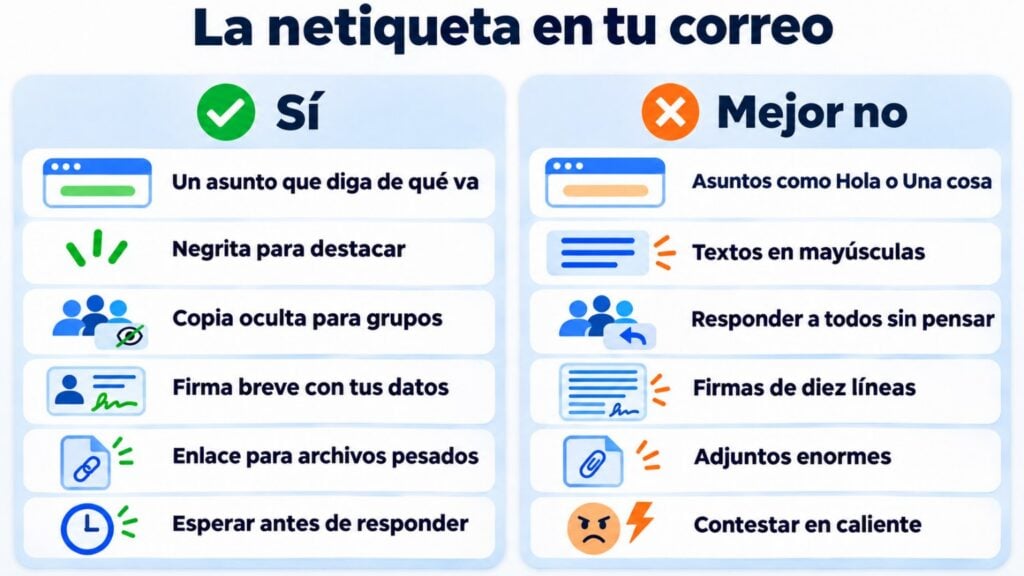
Writing in capital letters is shouting
A text written entirely in capital letters reads as if someone were shouting. RFC 1855 said so, and almost everyone still thinks so. If you want to highlight a word, use bold. And in the email subject line, capital letters also smell like spam.
One of the most common mistakes we see in emails is the misuse of capital letters. They are often used in the belief that they will bring more visibility, stand out in the inbox or help the recipient understand us better. But that’s not the case: when the whole text is in capitals, it is harder to read, and most recipients see it as disrespectful. Capital letters are no substitute for bold. If you need to highlight something, write clearly and concisely: capital letters won’t do that for you.
Jose Argudo, CMO of Mailrelay
A subject line that says what the email is about
The subject line has to reflect the content of the message. “Hi” or “Quick question” doesn’t help anyone decide when to read it. The same goes for the email body: one clear idea and a specific request. And if the topic changes halfway through a thread, change the subject line too.
Be careful with “reply all” and copies
Before you hit “reply all”, ask yourself whether everyone needs your reply.
And if you are going to be away for a few days, set up an out-of-office message so nobody is left waiting.
When writing to people who don’t know each other, use blind copy and don’t reveal their addresses to the others. You’ll find all the details in our post on CC and BCC.
Quote only what’s necessary
When replying, keep only the parts of the original message that give context. And when forwarding an email, don’t change its text or share it in a group without permission from the person who wrote it.
Light attachments and a short signature
RFC 1855 asked that attachments not be huge and that signatures be no longer than four lines. Inboxes are bigger today, but the idea still holds.
Share heavy files through a link and keep your email signature short, with your contact details.
Don’t reply in the heat of the moment
If an email upsets you, wait before answering. RFC 1855 recommended sleeping on it.
Humor and irony don’t travel well in writing either: what is a joke in person can come across as a reproach in an email.
Abbreviations, emojis and tone
Abbreviations like ASAP or FYI save time, but they can sound abrupt or confuse people who don’t know them. Something similar happens with emojis and kaomojis: in an informal email they soften the tone, while in a formal one they may be out of place.
If in doubt, follow the guidelines for a formal email.
The rules are the same on every channel, although each one has its own customs.
On social media, netiquette means not sharing hoaxes, citing your sources and not taking the bait from trolls. A good meme can brighten up a thread, but not if it mocks someone. In messaging groups, it means not sending ten-minute voice notes or writing in the middle of the night.
On a video call, it means muting your microphone when you’re not speaking and letting people know if you’ll be late.
Many of these rules blend with internet slang, which has its own codes too: writing for your team is not the same as writing for a client.
Netiquette in email marketing
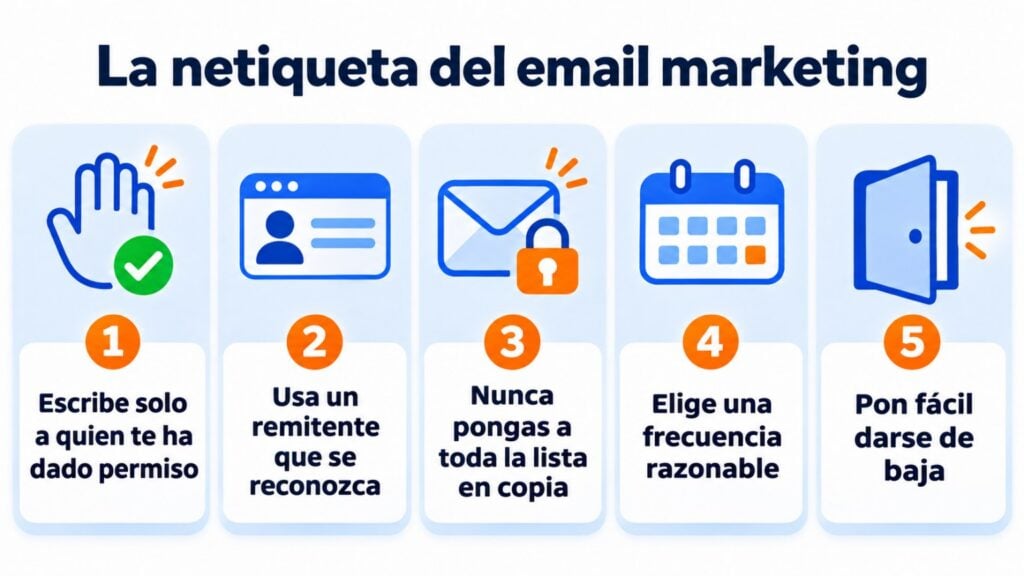
Netiquette also applies when you write to hundreds or thousands of people at once. In email marketing, many of these rules are also required by law:
| Netiquette rule | How it applies to your campaigns |
|---|---|
| Write only to people who want to read you | Send only to contacts who signed up through your subscription form, ideally with double opt-in |
| Introduce yourself | Use a recognizable sender and your own domain |
| Respect privacy | Never send a mass email with all the addresses in CC |
| Respect other people’s time | Choose a reasonable sending frequency and get to the point |
| Let them go | Include a visible unsubscribe link and the List-Unsubscribe header so unsubscribing is easy |
| Look after your image | Check for typos, links and design with a test send |
Ignoring netiquette in a campaign has measurable consequences: more spam complaints, a higher unsubscribe rate and worse deliverability. If you want to see how costly a slip-up can be, take a look at our Murphy’s laws of email marketing.
How Mailrelay helps you follow netiquette in your sends
At Mailrelay we make it easy for your campaigns to be polite to the people who receive them:
- Double opt-in on your forms, so you only write to people who really want to hear from you.
- Individual sends: each subscriber receives their own email and nobody sees anyone else’s address.
- Automatic unsubscribe link in every campaign, so unsubscribing takes just one click.
- Test sends to check the text, links and design before they reach your list.
- Segments and A/B tests to send each group what interests them, at the right frequency.
And all of this on the free account, with up to 80,000 emails a month and 20,000 contacts, plus human support on every plan.
Write only to people who want to read you
Up to 80,000 emails a month for free, with human support on every plan.
Frequently asked questions about netiquette
These are the most common questions about the rules of good manners on the internet.
Why is netiquette important?
Because in writing you lose tone of voice and gestures, and it is easier to misread a message. Following netiquette avoids conflicts, saves your readers time and protects your personal image and your company’s.
Is writing in capital letters rude?
Yes. In netiquette, writing an entire text in capital letters is the same as shouting. It is acceptable for acronyms or a single word, but to highlight something it is better to use bold.
Netiquette or netiqueta: what’s the difference?
Both forms are used for the same thing. Netiquette is the original English term, and netiqueta is its Spanish adaptation, the most common form in Spanish-language texts.