Murphy’s Law: what it is, where it comes from and 20 laws that come true in your email marketing
The true story behind the most famous saying about bad luck and what it teaches anyone who sends emails

The true story behind the most famous saying about bad luck and what it teaches anyone who sends emails
Have you ever hit “Send” and, a second later, spotted the typo in the subject line? Not in the footer, which nobody reads. In the subject line, which everybody reads.
If that’s happened to you, you already know Murphy’s Law from personal experience.
It’s the idea that the universe waits for the worst possible moment to play its tricks: the toast that lands butter-side down, the supermarket line that grinds to a halt just as you switch to it, or the broken link that, out of all the links in the email, just had to be the one on the button.
In this article we explain what Murphy’s Law is, the true story behind it (it involves rockets, a chimpanzee and some miswired sensors) and the most famous laws in the family.
Then we get down to business: 20 Murphy’s Laws of email marketing that come true with astonishing punctuality, each with its antidote so this Friday it isn’t your turn.
Murphy’s Law is a popular saying that states “if anything can go wrong, it will.” It’s used, half-jokingly, to explain why failures always seem to arrive at the worst possible moment.
It sounds pessimistic, but its origin is the exact opposite. It was born in an engineering lab as a practical warning: if a mistake is possible, sooner or later someone will make it, so design things so it can’t happen. Murphy wasn’t a doom-monger. He was a cautious engineer.
Over the years, the phrase became a way to laugh at everyday bad luck. And it gave rise to hundreds of “corollaries” that follow the same pattern:
| Version of Murphy’s Law | What it means |
|---|---|
| If anything can go wrong, it will | The classic version, the one we all know |
| Nothing is as easy as it looks | There’s always a problem that wasn’t in the plan |
| Everything takes longer than you think | Your “five minutes” are almost never five minutes |
| If there are several ways to do something and one ends in disaster, someone will choose it | The original wording, the engineers’ version |
| If nothing can go wrong, it will go wrong anyway | The version for optimists |
| When everything seems to be going well, you’ve overlooked something | The favorite of anyone who reviews campaigns |
As you can see, Murphy’s Law isn’t a scientific law. It’s a way of looking at the world that mixes humor, resignation and, when used well, a lot of prevention.
The story begins in 1949, at an air base in the California desert now known as Edwards.
There, the team led by colonel and physician John Paul Stapp was working on project MX981. They wanted to know how much deceleration the human body could withstand in a crash, so they launched a rocket-powered sled along a set of rails and brought it to a sudden stop.
First they tested with dummies and chimpanzees. Then with Stapp himself, who rode the sled in person.
Edward A. Murphy Jr., a captain and engineer in the US Air Force, had designed sensors to measure the exact force the sled’s passenger was subjected to. In one of the tests, the sensors read zero. Nothing. Not a single data point.
When they checked them, they found the problem: some had been wired backwards. Annoyed, Murphy blamed the technician who had installed them with a phrase that, according to witnesses, went something like this: “If there’s any way to do it wrong, he’ll find it.”
Accounts don’t fully agree.
According to the version on Wikipedia, Murphy’s original advice was this: if there are two or more ways to do something and one of them ends in catastrophe, someone will choose it.
George E. Nichols, the project’s quality manager, later said the team summed up the idea as “if it can happen, it will happen” and, somewhat tongue-in-cheek, named it “Murphy’s Law.”
A few months later, at a press conference, Stapp said the team’s safety record was due to their respect for Murphy’s Law: they assumed any possible failure would eventually happen, so they prevented it before each test. The journalists picked up the phrase and it started to spread.
In the 1950s it was already appearing in aviation mechanics newsletters. But it became famous worldwide in 1977, with Arthur Bloch’s book Murphy’s Law and Other Reasons Why Things Go Wrong!, which collected dozens of corollaries and became a bestseller.
The finishing touch came in 2003, when Stapp, Murphy and Nichols received the Ig Nobel Prize in Engineering “for (probably) giving the law its name.” The Ig Nobels reward research that first makes people laugh and then makes them think. It’s hard to imagine a better-suited prize.

That said, the idea is older than the name.
In 1866, the mathematician Augustus De Morgan had already written that whatever can happen will happen if enough attempts are made.
And in 1908, the magician Nevil Maskelyne complained that everything tends to go wrong the first time a trick is performed in public. Murphy just put a name to something anyone who has worked with the public already knew.
Don’t let Murphy sign your next newsletter
Send yourself tests, check the email on your phone and schedule the send without rushing. Free for up to 80,000 emails a month.
Murphy’s Law has a huge family. Some laws are corollaries of the original and others are “cousins” with their own names that were born in other fields. Here are the best known:
| Law | What it says |
|---|---|
| Law of toast | Toast always lands butter-side down |
| Law of the line | The other line always moves faster, until you switch to it |
| Law of the last place | What you’re looking for is always in the last place you look |
| Law of the umbrella | If you bring it, it doesn’t rain; if you leave it at home, it pours |
| Parkinson’s Law | Work expands to fill all the time available |
| Hofstadter’s Law | Everything takes longer than expected, even when you take Hofstadter’s Law into account |
| Finagle’s Law | If anything can go wrong, it will go wrong at the worst possible moment |
| Sod’s Law | The British version of Murphy, even more pessimistic |
| The Peter Principle | In a company, every employee rises to their level of incompetence |
Some Murphy’s Laws have more science behind them than you might think. The toast one, for example.
In 1995, British physicist Robert Matthews published a paper in the journal European Journal of Physics with an irresistible title: “Tumbling toast, Murphy’s Law and the fundamental constants.” His conclusion was that toast doesn’t land on the wrong side because of bad luck, but because of pure physics.
A slice of toast that slides off a normal table rotates, but it doesn’t have time to complete a full turn before it hits the floor. So if it starts butter-side up, it will most likely land butter-side down.
And why are tables that height? Because they’re built to suit people. Matthews linked our height to the constants of physics, so, according to him, toast lands on the wrong side because the universe is the way it is.
The paper won him the Ig Nobel Prize in Physics in 1996. His practical advice: if you see the toast falling, swipe it so it spins faster. Or eat at a taller table.

Sometimes you have to be able to laugh at mistakes, but it’s easier when they’re other people’s mistakes. It’s true that it feels like if something can go wrong, it will, and that toast always lands on the messy side, on the most delicate rug. Karma? Fate? Or just a bad Friday?
Jose Argudo, CMO at Mailrelay
Email is fertile ground for Murphy. It’s written in a hurry, sent with a click and, once it’s out, there’s no going back. These two cases prove it.
On November 14, 2016, an IT contractor for the NHS, the UK’s public health service, sent a test email to a distribution list. Because of a fault in the new email system, the message reached more than 840,000 employee accounts in England.
What came next was pure Murphy. Hundreds of people hit “reply all” to ask to be removed from the list, and every reply went out again to all 840,000 accounts. According to Digital Health, around 500 million emails were generated in 75 minutes, and email was delayed for hours. A lesson in netiquette that still applies: before you hit “reply all,” ask yourself whether everyone needs to hear from you.
The lesson: the problem wasn’t one email, but a badly configured list. The same thing happens with a campaign: choosing the right recipients matters as much as what you send.
In June 2021, many HBO Max subscribers received an email with the subject line “Integration Test Email #1.” All it said was that the template was used for internal testing. It was a test email that should never have left the tech department.
The brand’s reaction was the best part. It posted a message on social media apologizing and explaining, with humor, that it had been the intern, and that they were helping the intern get over it. Thousands of people replied with their own work disasters to cheer the intern up. A sending mistake turned into one of the friendliest conversations of the year.
As you can see, Murphy’s Law doesn’t spare even the big brands. But a well-handled mistake can end up working in your favor, and we talk about that further down.
Here are the 20 laws that come true most often when you’re preparing a campaign. We’ve grouped them into four stages: writing, designing, sending and measuring. Each one comes with its antidote, because laughing is good, but not having it happen to you is better.
Murphy’s Law gets to work before you even open the editor. These five go after your copy.
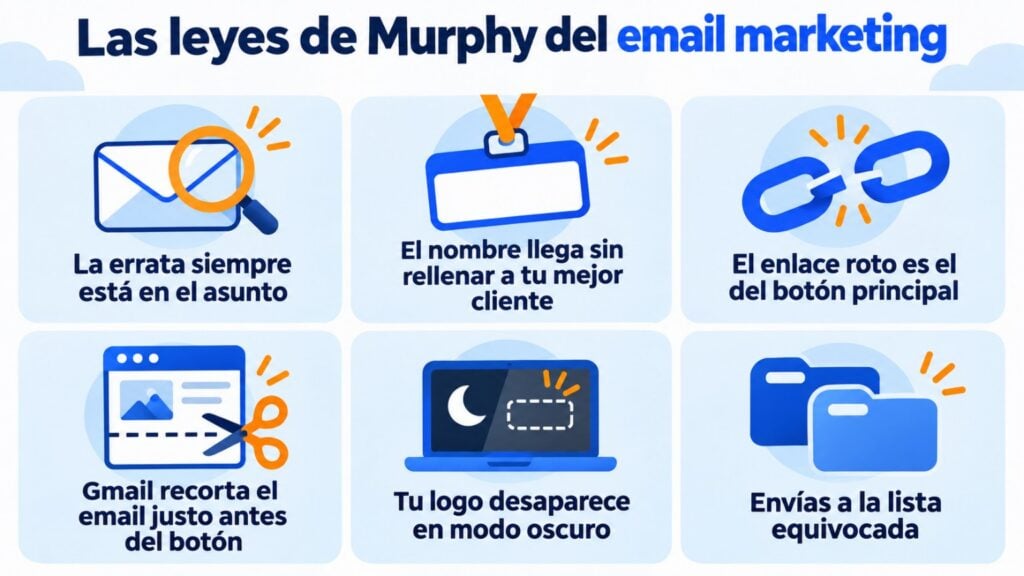
Law 1. The typo is never in the footer: it’s in the subject line.
You can check the body ten times, and the typo will still hide in the five words everyone reads.
Antidote: read the email subject line and the preheader out loud before sending. Your ear catches what your eye skips.
Law 2. The unfilled “Hi, [Name]” always reaches your best customer.
The contact whose name is missing from the database is always the one you care about most.
Antidote: give every dynamic variable a default value, like a plain “Hi,” in case the field is empty.
Law 3. The more time you spend on the subject line, the fewer people open it.
Two hours polishing a brilliant line, and the simple subject line you wrote in a minute wins.
Antidote: don’t decide it yourself. Run an A/B test with two subject lines and let the data speak.
Law 4. A last-minute price change only gets changed in one place.
You fix it in the text, and the old one stays on the button, in the image or on the landing page.
Antidote: whenever you change a figure, search for it throughout the email and on the landing page.
Law 5. The email you write angry gets sent; the one you write calmly stays in drafts.
This one comes true more often with personal email than with campaigns, but it does come true.
Antidote: turn on “Undo Send” in Gmail, which gives you up to 30 seconds to change your mind. And for sensitive emails, schedule the send and read it again over a coffee.
Here Murphy’s Law teams up with screens, email clients and dark mode.
Law 6. The email looks perfect on your screen and broken on your boss’s phone.
You check it on a 27-inch monitor and your boss opens it on their phone, on the subway. And if the font you picked is Comic Sans, Murphy’s day is made.
Antidote: use a responsive design and send yourself a test so you can open it on your phone too.
Law 7. The most important image is the one the reader can’t see.
Some email clients don’t load images until the reader allows it. And if your offer is inside the image, it doesn’t exist.
Antidote: put the important stuff in text and add alt text to every image.
Law 8. The button nobody can find is the one that leads to the offer.
You add five links, three buttons and a linked image, and the reader doesn’t know where to click.
Antidote: one goal per email and one clearly visible call to action.
Law 9. Dark mode turns your logo into a black hole.
A black logo on a transparent background disappears as soon as the reader turns on dark mode.
Antidote: use a version of the logo with an outline or its own background, and check the test in dark mode too.
Law 10. Gmail clips the email right before the button.
If the message’s code goes over 102 KB, Gmail clips it and shows “View entire message.” And what’s left below is, of course, usually the call to action.
Antidote: lightweight emails with the right dimensions and no leftover code.
The moment you click is Murphy’s Law’s favorite. One second of haste and there’s no going back.
Law 11. The broken link is always the one on the main button.
There can be twelve working links and one broken one. Guess which.
Antidote: in the test email, click every link, one by one. Yes, every single one.
Law 12. If you have two lists with similar names, you’ll pick the wrong one.
“Customers 2025” and “Customers 2025 (2)” are an open invitation to Murphy.
Antidote: give your email lists clear names and work with segments instead of duplicating groups.
Law 13. The attachment you mention in the text is exactly the one you forget to attach.
“I’m attaching the quote,” and the quote stays on your desktop.
Antidote: in your campaigns, put the file on a page and link to it instead of attaching it. In personal email, attach the file before you start writing.
Law 14. The email scheduled for Monday morning goes out on Sunday night.
The culprit is usually the account’s time zone or a wrongly chosen AM/PM.
Antidote: check the time zone before scheduling and confirm the date and time in the sending summary.
Law 15. Your best newsletter lands on the day nobody reads their email.
A public holiday, a long weekend, the final of a big game or the day of the blackout.
Antidote: check a marketing calendar and test different days with your own list before settling on a sending frequency.
And just when you think the worst is over, Murphy’s Law drops by your stats.
Law 16. You check the stats just before the opens have come in.
You send at 10:00, look at 10:05 and get depressed.
Antidote: wait at least 24 or 48 hours before drawing conclusions from your open rate.
Law 17. The person who complains most about getting your newsletter is the one who never subscribed.
Someone mistyped their address, another person used it and now they get emails they never asked for.
Antidote: double opt-in confirms that the email address belongs to whoever says it does.
Law 18. The email that ends up in spam is exactly the one you couldn’t afford to lose.
Your regular newsletter arrives fine, but the launch one ends up in the spam folder.
Antidote: set up SPF, DKIM and DMARC on your domain and look after your deliverability all year round, not just on the big day.
Law 19. Unsubscribes skyrocket on the day your boss looks at the report.
A quiet month and then, suddenly, a spike in unsubscribes right on the day of the meeting.
Antidote: check your unsubscribe rate every week and, if it goes up, review your frequency and your segments too.
Law 20. The day everything goes perfectly, nobody’s watching.
A brilliant subject line, zero typos, record opens… and your team is on vacation.
Antidote: write it down. Keep a record of what worked so you can repeat it, and celebrate your wins as much as you regret your mistakes.
Put Murphy out of a job
Test sends, A/B tests and segments, even on the free account.
You can’t repeal Murphy’s Law, but you can put it out of a job. The law’s own history shows how: Stapp’s team had no accidents because they assumed everything could fail and checked it before each test. Apply the same approach to your campaigns with this 8-step checklist:
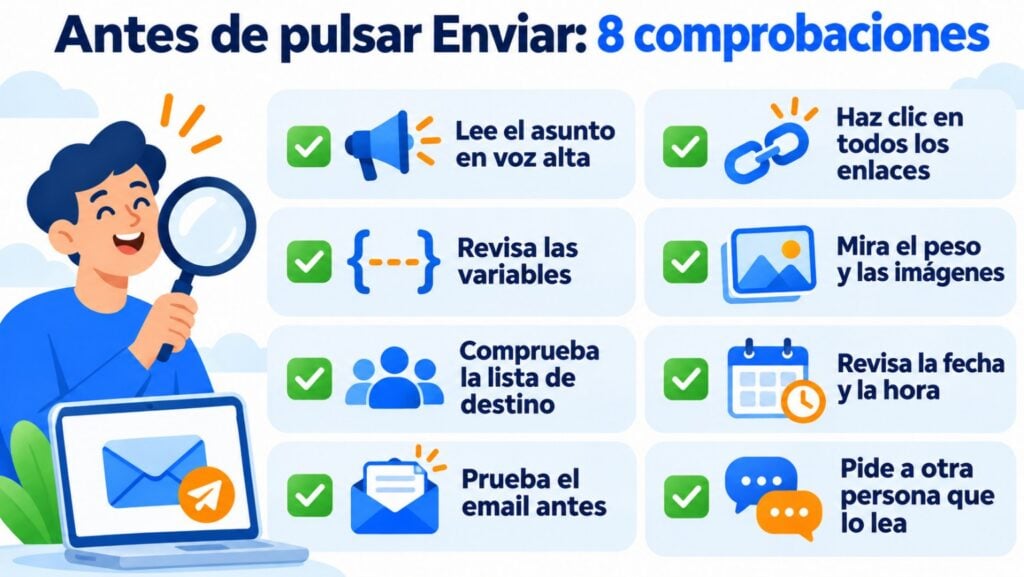
This checklist won’t take you more than ten minutes. And it will save you most of the headaches in this section: Murphy’s Law almost always comes true because of haste.
Breathe. It’s happened to HBO Max, to the NHS and to everyone who has ever sent a newsletter. What makes the difference isn’t the mistake, but how you react. Here’s a quick guide by severity:
| Mistake | Severity | What to do |
|---|---|---|
| Typo in the text or subject line | Low | Nothing. Correcting it with another email draws more attention than the typo |
| Image that doesn’t load or broken layout | Low | Fix it for the next send and check the template |
| Unfilled variable (“Hi, [Name]”) | Medium | If it affects a few contacts, nothing; if it affects the whole list, a short apology with a touch of humor |
| Broken link on the main button | Medium-high | If you can, redirect that URL to the right page; if not, send a correction only to those who didn’t click |
| Wrong price, date or discount code | High | A clear, quick errata notice, and honor what you promised if you can |
| Email sent to the wrong list | High | Apologize to that list and explain what happened, without hiding it |
For serious mistakes, a short email that acknowledges the error, explains what happened and says how it was fixed usually works better than acting as if nothing happened. You’ll find ideas and templates in our guide to apologizing in writing.
And if the mistake is funny, use it.
A subject line like “OK, we messed up” or “Murphy was here” can spark more curiosity than the original newsletter.
If you like playing with language, you’ll find ideas in our wordplay article. If you fancy exploring that route, our article on funny emails has examples to inspire you. Just one limit: if the mistake has hurt the customer, the fix comes first and the joke second.
At Mailrelay we can’t promise that your toast will land on the right side. But we can help your campaigns go out the way you planned them. These are the tools that put Murphy out of a job:
All of this is included in the free account, with up to 80,000 emails a month and 20,000 contacts, and human support on every plan. If Murphy pays you a visit, someone on our team will help you show him the door. You can see all the plans on our pricing page.
Your next campaign, without the scares
Start free today, with human support on every plan.
Murphy’s Law was born to keep a team of engineers from having accidents, not to lament bad luck. And that’s the best way to use it in email marketing too: assume something can go wrong and check it before it does.
So the next time you’re about to hit “Send,” think of Captain Murphy and his backwards-wired sensors. Send yourself a test, click the links and read the subject line out loud. And if Murphy’s Law still strikes and a typo slips through, have a little laugh. Even if it’s a Friday.
These are the questions people ask most often when they search for Murphy’s Law on Google.
Murphy’s Law says that “if anything can go wrong, it will.” Its original wording, from the engineers in 1949, was more precise: if there are several ways to do something and one of them ends in disaster, someone will choose it.
It’s attributed to Edward A. Murphy Jr., a US Air Force engineer who said the original phrase in 1949 during tests at Edwards Air Force Base (California). John Paul Stapp made it public at a press conference, and Arthur Bloch’s book (1977) turned it into a worldwide phenomenon.
It isn’t a scientific law. It’s a humorous saying based on a bias in our memory: we remember the times something goes wrong much better than the times it goes right. Even so, some cases, like toast landing butter-side down, do have a physical explanation.
In the film Interstellar (2014), the main character’s daughter is called Murph after Murphy’s Law. Her father explains that the law doesn’t mean something bad is going to happen, but that whatever can happen will happen. It’s a more optimistic reading of the same idea.
It’s a Disney animated series that premiered in 2016, created by the makers of Phineas and Ferb. Its main character, Milo Murphy, lives under Murphy’s Law: everything around him goes wrong, so he’s always prepared with a backpack full of things to get him out of trouble. As you can see, even cartoons recommend prevention.
Email and SMS retention strategy: 6 flows to copy
Six email and SMS flows to get your customers buying again.
Funny emails: 15 examples and how to use humor in your campaigns
Examples to copy and when it’s better not to joke.
Wordplay: types, examples and 30 catchy email subject lines
Subject lines to get your newsletter opened with a smile.
How to apologize in writing: steps, phrases and 10 email templates
In case Murphy has already been through your outbox.

Jose Argudo
CMO at Mailrelay. Writes about email marketing, copywriting and conversion for small businesses and entrepreneurs.